Volcano·Guide
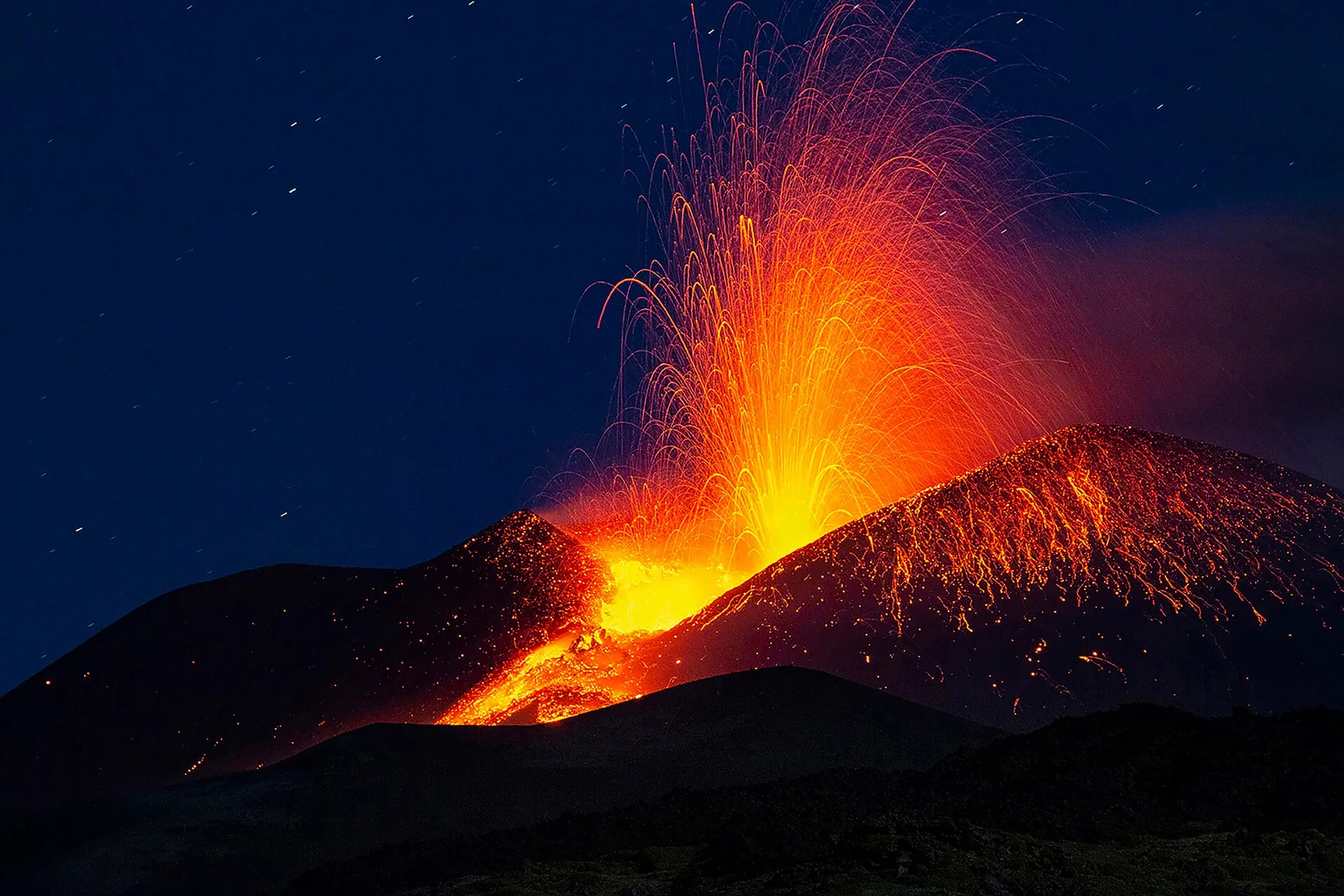
A lava fountain at Mount Etna's Southeast Crater at night, glowing lava running down the flank

Mount Etna today

Three official signals decide what you can do on the mountain today. We fetch them every morning – here they are side by side.

Photo: Giuseppe Amenta · CC BY-SA 4.0

As of today

What applies on Mount Etna today

Three authorities assess Etna, and each one means something different. The Sicilian civil protection declares the alert phase, which decides who may enter the summit zone. The national civil protection sets the alert level for the bigger picture. The volcano institute INGV issues the colour code for air traffic. We fetch all three automatically at six every morning; every line shows the date it was fetched and its source.

Up to about 2,900 m

Can I go up today?

The mountain is never completely closed. The cable car, the Silvestri craters and everything up to about 2,900 m (9,500 ft) are open in the phases Attenzione and Preallarme. What changes is the top: in Preallarme the summit crater zone is closed to everyone, even with a guide; in Allarme everything above roughly 2,500 m (8,200 ft) is closed and cleared. Which phase is in force this morning is shown in the first line below.

Depends on the wind

Is Catania airport open?

We cannot check that automatically; the airport decides hour by hour. Watch the aviation colour code in the third line below: Red means an ash cloud is rising right now and cancellations are possible but not certain – it depends on where the wind carries the ash. The only reliable sources are your airline and aeroporto.catania.it.

Preallarme
Alert phase – decides how high you can goOperational phase of the Sicilian civil protection (Attenzione/Preallarme/Allarme) – governs access to the summit zone · Notice no. 13 of 2026-08-22 · since 2026-08-22 · checked on 2026-10-03 · Dipartimento Regionale della Protezione Civile Sicilia – Avvisi regionali per eventi vulcanici
Yellow
National alert level for EtnaCivil protection alert level (green/yellow/orange/red) · checked on 2026-10-03 · Dipartimento della Protezione Civile – Presidenza del Consiglio dei Ministri (CC BY 4.0)
Orange
Aviation colour code – is ash rising right now?INGV aviation color code (green/yellow/orange/red) – for air traffic, not for visitors · since 2026-09-29 · checked on 2026-10-03 · INGV Osservatorio Etneo – Comunicati VONA

The alert phase: access

Attenzione is the normal state: the crater zone may be entered with a licensed mountain guide, everything below is free to visit. In Preallarme the crater zone is closed to everyone, even with a guide – the cable car, the 4x4 buses to about 3,000 m (9,850 ft) and all tours below that keep running. In Allarme everything above roughly 2,500 m (8,200 ft) is closed and evacuated.

The alert level: the bigger picture

Green, yellow, orange, red – set by the national civil protection in Rome and changed only after formal assessment rounds. On 26 June 2026 Etna went from green to yellow. Yellow means the volcano is active and the authorities are watching more closely. It does not mean the villages on the mountain are in danger or that anything is closed.

The aviation colour code: the ash

INGV reports it to pilots and air traffic control. Orange: the volcano is restless, ash is possible or stays at the summit. Red: an ash cloud is rising right now. Red does not close the mountain – but it is the signal at which Catania airport cancels flights at short notice.

The three phases

What you can do in each phase

The phase changes with INGV's early-warning system ETNAS, which rates the probability of a lava fountain – sometimes several times a day. The phase our fetch reported this morning is marked. Tap another one to see what applies then.

Legal basis: notes of the Sicilian civil protection no. 28490 of 30 June 2023 and no. 37727 of 21 August 2025, implemented through ordinances of the summit municipalities, most recently Belpasso no. 135 of 10 August 2026. Our fetch is from 6 am – if you want to go up today, also check the notices of the Sicilian civil protection before you set off. How we check is explained on How we check.

Etna eruption today

What has happened since June 2026

Etna does not erupt the way it does in films. It has been active without interruption for decades, and 2026 has been a loud year: a flank eruption in summer, several lava fountains in August, and ash clouds above the summit again since mid-September. The timeline, with sources.

  1. 26 June 2026The eruption begins

    Lava emerges in the upper Valle del Leone at around 3,000 m. The same day, the national civil protection raises the alert level from green to yellow.

  2. 8 AugustNew vent, pyroclastic flow

    A vent opens between Monte Rittmann and Monte Simone, a pyroclastic flow runs down and lava heads towards the Valle del Bove. The municipalities on the eastern flank close roads: the Mareneve between Fornazzo and the Rifugio Citelli, and the Via Paternò Castello near Sant'Alfio.

  3. 16 to 19 AugustLava fountains, phase Allarme

    Several paroxysms. The Sicilian civil protection declares the Allarme phase three times; everything above roughly 2,500 m is cleared. Ash falls on Catania and the airport cancels hundreds of flights.

  4. 22 AugustBack to Preallarme

    Notice no. 13: the early-warning system is back at F0, but the phase stays Preallarme – the crater zone remains closed to everyone. Whether a newer notice has appeared since is shown in the "Alert phase" line above.

  5. 26 AugustINGV: the phenomena have ended

    The Osservatorio Etneo reports the end of the activity reported in August. The flank eruption is over; the summit continues to degas.

  6. 15 SeptemberWeekly bulletin: ash at the Northeast Crater

    INGV describes degassing, almost continuous ash emission from the Northeast Crater and weak Strombolian activity at the Bocca Nuova.

  7. 14, 16 and 24 SeptemberAviation colour code red

    Three times INGV sets the aviation code to red because an ash cloud is rising – on 24 September to about 4,000 m (13,100 ft), drifting south-southeast. Between the events the code stands at orange.

Sources: press release of the Dipartimento della Protezione Civile of 26 June 2026 · ordinances Milo no. 41 and Sant'Alfio no. 48 of 13 August 2026 · notices of the Sicilian civil protection nos. 3 to 13 (8 to 22 August 2026) · INGV Osservatorio Etneo: communiqué of 26 August 2026, weekly bulletin Rep. 38/2026 of 15 September 2026, VONA notices of 14, 16, 22 and 24 September 2026. The full record of eruptions since 2021 is on Etna eruption.

A look at the mountain

INGV's cameras, right now

Two of the seven official cameras: the whole cone seen from Catania, and the summit craters from 2,600 m (8,500 ft). All seven, including the thermal cameras for the night, are on the webcam page. We fetch the images ourselves every 30 minutes; the time shown in the image is UTC.

From Catania towards the mountain
From Catania towards the mountainThe widest view, around 30 km (19 miles). If an ash plume stands above the summit, this is where you see it most clearly – and which way the wind is carrying it.The capture time is printed in the image, in UTC · INGV Osservatorio Etneo (CC BY 4.0)
From the Montagnola towards the summit craters
From the Montagnola towards the summit cratersThe camera sits at 2,600 metres, above the top station of the cable car. It shows the craters from close range – when the mountain steams, this is where you see it first.The capture time is printed in the image, in UTC · INGV Osservatorio Etneo (CC BY 4.0)

Still images, not live streams: we fetch them ourselves every 30 minutes and store them here, so no request leaves your browser for another server. Times in UTC.

Getting there

Catania airport and Etna

The airport lies 30 km (19 miles) south of the summit and is the only major airport on the east coast. When ash falls, it is the first to suffer.

When the airport cancels flights

Not with every ash cloud. What matters is where the wind carries it: if it drifts south or southeast over the city, the airspace is closed sector by sector and flights are cancelled or diverted to Palermo and Comiso. In August 2026 hundreds of flights were affected on several days. When the aviation colour code above shows red, that is the moment to open your airline's app.

What you can do

Build in a buffer on the day you fly home and check your flight status early. A closure usually lasts hours, rarely more than a day. If you are flexible, Comiso (around 100 km / 60 miles) and Palermo (around 210 km / 130 miles) are two alternative airports the ash rarely reaches. The airport publishes its current operating status on aeroporto.catania.it.

Weather

Weather on Etna: what is different up top

There is no authority we could fetch for the weather on the mountain – but three rules that almost always hold.

About 6 degrees colder per 1,000 metres

Between Catania at sea level and the top station at 2,500 m (8,200 ft) there is a gap of around 15 °C, up to 2,900 m almost 20. With 32 °C on the beach it is about 12 up there, plus wind. A windproof jacket, long trousers and sturdy shoes belong in your rucksack even in August – jackets and boots can be hired at the top station.

The clouds come in from midday

On most summer days cumulus clouds form around the summit towards midday and stay until evening. If you want to see the mountain, go early. Whether it is clear right now is shown better by the camera in Nicolosi on the webcam page than by any forecast.

Wind stops the cable car

In strong wind the Funivia suspends operations, and online tickets are not refunded. If the forecast is uncertain, buy your ticket at the bottom station instead. In winter there is snow above 1,800 m (5,900 ft) – then snowcats run instead of the 4x4 buses.

In brief

The most common questions about Etna today

Is Mount Etna open today?

The mountain is never completely closed. The cable car, the Silvestri craters and the slopes up to about 2,900 m are accessible in the phases Attenzione and Preallarme. In Preallarme the crater zone is closed; in Allarme everything above roughly 2,500 m. Which phase applies today is shown in the first line at the top.

Is Mount Etna erupting right now?

It is always active; the only question is how much. Whether ash is rising right now is shown by the aviation colour code: red means an ash cloud is on its way, orange means the mountain is restless but the ash stays at the summit. Whether a lava fountain is looming is shown by the alert phase.

Can I see lava today?

Nobody can guarantee it. With ongoing activity and clear skies, the glow above the summit craters is often visible from the southern slopes after sunset – which is why the best tours leave in the afternoon. At night the thermal cameras on the webcam page show whether anything at the summit is hot.

Is Catania airport operating?

We cannot check that automatically; the airport decides hour by hour. If the aviation colour code is red, a closure is possible but not certain – it depends on the wind direction. The only reliable sources are your airline and aeroporto.catania.it.

How up to date is this page?

We fetch the alert level, the alert phase and the aviation colour code every day at 6 am, and the webcam images every 30 minutes. The alert phase can change during the day; if you want to go up, also check the notices of the Sicilian civil protection in the morning. The fetch date is shown on every line.
Sources · accessed on 25.09.2026