Volcano·Guide
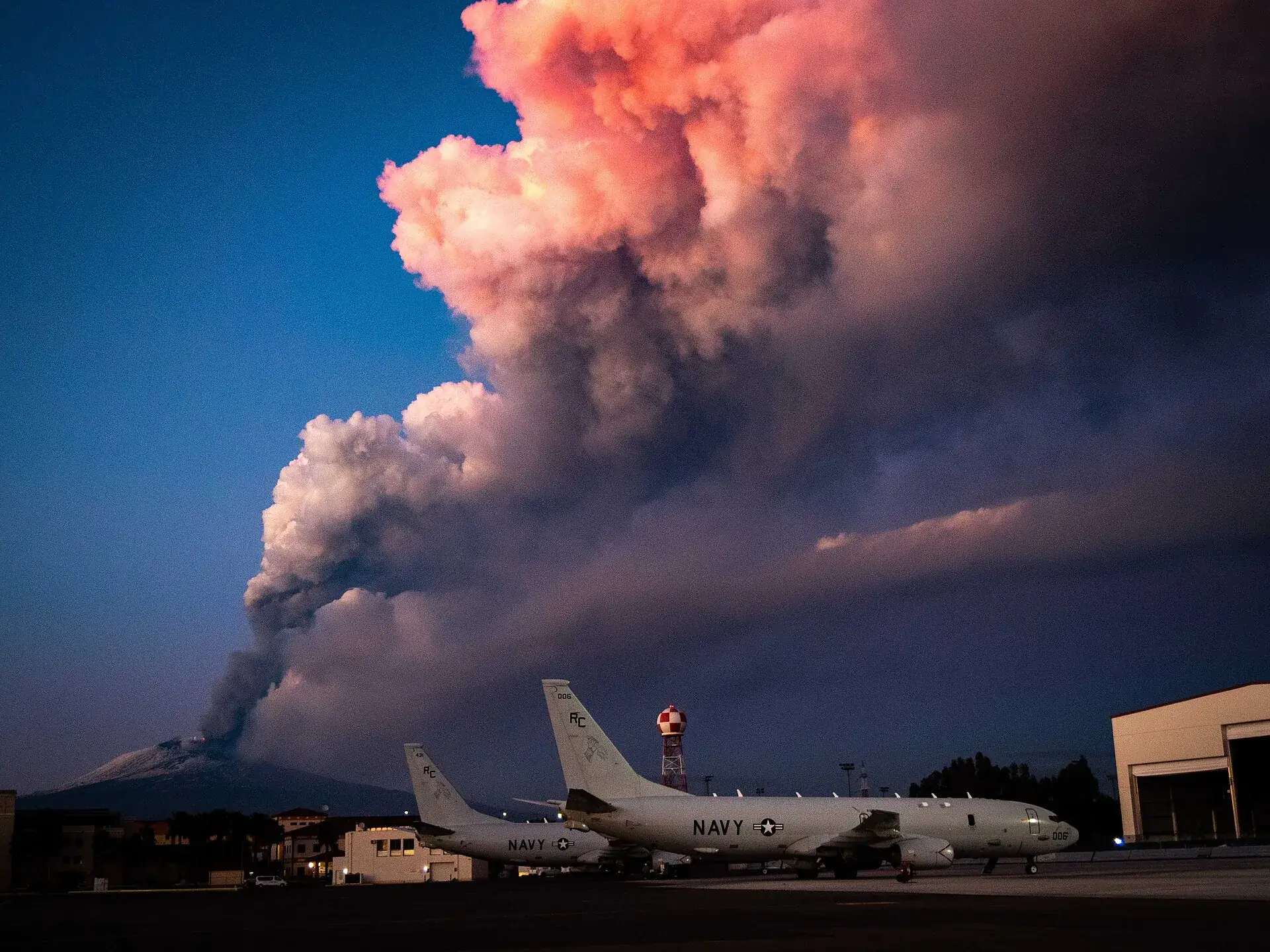
Ash column above Mount Etna on February 16, 2021, with aircraft on the airfield at Sigonella near Catania in the foreground

Volcanoes › Mount Etna

Mount Etna: Eruption

February 16, 2021, seen from the Sigonella airfield: the first of about 50 paroxysms. Etna has not settled down since that evening – and an airport sits downwind of it.

Photo: U.S. Navy · CC BY 2.0

As of 25 September 2026Is Mount Etna erupting right now – and when was the last eruption?

Yes, in an ash phase. Since the morning of September 24 the summit craters have been emitting ash again; the cloud stands about 4 kilometers (13,000 feet) above sea level and drifts south to southeast. It is not a lava fountain and not a lava flow: according to INGV the tremor is only at medium-low levels, as it was during the ash emissions on September 9 and 14–15. The aviation color code is red, and Catania airport keeps flying with reduced landings. The last flank eruption with lava ran from June 26 to August 21, 2026. Sicily's civil protection has held the Preallarme phase since August 22: crater zone closed, the rest of the mountain open. What was reported this morning is on Mount Etna – this page is the record.

Preallarme
Civil protection alert phaseOperational phase of the Sicilian civil protection (Attenzione/Preallarme/Allarme) – governs access to the summit zone · Notice no. 13 of 2026-08-22 · since 2026-08-22 · checked on 2026-09-25 · Dipartimento Regionale della Protezione Civile Sicilia – Avvisi regionali per eventi vulcanici
Red
Aviation color code (VONA)INGV aviation color code (green/yellow/orange/red) – for air traffic, not for visitors · since 2026-09-24 · checked on 2026-09-25 · INGV Osservatorio Etneo – Comunicati VONA
4km

Ash cloud on September 24

Height above sea level according to INGV (about 13,000 feet), heading south to southeast. The latest weekly bulletin names the Northeast Crater and the Bocca Nuova as the sources; the Voragine and the Southeast Crater show only fumaroles. Four earthquakes of magnitude 2 or more in the week, the strongest 2.4.

10landings per hour

Catania airport

Instead of 12 in normal operation. On September 24 from 1:30 p.m. first 5, in the evening 10; the rule runs until 11 p.m. on September 25. Departures are normal. On September 15 the airport was closed completely until 10 p.m.

1,900flights

affected in August 2026

About 36 percent canceled, roughly 630 diverted – the operator SAC's figures for the strongest phase in years: nine new vents, a lava field in the Valle del Bove, ash columns up to 7 kilometers (23,000 feet), the Allarme phase on four days.

INGV Osservatorio Etneo, weekly bulletin Rep. 39/2026 of September 22, 2026 (week of September 14–20) and communiqué of September 24, 2026 · DRPC Sicilia, notice no. 13 of August 22, 2026 · Catania airport operations coordination unit (ANSA, September 25, 2026) · SAC president Anna Quatrone, quoted in Il Fatto Quotidiano, August 14, 2026 · accessed September 25, 2026. Times and heights for September 24 come from press reports quoting the INGV communiqué.

Since February 16, 2021Mount Etna eruption history since 2021: paroxysms, collapse, the summer of 2026

Etna does not erupt "now and then" – it is active almost all the time. Since February 16, 2021 it has been in a phase that INGV, taking everything together, compares with the great eruptions of the past 350 years: first about 50 short, violent lava fountains (paroxysms) from the Southeast Crater, then the collapse of part of the cone with a pyroclastic flow, in 2024 the return of the Voragine, in 2025 two small flank eruptions and the largest pyroclastic flow since 1986, in 2026 the strongest summer phase in years. One thing stands out: every vent opened above 1,900 meters (6,200 feet), almost all of them in the uninhabited Valle del Bove. The lava was never a threat to the towns – the ash was, constantly.

  1. February 16 to October 23, 2021About 50 paroxysms – Etna grows

    At first the Southeast Crater delivers a fountain every one or two days, over a kilometer (3,300 feet) high, with ash columns several kilometers tall. Ashfall reaches Catania, the airport closes repeatedly. By July the cone has grown to 3,357 meters (11,014 feet, ±3 m, Pléiades satellite data) and overtakes the Northeast Crater, which had stood at 3,350 meters since 1981 and had sunk to 3,326 by 2018. According to INGV, the magma volume of the series matches one of the largest eruptions of the past 350 years.

  2. February 10, 2022Collapse and pyroclastic flow

    A paroxysm with fountains up to 1,500 meters (4,900 feet) and a column up to 12 kilometers (39,000 feet). At 9:34 p.m. the first pyroclastic flow runs off, at 10:26 p.m. the south flank of the cone collapses; the flows reach about 1.6 kilometers (1 mile), roughly one million cubic meters. Ash falls as far as the Tyrrhenian coast. Another paroxysm on February 21, on May 29 a collapse with a lava flow. The February 10 flow is the basis of the summit-zone hazard map published in 2025. Since April 1, 2022 the ETNAS early-warning system has been running.

  3. 2023Four paroxysms, one closes the airport

    May 21 almost unnoticed under clouds, August 13–14 with fountains from 6:30 p.m. and ash to the south, November 12 with a column of 4.5 kilometers (15,000 feet), December 1 with fountains and overflows. On August 14 Catania is closed completely until 1 p.m. because of sectors C1 and B3; in November ash falls on Milo and Zafferana while the airport stays open. On December 1 the Southeast Crater measures 3,354 meters (11,004 feet).

  4. June to August 2024The Voragine shuts down Catania

    After more than three years of quiet the Voragine wakes up on June 14. Paroxysms on July 4 (from 6:15 p.m., column 4,500 meters / 14,800 feet), July 7 and 23, August 4 and 15. On July 4–5 ash falls over Catania, the airport is closed until 3 p.m., the mayor bans two-wheelers and sets a 30 km/h limit for 48 hours; on July 23 and August 14–15 the airport closes again. The rim of the Voragine rises 107 meters to 3,369 and, after the drone survey of September 12, to 3,403 meters (11,165 feet) – the highest point ever measured on Etna.

  5. February 8 to March 2, 2025Lava in the snow on the southwest flank

    A fissure at 3,050 meters (10,000 feet) at the southern foot of the Bocca Nuova sends a flow more than 4 kilometers (2.5 miles) long southwest to about 2,480 meters (8,100 feet); on February 16 it cuts the Altomontana forest road. Thousands of onlookers in the snow, steam explosions at the front, warnings from civil protection. Then from March 15 to June 19 fifteen mostly modest episodes at the Southeast Crater.

  6. June 2, 2025Collapse of the Southeast Crater

    A nighttime paroxysm; part of the north flank of the Southeast Crater breaks away and produces a pyroclastic flow into the Valle del Leone, about 3 kilometers (2 miles) long – according to INGV probably the largest documented since 1986. The cloud rises to 6.5 kilometers (21,000 feet). ETNAS had given warning; at 6:28 p.m. INGV declares the phase over. Videos of fleeing hikers go around the world, no injuries are reported, the airport stays open.

  7. August 9 to 20, 2025Small flank eruption above the Sapienza

    A fissure at about 3,100 meters (10,200 feet) between the Southeast Crater and the Bocca Nuova, lava only 150 meters (500 feet) long; from August 14 again from 2,980 meters down to about 2,400 meters (7,900 feet) on the south-southwest flank, on August 20 more fissures with spattering. Thousands watch the flows from a safe distance, no damage. On August 21, 2025 the new delimitation of the summit zone (ZS and ZPP) takes effect, and every closure since has followed it.

  8. December 24, 2025 to January 2026The Northeast Crater returns

    After almost 28 years, paroxysms at the Northeast Crater again: on the morning of December 27 fountains of 100 to 150 meters with a column up to 8 kilometers (26,000 feet), in the afternoon 400 to 500 meters (1,300–1,600 feet) with a column over 10 kilometers (33,000 feet); from the east flank of the Voragine a lava flow almost 2 kilometers long. On January 1, 2026 a fissure opens at 2,100 meters (6,900 feet) above Monte Simone on the northern rim of the Valle del Bove (about 5 cubic meters per second). The lava field grows to 3.4 kilometers (2.1 miles), the front stands at 1,360 meters (4,460 feet) near Rocca Capra on January 4; from January 6 it declines. Everything stays in the uninhabited valley.

  9. June 26 to July 7, 2026Start of the summer series – alert level yellow

    From June 10 ash from a pit crater, from June 22 rising tremor; on June 26 lava emerges at about 3,030 meters (9,940 feet) into the upper Valle del Leone (1.2 kilometers, 260,000 cubic meters). The same day the national civil protection raises the alert level from green to yellow. On July 5 from 7:45 a.m. ash emission from the Voragine, cloud about 4.5 kilometers (14,800 feet) above sea level, VONA red: sector B2 closed until 7 p.m. and C1 until 5 a.m., arrivals suspended; on July 6 arrivals and departures are canceled until noon, diversions to Comiso.

  10. July 30 to August 2, 2026A 7-kilometer column and a new fissure at 2,700 meters

    From 3:30 a.m. Strombolian activity at the Voragine, from 9 a.m. an ash column about 7 kilometers (23,000 feet) high drifting west, at 9:59 a.m. a small pyroclastic flow into the Valle del Bove; the fountain lasts until 1:40 a.m. on July 31. At 8:49 p.m. a fissure opens at 2,700 meters (8,860 feet) in the Valle del Leone: lava flow 2.9 kilometers (1.8 miles), 500,000 cubic meters, front at 1,700 to 1,750 meters near Rocca Capra. Ashfall on Bronte. On August 2 INGV confirms the end.

  11. August 6 to 21, 2026Nine vents, Monte Rittmann, 1,900 flights

    From the evening of August 6 until 4 a.m. a violent fountain at the Voragine. On August 7 a vent opens at 2,750 meters (9,020 feet), on August 8 at 11:30 a.m. one at 2,360 meters (7,740 feet) at Monte Rittmann, whose opening triggers landslides and small pyroclastic flows; more vents on August 10 (1,900 m) and August 11 (2,090 m). On August 13 the lava fronts stand at about 1,340 meters (4,400 feet) around Rocca Capra, ash columns up to 6,000 meters (19,700 feet); on August 15 an earthquake of Ml 3.9 on the Pernicana fault; on August 17 a fissure at the Northeast Crater at 3,000 meters. Lava from the 1,900-meter vent stops on August 21; on August 26 INGV sets VONA to green. From August 7 to 17 alone, 5.6 to 7.6 million cubic meters of lava. Sicily's civil protection declares the Allarme phase on August 13, 16, 17 and 19 – summit zone closed, Guardia di Finanza at the barriers; Milo and Sant'Alfio close the Mareneve road to Rifugio Citelli, 200 meters minimum distance from the lava. Catania airport: ash on the runway from August 10, closed until 6 a.m. on August 11; on August 17–18 sector B1 closed, 10 landings per hour; according to SAC about 1,900 flights affected. Heavy ashfall in Valverde, Viagrande, San Gregorio, San Giovanni la Punta and Catania; Trecastagni and other towns ban two-wheelers.

  12. Since September 1, 2026Ash phase without fountains – to this day

    September 1 VONA orange, September 4 red (weak ash to the south-southwest), September 9 ash column about 5 kilometers (16,000 feet) to the east-southeast, September 14 landings suspended until 4 p.m. (sector C1, diversions to Palermo), September 15 airport closed until 10 p.m. (sectors C1 and B3, diversions to Comiso and Palermo), September 18 declining activity without a cloud (orange). The Northeast Crater and the Bocca Nuova take turns emitting ash; in the night of September 15–16 weak Strombolian activity at vent BN1. On September 24 from 5 a.m. ash again up to about 4 kilometers, VONA red, 5 and then 10 landings per hour. No lava flows, no injuries, crater zone closed.

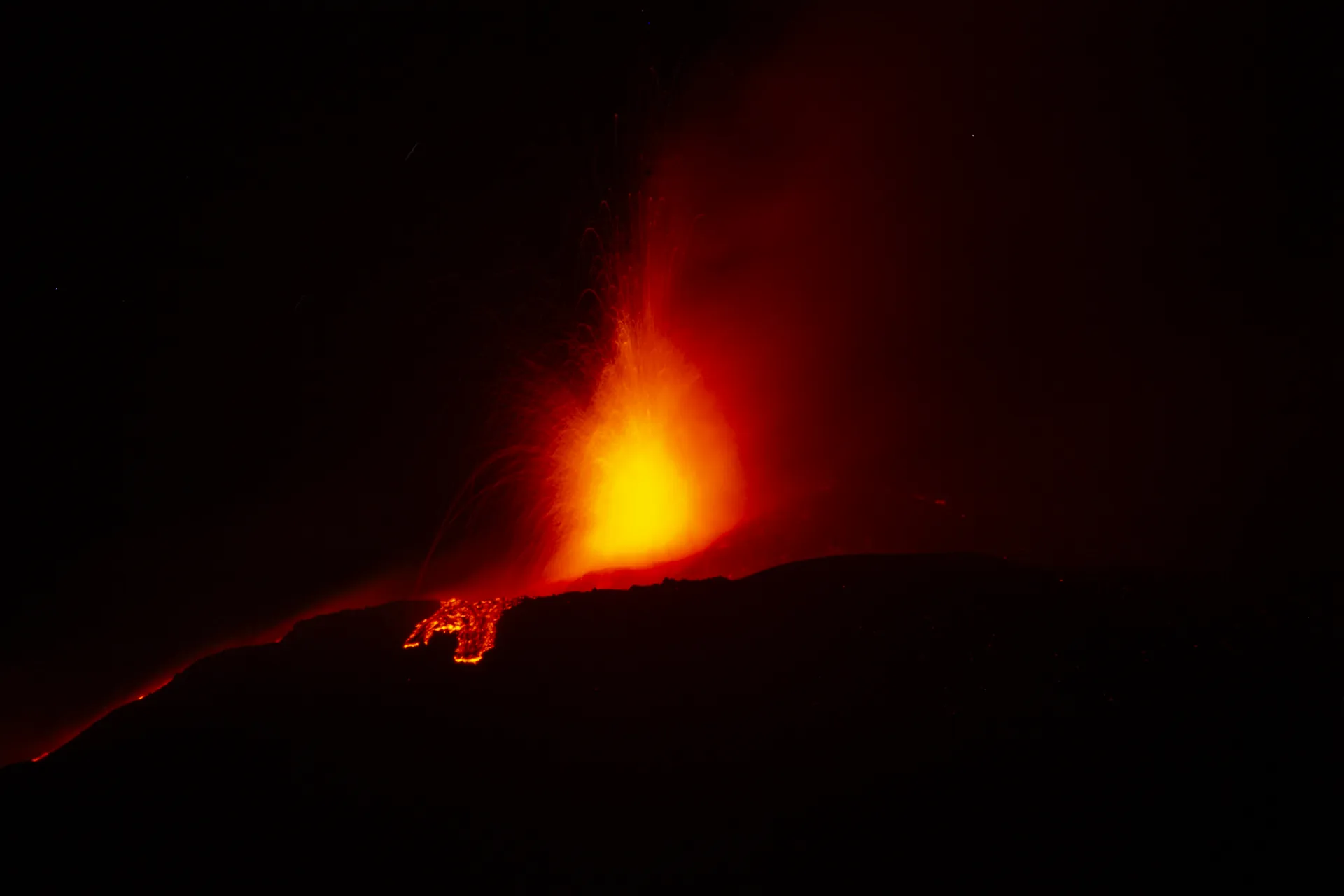
Lava fountain from the Voragine crater on Mount Etna in the night of August 15, 2024, seen from Adrano, with a glowing lava flow on the cone
August 15, 2024, from Adrano: the Voragine fires its fifth fountain of the summer. After this series Etna stood at 3,403 meters – higher than ever measured.

Photo: Alessio Bivona 70 · CC BY-SA 4.0

ETNAS: the early warning

Since April 1, 2022 INGV's early-warning system has rated the probability of a lava fountain (levels F0, F1, F2) and of a magma intrusion (I0, I1) around the clock and alerts civil protection and the mountain guides automatically. F1 and F2 typically come minutes to a few hours before the peak – as on June 2, 2025. The civil protection phase is tied to these levels and changes without a new ordinance, in August 2026 several times on the same day.

ZS and ZPP: the zones

Since August 21, 2025 note no. 37727 of the DRPC Sicilia applies: the Zona Sommitale (ZS) covers the summit craters, the upper Valle del Bove down to about 1,700 meters (5,600 feet) and the flanks above roughly 2,500 meters (8,200 feet). Inside it lies the Zona a Pericolosità Permanente (ZPP), the area of the active craters, where a guide is mandatory regardless of the phase. The old "Zona Gialla" is history; the boundary is marked on the ground with posts, ropes and signs.

3,403m

The new summit (11,165 ft)

The eastern rim of the Voragine after INGV's drone survey of September 12, 2024. Before that, 3,357 meters at the Southeast Crater (2021) and 3,350 meters at the Northeast Crater (1981). The figure changes with every paroxysm and every collapse; we know of no newer survey. The civil protection page still gives about 3,350 meters.

INGV Osservatorio Etneo: News 303 (3,357 m, ~50 paroxysms in 2021), weekly bulletin of September 17, 2024 (drone survey), INGVvulcani posts of February 21, 2022, March 5, 2025, June 3, 2025 (ETNAS), December 28, 2025, January 9, 2026, August 3, 2026 and August 22, 2026 · AIVulc 2025 · Gazzetta del Sud, June 26, 2025 (study on the collapse) · DRPC Sicilia, notices no. 3–13/2026 and note of August 17, 2026 · press on the airport and ashfall (ANSA, AGI, Sky TG24, La Sicilia, Il Fatto Quotidiano, LiveUnict). The height of 3,403 m comes from press and Wikipedia citing the INGV bulletin.

March 11 to July 11, 1669The eruption that reached Catania

Four months, about 600 million cubic meters of lava, a lava field of 40 square kilometers (15 square miles) and 17 kilometers (11 miles) long – civil protection calls 1669 the largest eruption of Etna in historical times. It is the yardstick for the worst the mountain can do to Catania: a vent low on the flank, close to the towns. And it is the reason why lava flows from low flank vents are the main scenario of civil protection planning – and why the summit eruptions of recent years, for all their pictures, were harmless for the cities.

  1. Late February to March 11Earthquakes, then the fissure at Nicolosi

    Earthquakes from late February; on March 10–11 they destroy the village of Nicolosi. On the afternoon of March 11 a fissure opens on the south flank at only about 800 meters (2,600 feet) above sea level (INGV: between 775 and 850 meters, east of Monte Salazara). Strombolian activity at the vent builds the double cone of the Monti Rossi within a few months – contemporaries call it the "monte della ruina".

  2. March and AprilVillage after village

    The flow runs south and southeast and buries Nicolosi, Mompilieri, Camporotondo, San Pietro and Misterbianco one after the other; several villages and wide stretches of farmland are lost. The lava is slow enough for people to get out of its way.

  3. April 16 to 30The city wall gives way

    On April 16 the lava reaches the city wall of Catania, on April 23 the sea. On April 30 a 57-meter (190-foot) stretch of wall between the Infetti and Tindaro bastions gives way under the pressure, and lava enters the city.

  4. Until July 11 and afterNew land, no deaths

    The flow creates more than a kilometer of new land along the coast, on which new city districts are later built; the Castello Ursino, once on the sea, has stood inland ever since. The eruption kills no one. The "20,000 dead" circulating online come from a mix-up with the earthquake of 1693.

The big ones since 1669Every major Mount Etna eruption: 1843, 1928, 1971, 1983, 1991, 2001, 2002

Etna has produced dozens of flank eruptions since 1669; INGV counts one every two years or so on average over the past 40 years. Here are the events that hit towns, people or the infrastructure on the mountain – more compact than the years since 2021, with the figures for which solid sources exist.

  1. November 25, 1843Deadly explosion near Bronte

    A violent eruption on the west flank that seriously threatens Bronte. When the lava front meets wet ground it explodes (phreatomagmatic). At least 36 dead according to the Italian Wikipedia, about 60 forestry workers according to other counts – the worst disaster in Etna's history. The number is uncertain; what is certain is that it was the lava front, not the crater.

  2. 1892Birth of the Monti Silvestri

    For about six months a fissure at roughly 1,900 meters (6,200 feet) on the south flank erupts; the cones of the Monti Silvestri form – the craters visited today right at Rifugio Sapienza, with no guide and no ticket. No towns affected.

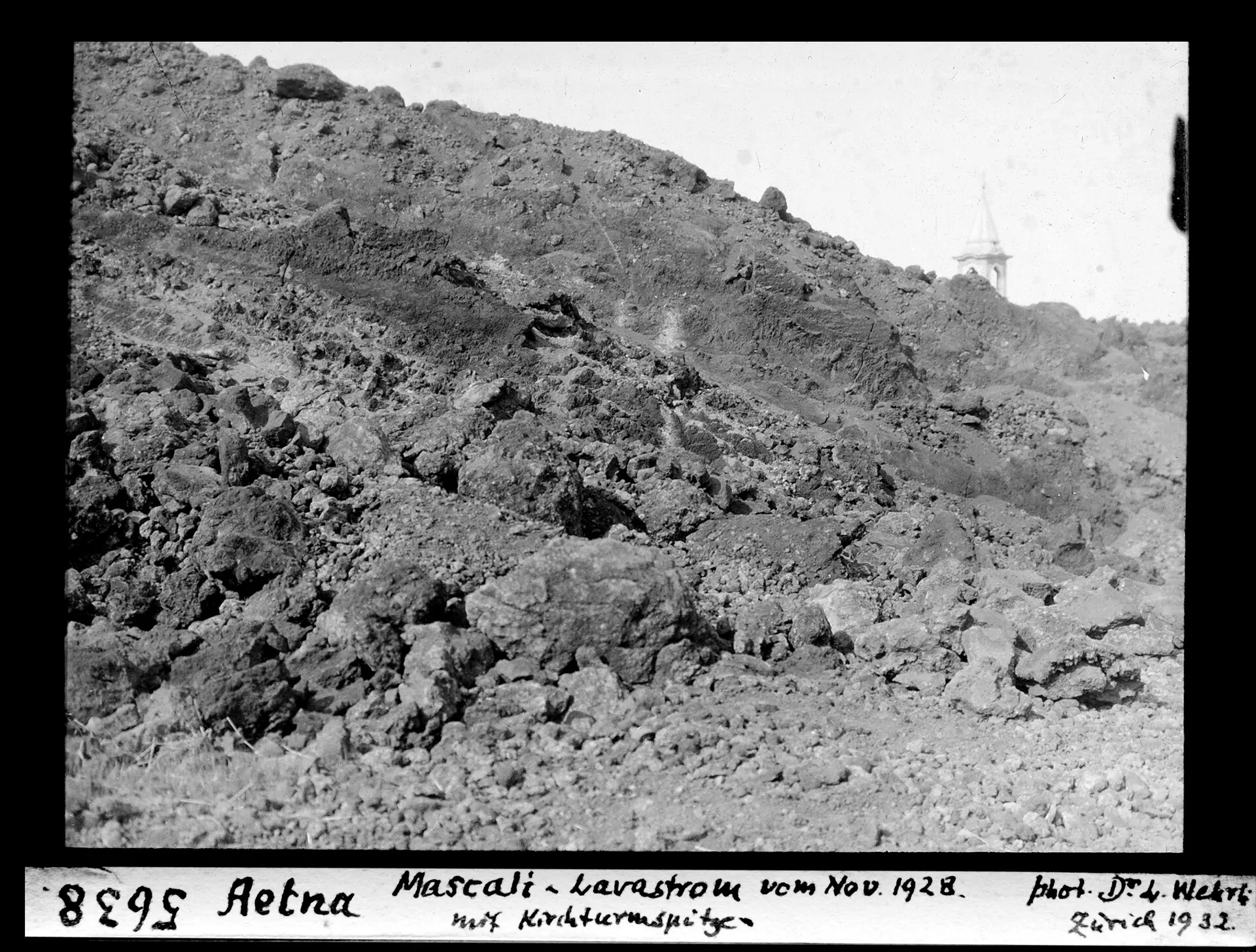
  3. November 2 to 20, 1928Mascali is wiped out

    After ash activity at the Northeast Crater, fissures open at 2,600, 2,100 and – on November 4 – 1,200 meters (3,900 feet); the lowest flow runs down the bed of the Pietrafucile toward Mascali. On November 7 it reaches the town and destroys it completely except for the outlying district of Sant'Antonino; the Circumetnea railway (November 6) and the Messina–Catania line (November 11) are cut. About 50 million cubic meters of lava over 4.38 square kilometers. Mascali is rebuilt elsewhere. It is the only destruction of a town on Etna since the 18th century – and the last to this day.

  4. April 5 to June 12, 1971Observatory buried, Southeast Crater born

    Fissures from the summit down into the Valle del Bove. The old volcano observatory near the Torre del Filosofo is destroyed, lava approaches Fornazzo. In the process the Southeast Crater forms – the crater that has produced most of the paroxysms since 2011.

  5. September 12, 1979Nine dead at the crater rim

    A 30-second explosion from the Bocca Nuova hurls blocks of rock up to the crater rim, where about 150 visitors are standing. Nine dead and 23 injured according to the Global Volcanism Program (the Italian Wikipedia gives about 30 injured). The event that led to the guide requirement in the crater zone, which still applies today.

  6. March 28 to August 6, 1983First blasting against the lava

    131 days on the south flank between 2,450 and 2,250 meters, about 100 million cubic meters of lava; buildings and tourist facilities around Rifugio Sapienza are destroyed. The first attempt anywhere in the world to divert a lava flow with explosives.

  7. April 17, 1987Two dead at the Southeast Crater

    A phreatic explosion kills two people from a group of about 30 visitors standing roughly 500 meters (1,600 feet) from the crater; seven injured. No death from volcanic activity on Etna has been documented since.

  8. December 14, 1991 to March 30, 1993473 days – Zafferana in danger

    The longest eruption of the 20th century: fissures at the foot of the Southeast Crater between 3,100 and 2,200 meters, lava into the Valle del Bove and the Val Calanna. Chestnut groves, orchards, farmhouses and the springs of Zafferana's water supply are buried. An earth barrier 234 meters long and 21 meters high at the Portella Calanna holds until April 8, 1992; on April 12 the cabinet declares a state of emergency. Blasting in May diverts the flow; on May 31, 1992 the lava stops about 700 meters (2,300 feet) short of the Sciara district.

  9. July 17 to August 9, 2001Cable car destroyed, airport closed

    24 days; vents on the south and northeast flanks between 2,950 and 1,030 meters (3,380 feet), a new crater at Piano del Lago. The upper station of the cable car is destroyed, pylons damaged, Rifugio Sapienza seriously threatened, the SP 92 road cut. Catania airport closes on July 21 and August 1, followed by weeks of ashfall; 25 to 40 million cubic meters of lava. It is the last eruption with a vent below 1,900 meters.

  10. October 27, 2002 to January 29, 2003Piano Provenzana razed

    After an earthquake crisis, fissures open on the north and south flanks at the same time during the night: vents at 2,750 and 2,800 meters (south) and 1,900 meters (northeast). On the morning of October 27 lava buries the tourist village of Piano Provenzana with its hotels and shops; the Rifugio Torre del Filosofo disappears for good. An earthquake of Md 4.4 on October 29 with its epicenter at Santa Venerina damages eight municipalities, more than 3,000 buildings are declared uninhabitable, up to 1,120 people live in emergency shelters. Ash reaches Libya and Greece, Catania airport closes for days at a time; about 160 million cubic meters of material. Rifugio Sapienza survives – earth barriers built by the army hold the lava back.

  11. May 13, 2008 to July 6, 200914 months of lava into the Valle del Bove

    417 days, the longest flank eruption since 1991–93. After more than 230 earthquakes in six hours (strongest M 3.9) a fissure opens at 2,800 meters east of the Northeast Crater. Lava flows up to 5 kilometers (3 miles) into the uninhabited valley, ashfall as far as Milazzo, no damage in towns.

  12. 2011 to 2013Paroxysms build the New Southeast Crater

    About 50 short, violent fountain episodes from a vent on the east flank of the Southeast Crater, which grows into the "Nuovo Cratere di Sud-Est"; fountains often more than a kilometer high, the most explosive paroxysm on November 23, 2013. Repeated closures of Catania airport. The first big paroxysm series – the blueprint for 2021.

  13. December 3 to 5, 2015The strongest paroxysm in twenty years

    In the night of December 3 (about 02:20 to 03:10 UTC) the Voragine fires a fountain well over a kilometer high, individual ejecta up to 3 kilometers; the eruption column rises to about 15 kilometers (49,000 feet) according to satellite analysis. Ashfall as far as Reggio Calabria (70 kilometers / 43 miles), Catania airport closed. More paroxysms on December 4 and 5.

  14. December 24 to 26, 2018Flank eruption at Christmas, earthquake in Fleri

    On December 24 more than 130 earthquakes in a little over three hours, then a fissure opens at the foot of the Southeast Crater; ash column, airspace over Catania closed from 2 p.m. On December 26 at 02:19 UTC an earthquake of Mw 4.9 follows on the Fiandaca fault between Fleri and Pennisi – the strongest ever recorded instrumentally on Etna, with 8 kilometers (5 miles) of surface ruptures. Heavy damage in Fleri, Pennisi, Fiandaca, Santa Maria La Stella and Aci Platani; no deaths, many people left homeless. The lesson: on Etna the shallow earthquakes of the east flank do more damage than the lava.

Historical photograph by Leo Wehrli: the cooled lava flow of 1928 in Mascali on Mount Etna, the tip of the church tower rising out of the lava behind it
Mascali, a few years after November 1928: only the tip of the church tower still rises out of the lava. It is the last town Etna has destroyed.

Photo: Leo Wehrli / ETH-Bibliothek Zürich · CC BY-SA 4.0

More documented eruptions (a selection from the catalogs)
1792–93 · 1852–53 · 1865 · 1879 · 1886Lava fields on the southeast and west flanks threaten Zafferana Etnea and Adrano · the Monti Centenari form in the Valle del Bove, Zafferana is spared · the row of cones of the Monti Sartorius above Fornazzo, today a hiking trail · fissures on the southwest and northeast flanks at the same time, the Alcantara river threatened · in 1886 Nicolosi is evacuated, the lava stops short of the town.
1910 · 1911 · 1923Lava passes about a kilometer west of Nicolosi, Belpasso threatened (Monti Riccò) · the Northeast Crater forms, in September lava approaches Solicchiata · about 3 square kilometers of vineyards near Linguaglossa destroyed, the station of Castiglione di Sicilia damaged.
1950–51 · 1981372 days from a fissure in the Valle del Bove (2,820–2,250 m), about 171 million cubic meters, Milo and Zafferana threatened · March 17–23, 1981: a fissure reaching down to 1,115 meters (3,660 feet), unusually fast flows cut roads and the Circumetnea railway, the lava stops about 2 kilometers short of Randazzo.
2004–05 · 2006The "quiet eruption": seven months of lava into the Valle del Bove from fissures between 2,850 and 2,350 meters, hardly any explosions, no damage · in 2006 two phases at the Southeast Crater (July 14–25, September 4 to December 15).
March 16, 2017A lava flow from the Southeast Crater meets snow; the steam explosion hurls blocks at a BBC crew, tourists and an INGV volcanologist. Ten injured, none seriously – the reminder that a lava front on snow or wet ground can explode at any time.
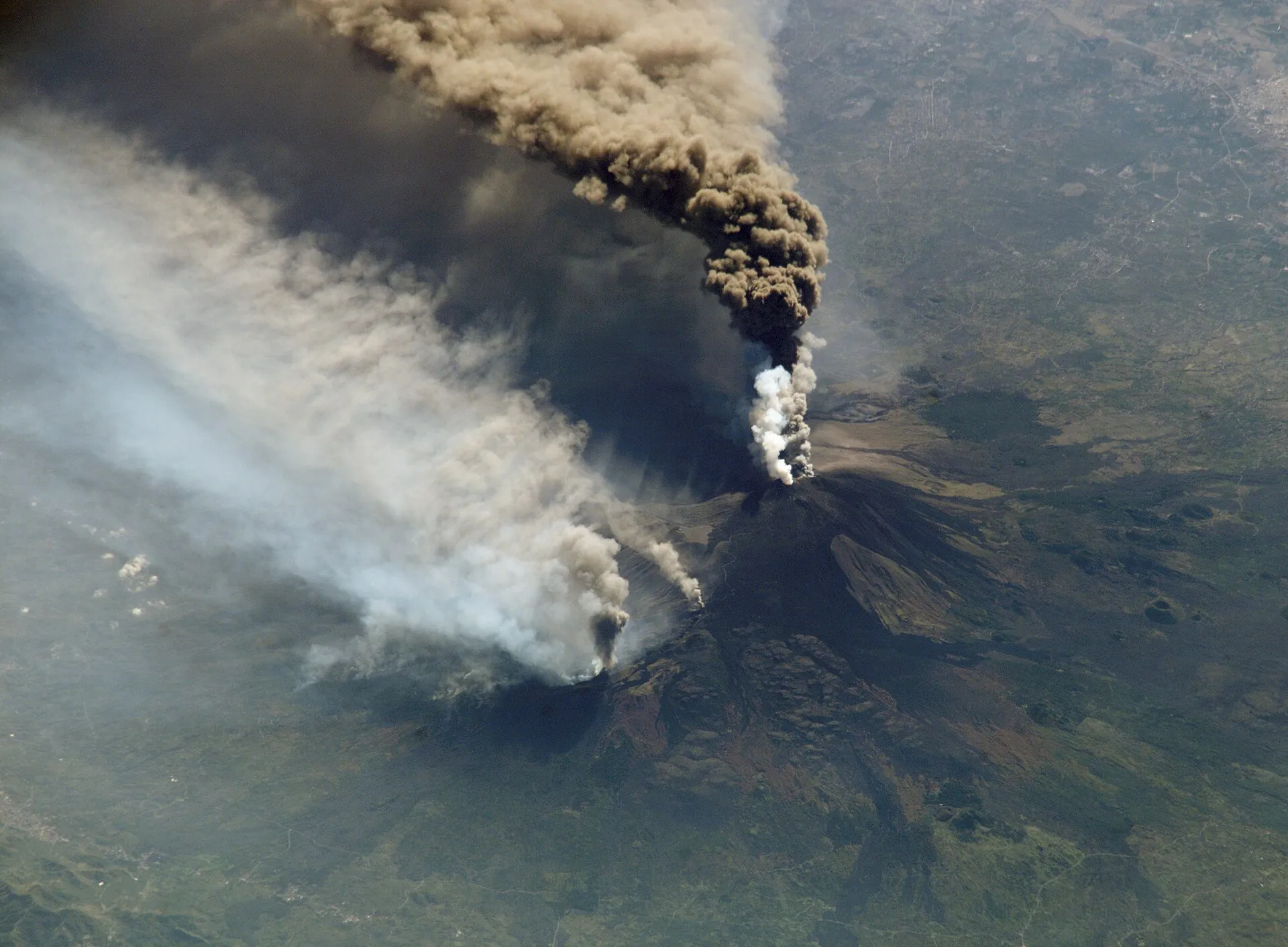
Photograph from the International Space Station on October 30, 2002: the ash column of Mount Etna drifting south, with smoke from fires the lava set on the north flank
October 30, 2002, photographed from the ISS: the ash drifts over Catania, the smoke on the left comes from fires on the north flank – three days after the lava buried Piano Provenzana.

Photo: NASA, ISS Expedition 5 · Public domain

INGVvulcani (1669, 1928, New Southeast Crater) · Dipartimento della Protezione Civile (1669, emergency 2002–03, 2006, 2008–09) · Behncke, Etna eruptions 1900–1996 (Michigan Tech) and italysvolcanoes.com (death tolls) · Global Volcanism Program, reports 1979 and 1987 · Wikipedia it, Eruzioni dell'Etna and the articles on 1928, 1991–93, 2001, 2002 · Corradini et al. 2018 (2015) · Quaternary International 2021 (Fleri earthquake). Where sources differ, death tolls are given as a range.

The questionWhen will Mount Etna erupt again?

On Etna the question is different from Vesuvius: the mountain is active practically all the time, and what people really want to know is when the next fountain or the next flank vent will come. INGV publishes no dates, only scenarios. In its weekly bulletin of September 22, 2026 it continues to expect frequent explosions at the summit craters with ash clouds and lava emissions in the summit area – and explicitly does not rule out a rapid escalation with eruption columns and the collapse of parts of the craters with pyroclastic flows. Figures like "x percent in the next few years" do not exist. In 2024 INGV specifically clarified that the scenarios in its bulletins describe the range of possible activity and are not a forecast of an eruption.

Minutesto hours

Lead time for a fountain

ETNAS reports F1 (high probability) and F2 (very high) typically minutes to a few hours before the peak. Anyone up there hears it from the guides and the closures – which is why a guide is mandatory in the crater zone.

~2years

Interval between flank eruptions

On average over the past 40 years according to INGV. Since 2000: 2001, 2002–03, 2004–05, 2006, 2008–09, 2018, 2025 and 2026 – eight or nine depending on how you count. Flank eruptions usually announce themselves hours ahead with earthquake swarms and ground deformation: in 2018 with 130 quakes in three hours, in 2008 with 230 in six.

< 1,000m

What a big eruption would take

Lava reaching the towns as in 1669 or 1928 requires a vent low on the flank. Since 2001 every vent has opened above about 1,000 meters (3,300 feet), in 2026 above 1,900 meters (6,200 feet) in the uninhabited Valle del Bove. Whether and when that changes, nobody predicts.

INGV Osservatorio Etneo, weekly bulletin Rep. 39/2026 of September 22, 2026 (expected scenario) and News 376 of September 5, 2024 (clarification on forecasts) · INGVvulcani, June 3, 2025 (ETNAS) · INGV, Etna page (flank eruptions every ~2 years on average) · Il Fatto Quotidiano, December 24, 2018 · DPC, eruption 2008–2009.
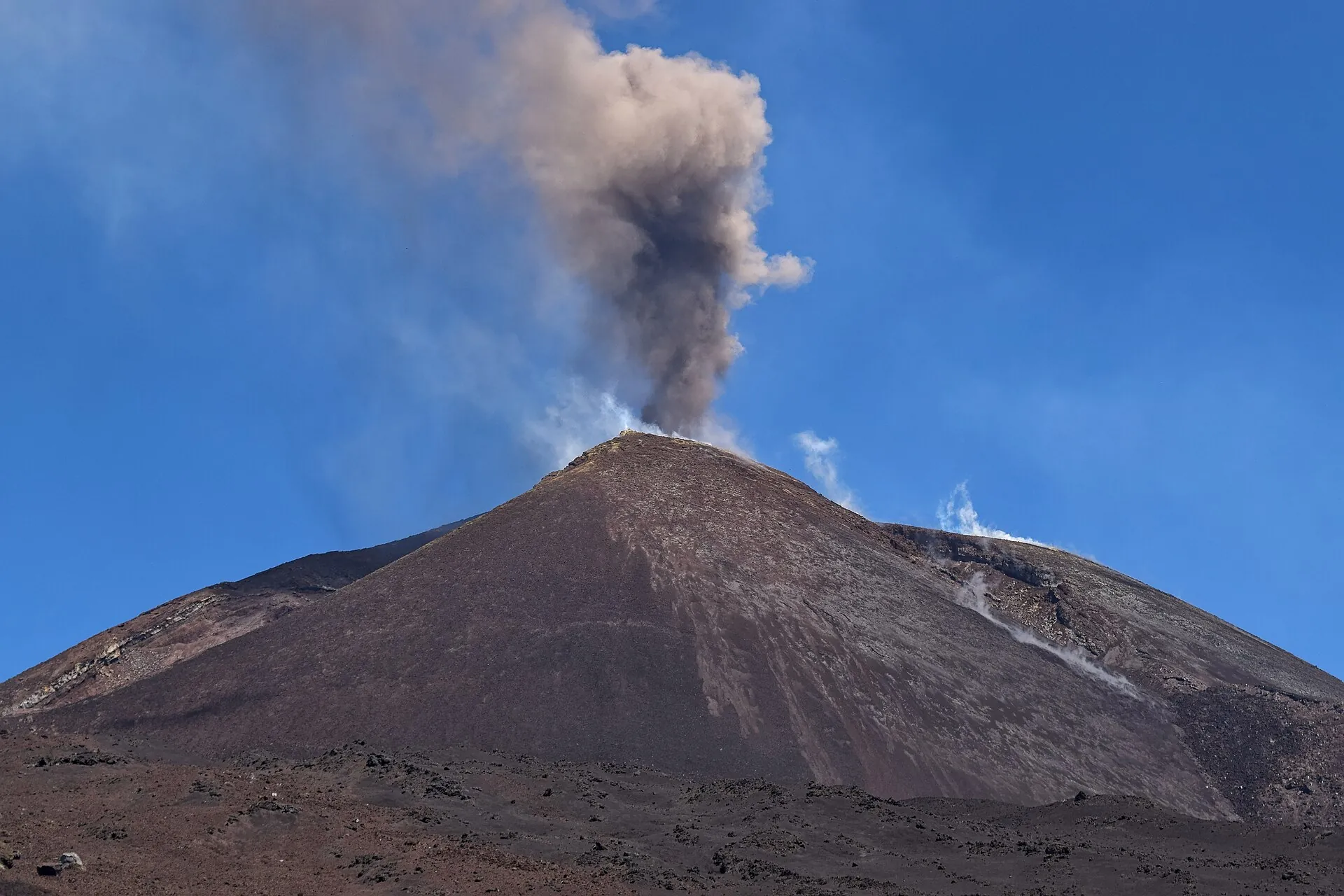
Etna's Southeast Crater sending a grey column of ash into the blue sky, the flank of dark cinder
The Southeast Crater, born in 1971, the busiest of the four since 2011: what happens here usually decides which phase applies in the morning.

Photo: The Cosmonaut · CC BY-SA 2.5 ca

For visitorsWhat an eruption means for you: alert phase, zones, airport

On Etna, "eruption" rarely means "mountain closed". Sicily's civil protection declares one of three phases, and that phase decides how high you get: in Attenzione the crater zone is open with a guide, in Preallarme only the crater zone is closed, in Allarme everything above about 2,500 meters (8,200 feet). The phase is tied to ETNAS and can change several times a day – in August 2026 Allarme applied on four days, with Preallarme in between. The phase our morning check reported today is marked.

The elevations are only a rule of thumb now

The limits of 2,500, 2,750 and 2,900 meters come from older ordinances (Nicolosi 2022: 2,500 m; south side 2,700–2,750 m; north side 2,920 m). Since the delimitation of August 21, 2025 what counts is the ZS/ZPP boundary marked on the ground, not a fixed elevation. As orientation it still works: Attenzione – without a guide up to the ZPP boundary, roughly the end points of the 4x4 buses (about 2,900 m south, 2,920 m north); Preallarme – ZPP closed, buses and trails open to about 2,900 m; Allarme – everything above about 2,500 m closed, including the upper station of the cable car and the upper trails from Piano Provenzana.

Cross the line and you get reported

The Guardia di Finanza and the forestry corps staff the barriers on the south and north sides; violations of the closures are reported under article 650 of the Italian penal code. In the summer of 2026 the Guardia di Finanza reported 13 volcano guides and one mountain guide who had led groups up despite the closure. The latest DRPC Sicilia notice is always what counts; the mayors implement it with ordinances, most recently Belpasso no. 135 of August 10, 2026. Which tours run in which phase: Mount Etna tours.

VONA – INGV's color code for aviation
GreenNo ash cloud, return to the previous state. Most recently on August 26, 2026 after the end of the summer eruption.
YellowHeightened unrest at the volcano, no ash in the air.
OrangeWeak ash emission without a sustained column – the ash stays at the summit. Most recently from September 18 to 24, 2026.
RedAsh at heights that endanger flight routes. It is a notice to pilots and air traffic controllers, not a closure: whether and how Catania is restricted is decided by the airport's crisis unit based on wind direction and ash concentration. In force since September 24, 2026.

Catania airport: sectors, reduced landings, closure

Catania-Fontanarossa airport lies 30 kilometers (19 miles) south of the summit; its operations coordination unit (operator SAC with ENAV and ENAC) decides hour by hour. Depending on the wind, airspace sectors above the volcano are closed (the reports name B1, B2, B3, C1) and landings per hour are reduced: 12 in normal operation, 10 or 5 with ash, zero with ash on the runway until it is cleaned. Departures often remain possible while arrivals are diverted to Palermo or Comiso. Examples from 2026: July 5–6 full closure until noon; August 10–11 closure until 6 a.m.; August 17–18 sector B1 closed, 10 landings per hour; September 15 closure until 10 p.m.; September 24–25 5 and then 10 landings per hour. Since 2021 no closure has lasted longer than about a day at a stretch – the rule is reduction, not shutdown. In practice: check your flight status with the airline on the day of travel, allow a day's buffer before return flights, and know the alternates Comiso (about 100 km / 60 miles) and Palermo (about 200 km / 125 miles). SAC publishes the operating status on aeroporto.catania.it.

Ashfall in Catania: the rules

When ash falls on the city, the mayors issue ordinances following a well-rehearsed pattern – Catania on July 5, 2024, Trecastagni, Aci Catena, Gravina and other towns in August 2026: a ban on two-wheelers and a 30 km/h speed limit across the municipality, usually for 48 hours; residents sweep the ash from yards and balconies into small containers and put them out in front of the house, the city clears streets and drains. For you that means: drive the rental car slowly, leave the scooter parked, and never run the wipers dry over the ash – it grinds like sandpaper. Close the windows, wear an FFP2 mask if you have breathing problems. Tap water stays clean. Whether Catania issued the same ordinance in August 2026 as in 2024, we have not seen in full text.

DRPC Sicilia: note no. 37727 of August 21, 2025 (ZS/ZPP) and explanation of August 17, 2026 · Belpasso, ordinance no. 135/2026 · INGV Osservatorio Etneo, VONA communiqués · SAC/ENAV/ENAC via ANSA, AGI, Corriere Etneo, Cataniaoggi, La Sicilia, Sky TG24 (July–September 2026) · Catania, Trantino ordinance of July 5, 2024 (La Sicilia) · Cataniatoday (guides reported). The sector names come from the press; we have not found an official sector map.
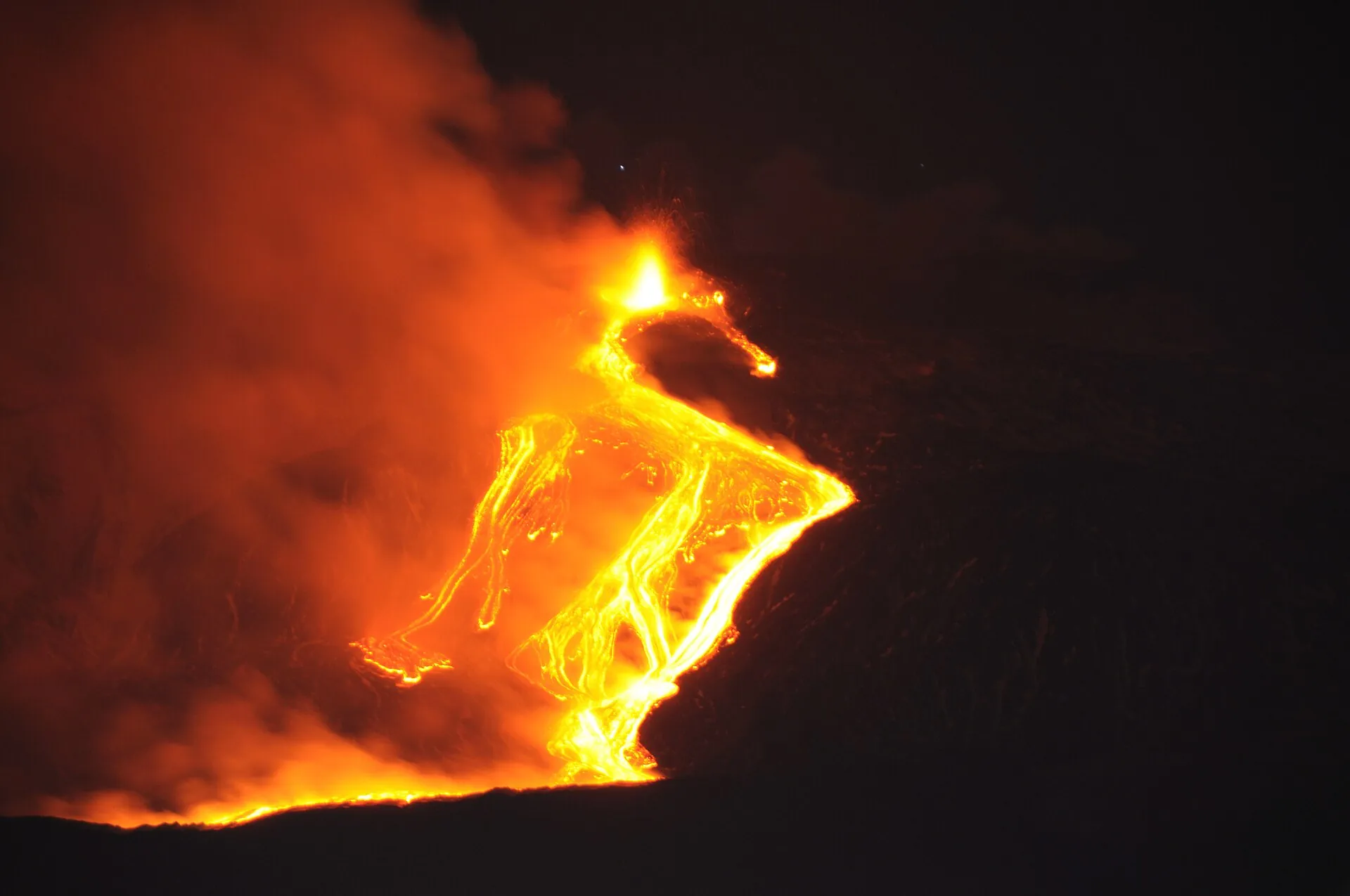
A glowing lava flow on Etna at night, January 2011
What you are allowed to see when the mountain shows it: lava from a safe distance, upwind, and at night only with someone who knows the way.

Photo: gnuckx · CC BY 2.0

WatchingWhere to see a Mount Etna eruption safely

In Preallarme, as today: from the upper station of the cable car (about 2,500 meters / 8,200 feet) and with the 4x4 bus to about 2,900 meters (9,500 feet) you see the summit craters from roughly a kilometer away – ash puffs by day, glow from the Bocca Nuova or the Northeast Crater at night when Strombolian activity is running there, which it was at times in September 2026. The craters themselves are off limits. In Attenzione, guided tours to the ZPP boundary with a view of the crater terrace are added. In Allarme nothing goes above 2,500 meters – then you watch from the towns at the foot, from the Mareneve road or from the coast. Fountains of 500 meters and ash columns of 7 kilometers can be seen from all of eastern Sicily and from Calabria; the problem is never the distance, always the wind.

South: Sapienza, Silvestri, Schiena dell'Asino

Rifugio Sapienza (1,900 m / 6,200 ft) and the Crateri Silvestri are freely accessible and face the summit craters; the viewpoint at the Schiena dell'Asino opens the view into the Valle del Bove, where the lava ran in 2026. The south gets ashfall most often – with a north wind, choose the other side.

North: Mareneve and Piano Provenzana

The Mareneve road and Piano Provenzana (1,800 m / 5,900 ft) are closest to the Northeast Crater paroxysms – unless closed: in August 2026 Milo and Sant'Alfio shut the Mareneve to Rifugio Citelli, with a 200-meter minimum distance from the lava front.

East and west: Zafferana, Milo, Bronte, Adrano

Zafferana Etnea and Milo look straight into the Valle del Bove, Bronte and Adrano at the west flank – the photo of the Voragine above was taken in Adrano. Where it is best on a given day depends on where the wind carries the ash. Keep at least 50 meters (160 feet) from lava flows under the ordinances (Belpasso, Nicolosi), 200 meters in the Milo/Citelli area; at night only with a local guide, in winter only with winter gear.

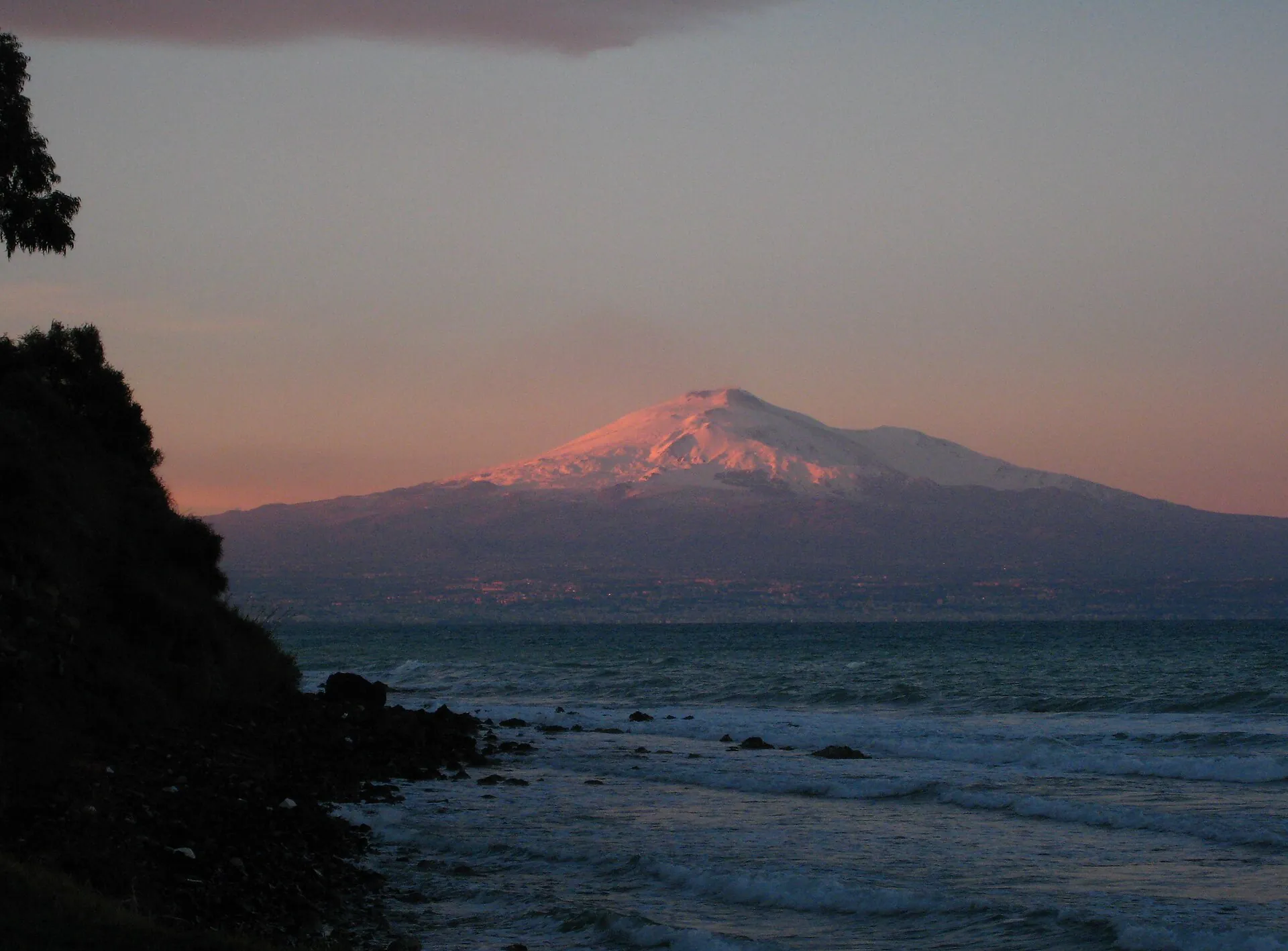
Etna at dusk, the summit glowing pink above the sea near Augusta
From Augusta, 40 kilometers (25 miles) to the south: even from this far you see fountains and ash columns – and breathe no ash.

Photo: Andrew Malone · CC BY 2.0

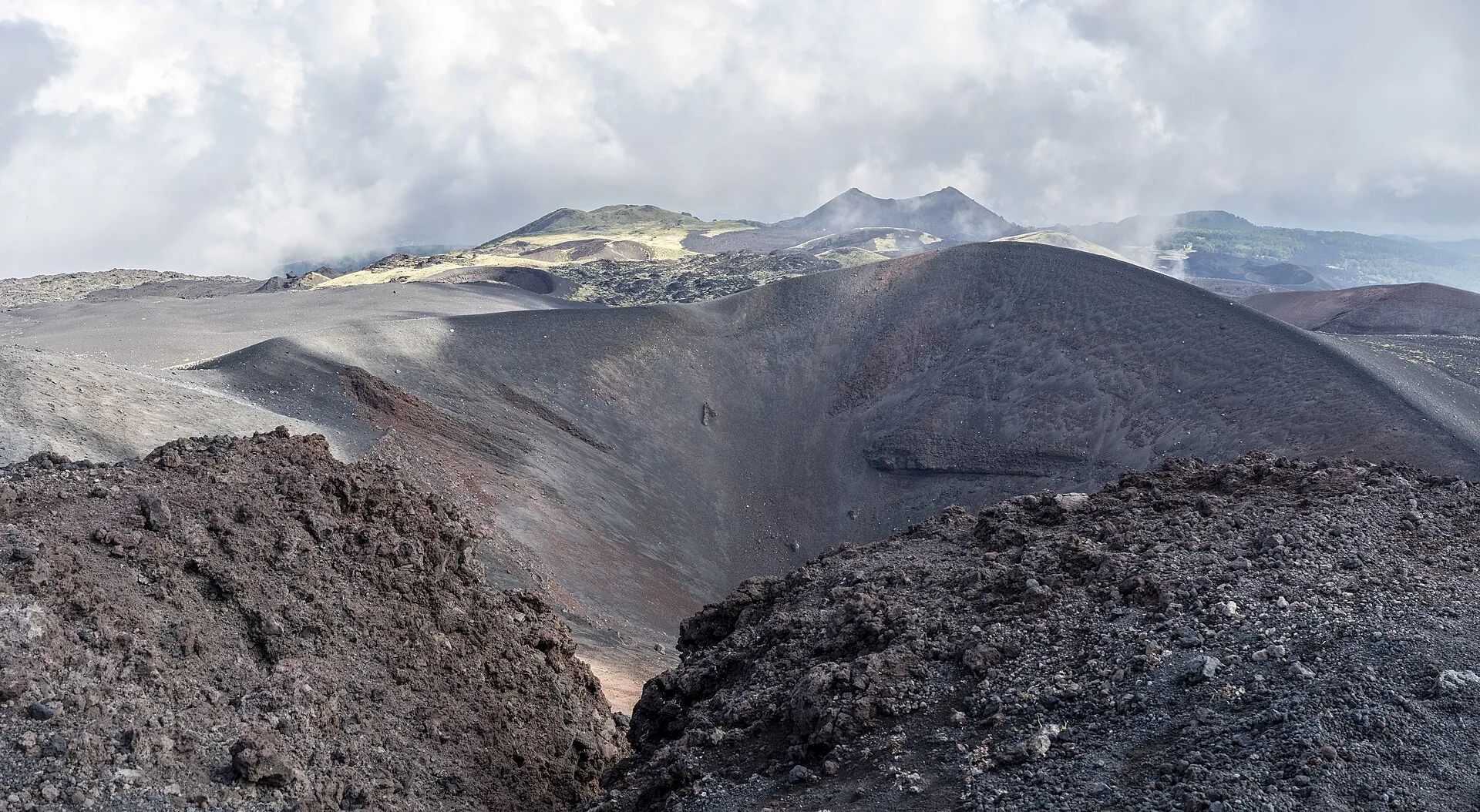
The rim of a summit crater on Etna: dark cinder ramparts, steaming craters and clouds behind
The crater terrace: with a guide in Attenzione, for no one in Preallarme. Nine people died here in 1979 – the rule dates from that day.

Photo: Cayambe · CC BY 4.0

Outdated onlineWhat other sites get wrong

“Etna is as dangerous as Vesuvius.”
Dangerous in a different way. Vesuvius has been plugged since 1944 and has an evacuation plan for 700,000 people with 72 hours' notice, because its next eruption is likely to be explosive. Etna is open and active almost all the time; its lava flows slowly enough to get out of the way (1669: no deaths). The dangers are ashfall, earthquakes on the east flank and explosions right at the crater. There is no red zone for towns.
“Eruption means the whole mountain is closed.”
No. In Preallarme, as today, only the crater zone is closed; the cable car and the 4x4 buses run to about 2,900 meters. Only in Allarme is everything above about 2,500 meters closed – and in 2026 that applied on four days in August.
“Catania airport closes with every eruption.”
Usually not. VONA red is a notice to pilots, not a closure. Depending on the wind, the airport reduces landings from 12 to 10 or 5 per hour and closes only sectors – or, with ash on the runway, closes fully for a few hours. On September 24–25, 2026 Catania kept flying despite red.
“Etna is 3,350 meters high (or 3,323, 3,329, 3,340).”
Outdated. Since the Voragine paroxysms of 2024 INGV measures 3,403 meters (11,165 feet) at the eastern rim of the Voragine. 3,350 meters was the Northeast Crater of 1981, which had sunk to 3,326 by 2018.
“Without a guide you can go up to 2,900 meters or to the Torre del Filosofo.”
Only in Attenzione and only to the ZPP boundary. Since August 21, 2025 the zone marked on the ground counts, not a fixed elevation – and in Preallarme the crater zone is closed even with a guide.
“20,000 people died in Catania in 1669.”
The lava flow of 1669 killed no one. The figure comes from the earthquake of 1693.
“The 2002 eruption destroyed Rifugio Sapienza.”
The Rifugio survived – earth barriers built by the army and civil protection held the lava back in December 2002. What was lost was Piano Provenzana on the north side and Nicolosi's service building next to the Rifugio. In 2001 it was the cable car's upper station, in 1983 buildings around the Rifugio.
“The many fountains since 2021 show that a big eruption is coming.”
Unsupported. On September 5, 2024 INGV made clear that the scenarios in its bulletin describe the range of possible activity, not a forecast – and that tremor fluctuations alone give no date for an eruption.

Quick answersMount Etna eruption: frequently asked questions

Mount Etna eruption today – where is the daily status?

On Mount Etna: we fetch the national alert level every morning at 6 a.m., and the alert phase and aviation color code are explained there. This page is the record with a fixed date; the status lines at the top show today's check.

Are tours canceled during an eruption?

Rarely all of them. In Preallarme only the crater tours are dropped; sunset and 3,000-meter tours keep running. In Allarme every tour ends below about 2,500 meters or is postponed. Cable car tickets are not refunded on a volcano alert – when the situation is uncertain, buy at the lower station.

Where is the best place to watch the eruption?

Upwind and from a distance: with a south wind from Piano Provenzana and the Mareneve road in the north, with a north wind from Rifugio Sapienza and the Schiena dell'Asino in the south; Zafferana and Milo look into the Valle del Bove, Bronte and Adrano at the west flank. Fountains and ash columns are visible from all of eastern Sicily.

Is Mount Etna erupting right now (September 2026)?

Yes, in an ash phase: since September 24, 2026 the summit craters (mainly the Northeast Crater and the Bocca Nuova) have been emitting ash up to about 4 km, the aviation color code is red, the tremor is only medium-low – no lava fountain, no lava flow. Sicily's civil protection has held the PREALLARME phase since August 22, 2026: crater zone closed, the rest of the mountain open.

When did Mount Etna last erupt?

The last flank eruption with lava flows ran from June 26 to August 21, 2026 (Valle del Leone, Monte Rittmann, nine vents); INGV set the color code to green on August 26. Since September 1 ash emissions from the summit craters have followed, most recently from September 24. The last big paroxysm with fountains was on August 6–7, 2026 at the Voragine.

When will Mount Etna erupt next?

Nobody gives a date. INGV continues to expect frequent explosions at the summit and does not rule out a rapid escalation; flank eruptions have come about every two years on average over the past 40 years. Fountains are usually reported by the ETNAS early-warning system minutes to hours in advance, flank eruptions by earthquake swarms.

Is Catania airport closed?

As of September 25, 2026: open but reduced – 10 landings per hour until 11 p.m. (normally 12), departures as usual. With ash on the runway it closes for a few hours (most recently September 15, 2026 until 10 p.m., August 10–11, 2026 until 6 a.m.). Check your flight status with the airline before heading to the airport; the alternates are Comiso and Palermo.

Can you go up Mount Etna during an eruption?

Usually yes, just not up to the craters. In PREALLARME (today) the cable car and 4x4 buses run to about 2,900 m, guided crater tours are canceled. Only in ALLARME – on four days in August 2026 – is everything above about 2,500 m closed. The latest DRPC Sicilia notice is what counts.

How close can you get to the lava?

To lava flows at least 50 m under the ordinances (Belpasso, Nicolosi), 200 m in the Milo/Citelli area in August 2026; to the foot of the Southeast Crater at least 300 m, and in the crater zone only with a guide. Explosions at lava fronts are possible with snow or moisture – in 2017 they injured ten people.

Is a Mount Etna eruption dangerous?

For towns rarely: lava last destroyed a town in 1928 (Mascali) and reached Catania in 1669. What is dangerous are explosions at the crater (nine dead in 1979, two in 1987), earthquakes on the east flank (2018 Fleri, Mw 4.9) and ashfall for traffic, roofs and airways. If you respect the closures, you are safer on Etna than on a Sicilian country road.

How often does Mount Etna erupt?

Practically all the time. In series years there were about 50 paroxysms (2011–13, 2021), flank eruptions eight or nine times since 2000. INGV gives one flank eruption about every two years on average over the past 40 years.

How many people has Mount Etna killed?

77 in recorded history up to 2001 (Behncke), most of them in 1843 near Bronte when a lava front exploded. Since 1970: nine dead in 1979 at the Bocca Nuova and two in 1987 at the Southeast Crater. No death from volcanic activity has been documented since 1987; accidents with ice, sleds and falls, however, occurred as recently as January 2025.

Is Catania under threat?

From lava only with a vent low on the south flank as in 1669 – since 2001 all vents have lain above 1,000 m, in 2026 above 1,900 m in the uninhabited Valle del Bove. What hits Catania regularly is ash: July 2024 and August 2026 with a two-wheeler ban and 30 km/h limit, reduced airport operations in September 2026.

What to do during ashfall?

Follow the municipal ordinances: no scooter, no bicycle, 30 km/h, sweep the ash into small containers and put them out in front of the house. In the car, do not run the wipers dry, check the filters; close the windows, wear an FFP2 mask if you have breathing problems; stocking up on water is not necessary, ash does not contaminate the mains supply.

Etna or Vesuvius – which is more dangerous?

Vesuvius – for the people at its foot: it has been plugged since 1944, its next eruption is likely to be explosive, 700,000 people would have to get out beforehand. Etna is open and constantly active, its eruptions are mostly effusive; for visitors it is the more spectacular, for residents the more predictable.

Can you see lava at night?

When activity is running, yes: glow at the Bocca Nuova or the Northeast Crater is visible from the upper station and the towns, fountains and lava flows from all of eastern Sicily. In September 2026 there is no lava flow; the Strombolian activity of the Bocca Nuova was visible only at night on September 15–16. Going up at night only with a guide.

How high is Mount Etna now?

3,403 m at the eastern rim of the Voragine according to INGV's drone survey of September 12, 2024 – higher than ever measured. In 2021 it was 3,357 m (Southeast Crater), in 1981 3,350 m (Northeast Crater). The figure can change with every paroxysm.

What does VONA red mean?

The highest of four levels of INGV's notice to aviation: ash at heights that endanger flight routes. It is information for pilots and air traffic controllers, not a closure; whether and how Catania is restricted is decided by the airport's crisis unit based on wind direction.

What was the worst Mount Etna eruption?

1669: lava from 800 m above sea level near Nicolosi buried several villages, broke through the city wall of Catania on April 30 and created new land in the sea – 600 million m³ over 40 km², but no deaths. The greatest disaster was in 1843 near Bronte (at least 36 dead from an explosion at the lava front).

What happened on Mount Etna in 2025?

Two small flank eruptions on the southwest side (February 8 – March 2 with lava down to 2,480 m in the snow; August 9–20), fifteen episodes at the Southeast Crater until June, on June 2 a collapse of the Southeast Crater with a 3 km long pyroclastic flow, and at Christmas the return of the Northeast Crater with a column over 10 km, followed by a fissure at 2,100 m on January 1, 2026.

What happened in 2026?

January: lava flow in the Valle del Bove down to 1,360 m. From June 26 a summer phase with three episodes, nine new vents, 7 km columns and about 1,900 flights affected, alert level yellow since June 26, ALLARME on four days in August. Since September 1 an ash phase, most recently from September 24 with VONA red and reduced airport operations.
Sources · accessed on 25 September 2026