Wai-O-Tapu
The cheapest of the four, and the one with the colors: the Champagne Pool and New Zealand's largest mud pool. Three loop walks, the shortest 30 minutes. 31 km (19 miles) south of town, cashless.
In the middle of town, steam comes out of the lawn. It costs nothing.
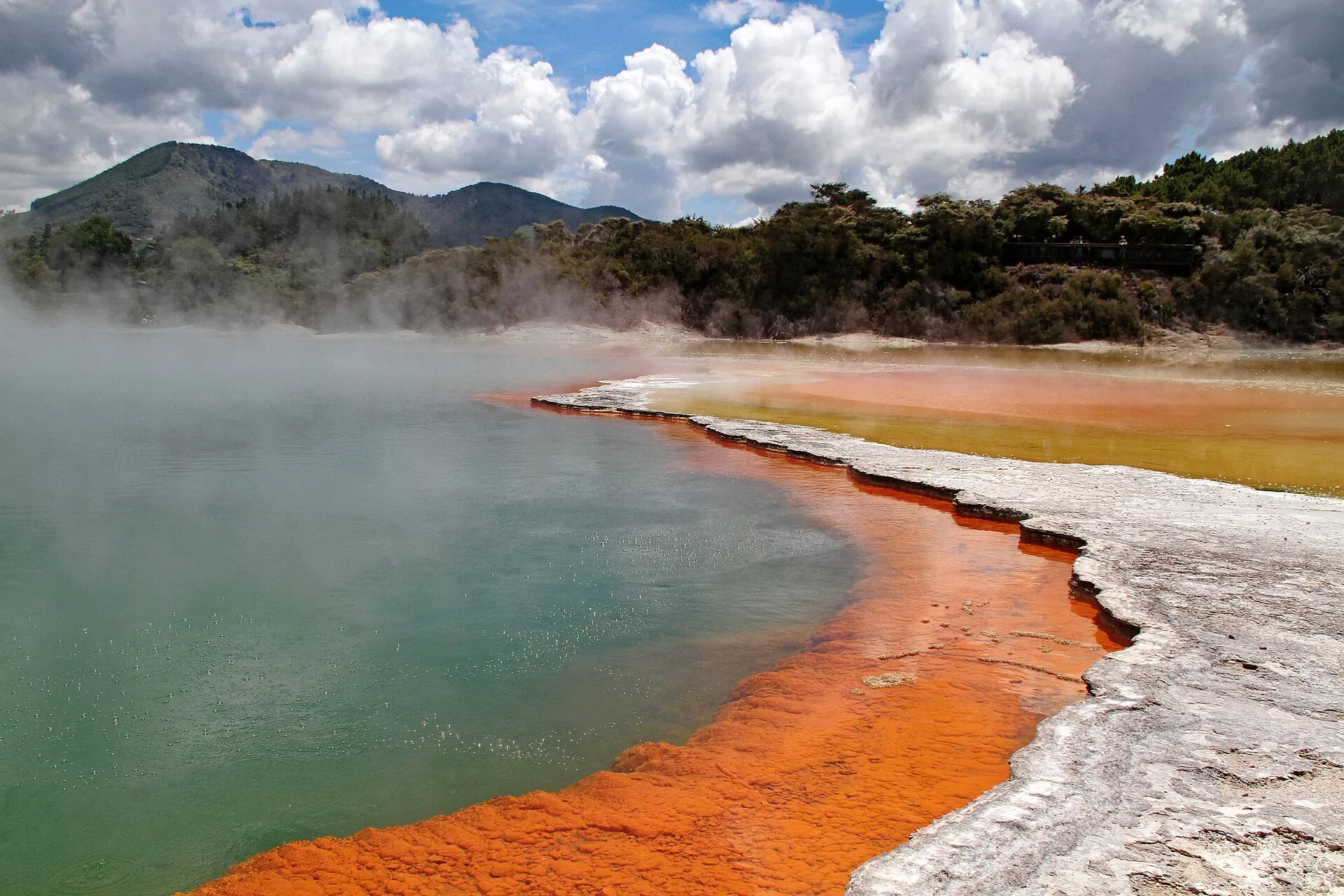
Thirty-one kilometers south, the Champagne Pool sits in its own fog.
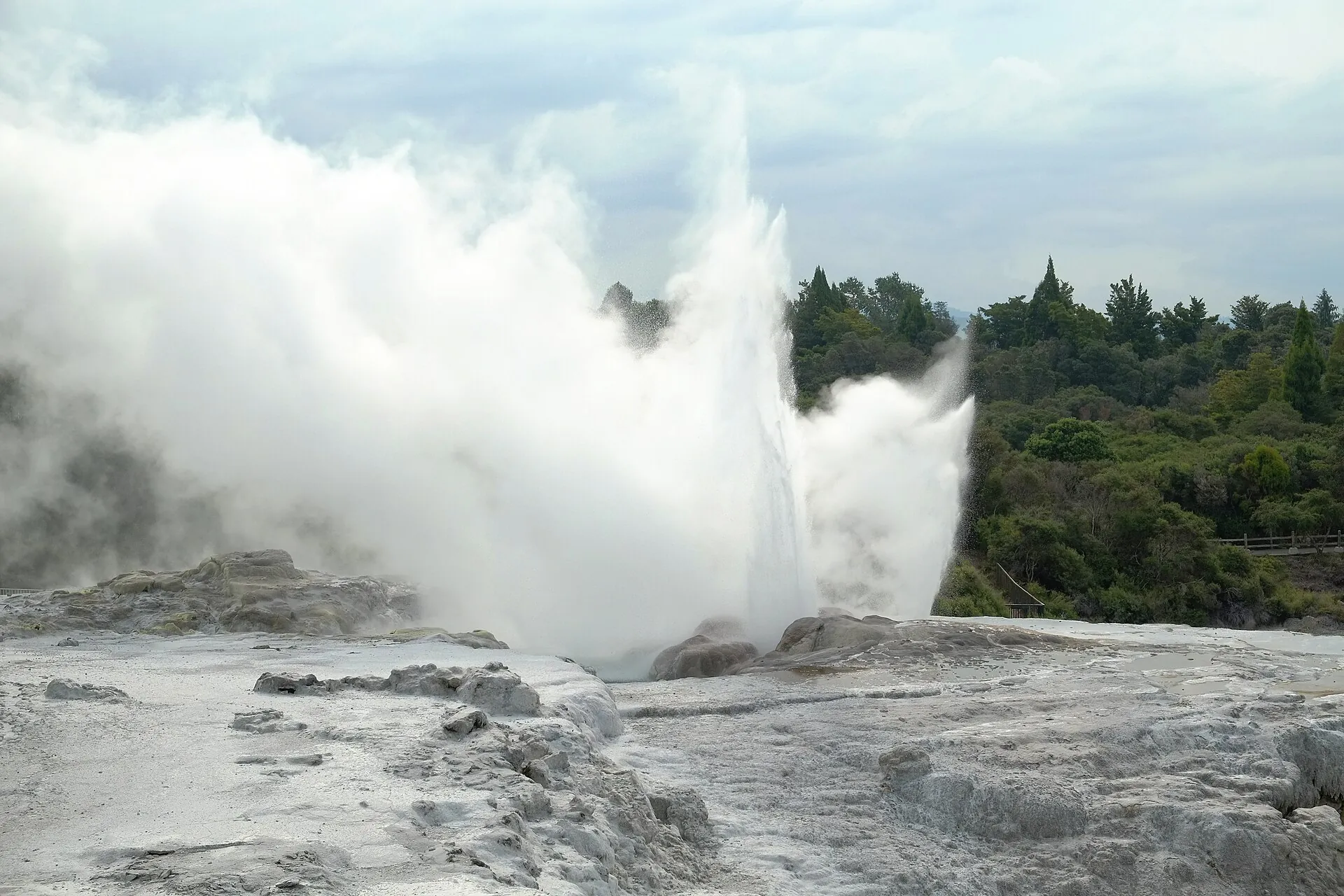
And at Te Whakarewarewa, Pōhutu goes up as far as thirty meters.
Scroll –
three places, three prices
GeoNet lists Rotorua as a volcanic center of its own and reports Volcanic Alert Level 0 on 21 September 2026 – no volcanic unrest, Aviation Colour Code Green. Level 0 explicitly does not mean harmless: the agency still names hydrothermal activity, gases, earthquakes and collapse holes as hazards of the place. That is what the barriers and formed walkways in every park are for.
The four paid parks all sit within half an hour's drive and all open year-round. What differs is the price, the time it takes and what you actually see – the range runs from NZD 45 to NZD 180. And if you do not want to spend anything at all, Rotorua still puts you on steaming ground: more on that below.
The cheapest of the four, and the one with the colors: the Champagne Pool and New Zealand's largest mud pool. Three loop walks, the shortest 30 minutes. 31 km (19 miles) south of town, cashless.
The Pōhutu geyser in the Te Whakarewarewa valley, plus the New Zealand Māori Arts and Crafts Institute and a kiwi enclosure. During the day you enter the valley only on a guided tour: 90 minutes, hourly. Book ahead, cashless.
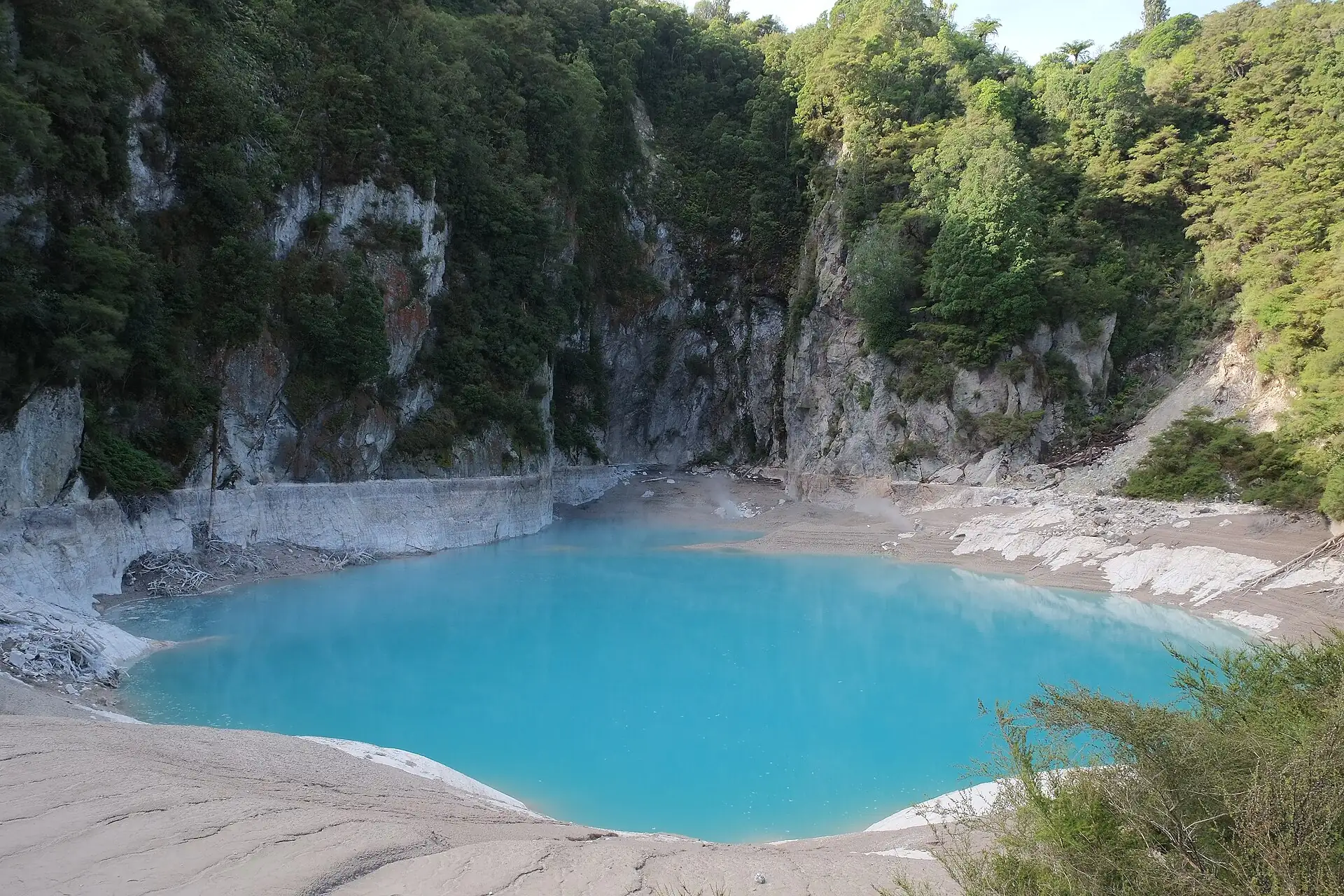
The largest and quietest area: 4 km (2.5 miles) downhill through a valley that did not exist before 1886, then a cruise on Lake Rotomahana and a shuttle back. Boat places are limited, so booking is required.
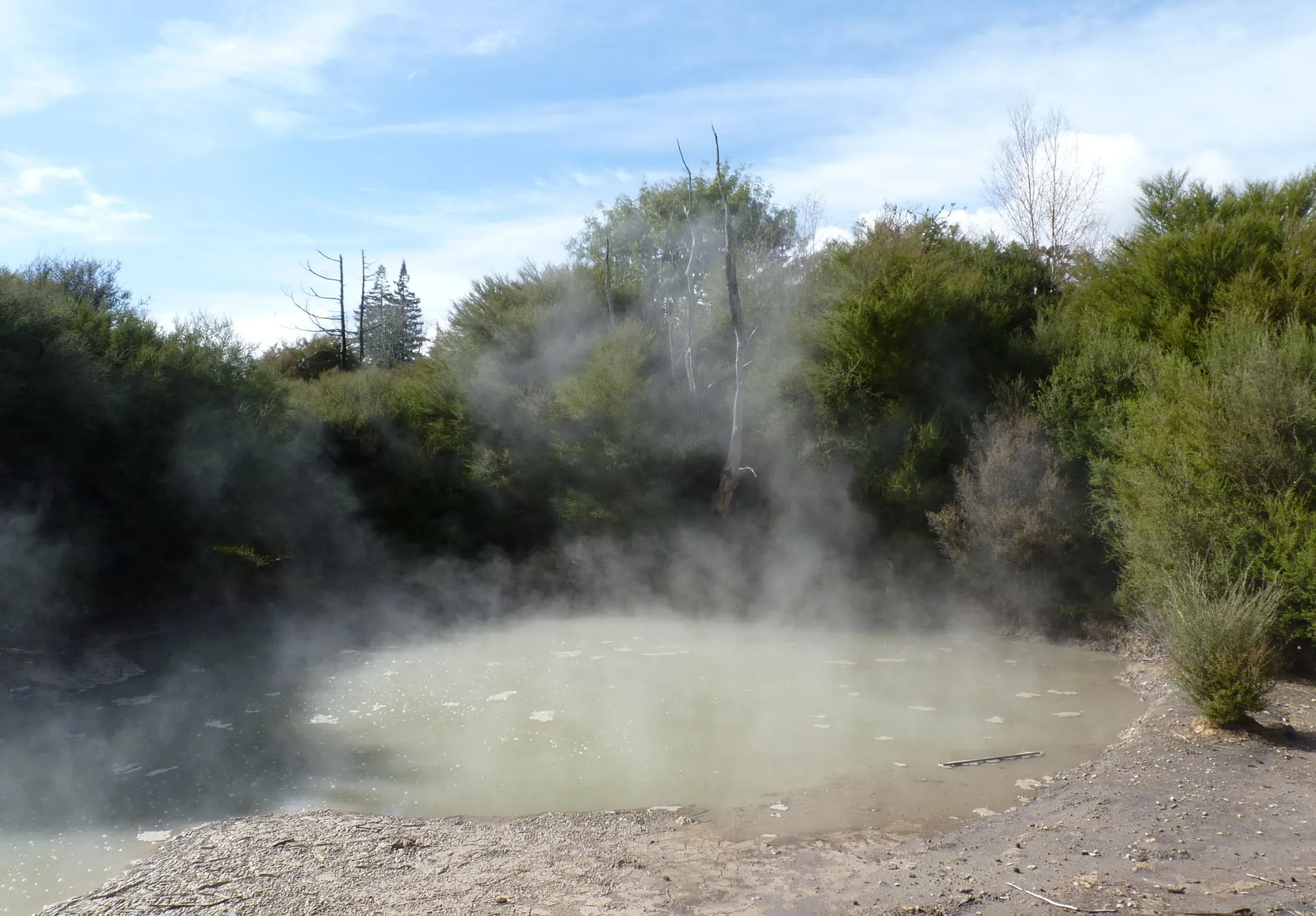
Tikitere, 15 minutes northeast: a mud volcano, the Kakahi Falls, and the only pools here you are allowed to get into. The walk takes 1 to 1.5 hours; the mud bath costs extra.

Photo: Pseudopanax · Public domain
Rotorua is the one town in New Zealand where steam comes out of the roadside. You notice it before you see anything: the rotten-egg smell hangs over the place, and after half an hour you stop registering it.
In the parks you walk on boardwalks and formed paths over ground that is undercut in many places. Gray mud plops on your left; on your right a pool stands in a green that looks like chemistry and is not. The Champagne Pool at Wai-O-Tapu is green, its sinter rim glows orange, and steam stands over the surface. Things hiss and gurgle, and in cool air the steam gets thick enough to swallow the path in front of you.
The Pōhutu geyser at Te Whakarewarewa is, according to Te Puia, the largest active geyser in the southern hemisphere: up to 20 eruptions a day, up to 30 meters (100 ft) high. There is no timetable. Over a 90-minute tour the odds are good, and afterwards you may stay in the valley until 5:30 p.m. and wait for the next one.
The other geyser Rotorua is known for works differently. Lady Knox at Wai-O-Tapu erupts daily at 10:15 a.m. because a staff member drops a surfactant into the vent. The operator consistently calls it a 'presentation' on its own pages. The jet is real; the timing is not. Knowing that in advance saves the disappointment afterwards.
Affiliate links to GetYourGuide: if you book, we earn a commission and the price stays the same. Prices and ratings as of 21 September 2026. Before you book, check whether park admission is included or whether you pay it on site.
Three parks in one day is too many – the entrances are up to 45 minutes apart by car, and after the third mud pool they all look alike. One paid park plus one free one makes a relaxed day. This table makes the choice for you.
| Wai-O-Tapu · NZD 47 | For color, and for a smaller budget. The Champagne Pool and the country's largest mud pool. Three loop walks, the shortest 30 minutes, one to two hours for all of them. 31 km (19 miles) south, a 27-minute drive. Daily 8:30 a.m.–4:30 p.m., last entry 3 p.m. Children 5 to 15 pay NZD 17, families NZD 115. The Lady Knox presentation at 10:15 a.m. has its own parking lot before the visitor center – which means being there by 9:45 a.m. There are no toilets inside the park, and no cash is accepted. |
| Te Puia · NZD 105 | For the geyser and the culture. Pōhutu erupts up to 20 times a day, up to 30 meters (100 ft) high. With it come the carving and weaving schools of the New Zealand Māori Arts and Crafts Institute and a kiwi enclosure. Daily 8:45 a.m.–5 p.m.; children 5 to 15 pay NZD 52.50. During the day: 'Entry into the valley is only via a guided tour.' The Te Rā walk runs 90 minutes and starts hourly between 9 a.m. and 4 p.m., after which you may stay until 5:30 p.m. Advance booking required, cashless, free parking. Not to be confused with neighboring Whakarewarewa Village – different business, different ticket. |
| Waimangu · NZD 99 instead of 180 | For landscape and quiet. About 4 km (2.5 miles) downhill past Frying Pan Lake and Inferno Crater to the jetty, then a 45-minute cruise on Lake Rotomahana and a shuttle bus back. Three to three and a half hours, daily 8:30 a.m.–5 p.m. The list price is NZD 180 for adults and NZD 99 for children 6 to 16; on 21 September 2026 a promotion was running at NZD 99 and 50. Note the cutoff: entry for the walk-and-cruise combination closes at 1:30 p.m., otherwise 3 p.m. Boat places are limited, and the operator calls bookings essential. |
| Hell's Gate · from NZD 45 | For mud you can touch. The only one of the four where you get into the pools yourself: mud bath from 2.5 years, sulfur pools from 6 months. Plus a mud volcano and the Kakahi Falls, which the operator calls the largest hot waterfall in the southern hemisphere. The Geothermal Walk costs NZD 45 and takes 1 to 1.5 hours, the mud bath NZD 90, the combination NZD 115. Daily 10 a.m.–6 p.m., and to 9 p.m. from 1 October 2026 to 30 April 2027. Fifteen minutes northeast of town, with a free shuttle from the center if you call ahead. Take your jewelry off first – the minerals tarnish silver. |
| Kuirau Park and co. · free | For anyone who does not want to pay. Kuirau Park is, according to New Zealand's official tourism organization, the country's only free geothermal public park: a crater lake, mud pools, hot springs and a free thermal foot bath – parking included, open at any hour. Add Sulphur Bay by the boardwalk behind the Bath House, the Government Gardens, and the public areas of Ōhinemutu. None of it is less active, only unmanaged. |
'Everything in Rotorua costs money' is not true. Four places are freely accessible, at any hour, with no ticket desk – and the best known of them is a five-minute walk from the main street.
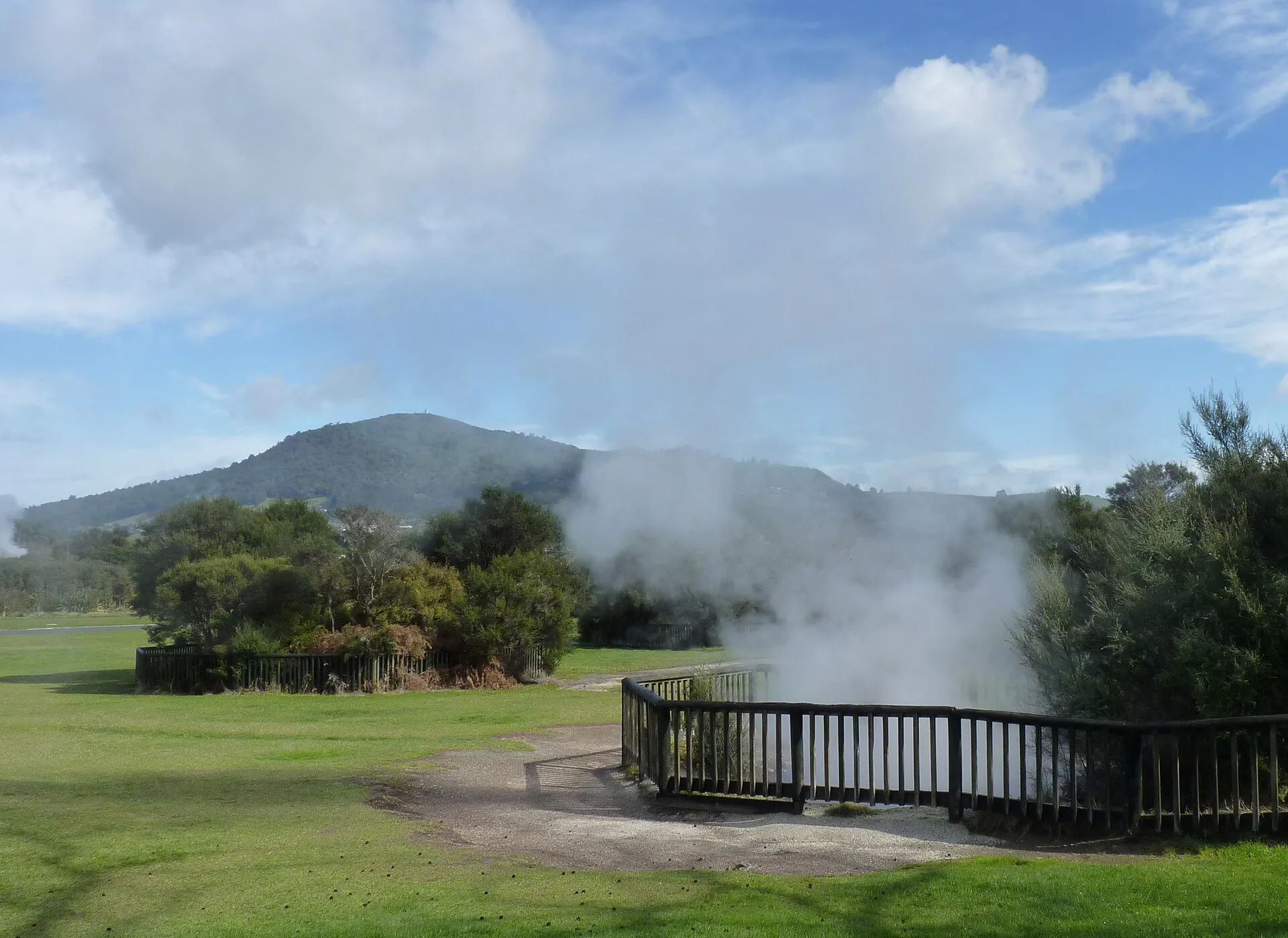
New Zealand's only free geothermal public park, right in town: a crater lake, mud pools, hot springs and a free thermal foot bath. There is a playground and there are toilets, and a market runs on Saturdays.
A 145-hectare (358-acre) wildlife refuge on the lakeshore, reached by the boardwalk behind the Bath House. The water is acidic (pH 3.5). Stay on the tracks: threatened birds breed here, among them the black-billed gull. Dogs are banned.
In the late nineteenth century local iwi gifted the Crown about 50 acres – explicitly 'for the benefit of the people of the world'. The Bath House opened here in 1908, the state's first major investment in tourism. The museum inside is closed for restoration.
A lived-in Māori village on the lake, occupied for more than 400 years, with Te Papaiouru Marae and steaming cracks between the houses. Public areas are freely accessible – provided you behave respectfully. It is not an open-air museum.

Photo: Michal Klajban · CC BY-SA 4.0
In Rotorua it is not the price of admission that decides whether the day works, it is the clock. Three parks have a last entry well before closing time – and Waimangu has a second, even earlier one for the combination with the boat cruise.
Wai-O-Tapu admits until 3 p.m. and closes at 4:30 p.m. Waimangu admits until 3 p.m., but only until 1:30 p.m. for the walk plus cruise. Te Puia starts its last tour at 4 p.m. and closes the gates at 5:30 p.m. Hell's Gate admits to the walk until 4 p.m. in winter. Set off at midday and half the day is already gone.
The Bay of Plenty Regional Council names collapse holes, subsidence, hydrothermal eruptions and gases as hazards of the geothermal field – off the paths the ground is undercut. Wai-O-Tapu words its conditions of entry so that a breach means immediate removal: supervise children, stay on formed paths and behind barriers, no smoking, no vaping, no drones, do not take rocks. And if a siren sounds for more than 30 seconds, head for the nearest assembly point.
Rotten eggs – that is hydrogen sulfide. The Bay of Plenty Regional Council writes that in enclosed or confined spaces the gas can reach lethal concentrations, while outdoors it disperses quickly, and that the risk is low for anyone careful in enclosed areas. A study in Rotorua found no worse lung function and no raised asthma or COPD risk at local levels. Still, avoid hollows and cavities.
| Wai-O-Tapu – adult 16 and over, including the Lady Knox presentation | NZD 47 |
| Wai-O-Tapu – child 5–15 · under 5 free | NZD 17 |
| Wai-O-Tapu – family, 2 adults + 2 or 3 children | NZD 115 |
| Wai-O-Tapu – shuttle from Rotorua i-SITE including entry | NZD 119 |
| Te Puia – Te Rā Guided Experience, adult · child 5–15 NZD 52.50 | NZD 105 |
| Te Puia – Te Pō, evening experience with hāngī buffet | NZD 203 |
| Te Puia – Mārama, evening walk with light installation | NZD 49 |
| Waimangu – walk + cruise, adult · list price NZD 180 | promotion NZD 99 |
| Hell's Gate – Geothermal Walk, adult / child / family | NZD 45 / 22.50 / 125 |
| Hell's Gate – Mud Bath and Spas, adult / child / family | NZD 90 / 45 / 250 |
| Hell's Gate – 'The Hell's Gate Experience' combo, adult | NZD 115 |
| Kuirau Park, Sulphur Bay, Government Gardens, Ōhinemutu | free |
Without a car: Te Puia: the Rotorua City Ride runs every 30 minutes until 6 p.m. from the stop opposite the Pullman Hotel, according to the operator. Wai-O-Tapu: a shuttle from Rotorua i-SITE (1167 Fenton Street) leaves at 9 a.m. and returns at 1:30 p.m.; as a package with entry it costs NZD 119. Intercity also serves the site. Hell's Gate: a free shuttle from the town center, booking on +64 7 345 3151, pickups at 9:50 a.m. and 1:50 p.m., return trips at 1:30 and 5:30 p.m. Kuirau Park and Sulphur Bay are walkable from the town center.
By car: Te Puia: free parking on site. Wai-O-Tapu: plenty of parking; at the Lady Knox Geyser most spaces are about 100 meters (330 ft) from the arena, with accessible parking outside the visitor center. Hell's Gate: ample space, including for campervans. Kuirau Park: free parking. Sulphur Bay: free in the Government Gardens or at the lakefront.
Cold mornings. The colder the air, the denser the steam – Waimangu openly promotes the cold season as the best time to come, because there are fewer people and the plumes stand hardest. To combine Wai-O-Tapu with the 10:15 a.m. Lady Knox presentation you need to be at the geyser by 9:45 a.m.; the rest of the day is then free for the park. For Waimangu with the boat cruise the morning is compulsory, because entry for the combination closes at 1:30 p.m. In summer Hell's Gate stays open until 9 p.m., which makes a sulfur bath at dusk possible.
257 km (160 miles) and a good three hours each way – Rotorua works as a day trip from Auckland, but it makes for a long day. Operators usually pair the drive with Hobbiton or the Waitomo caves and are out for 9 to 13 hours. Stay the night in Rotorua and you see more.
Affiliate links to GetYourGuide: if you book, we earn a commission and the price stays the same. Prices and ratings as of 21 September 2026. On a day trip from Auckland a large part of the day goes on the road. What is included is set out in each listing.

Photo: Krzysztof Belczyński · CC BY-SA 2.0
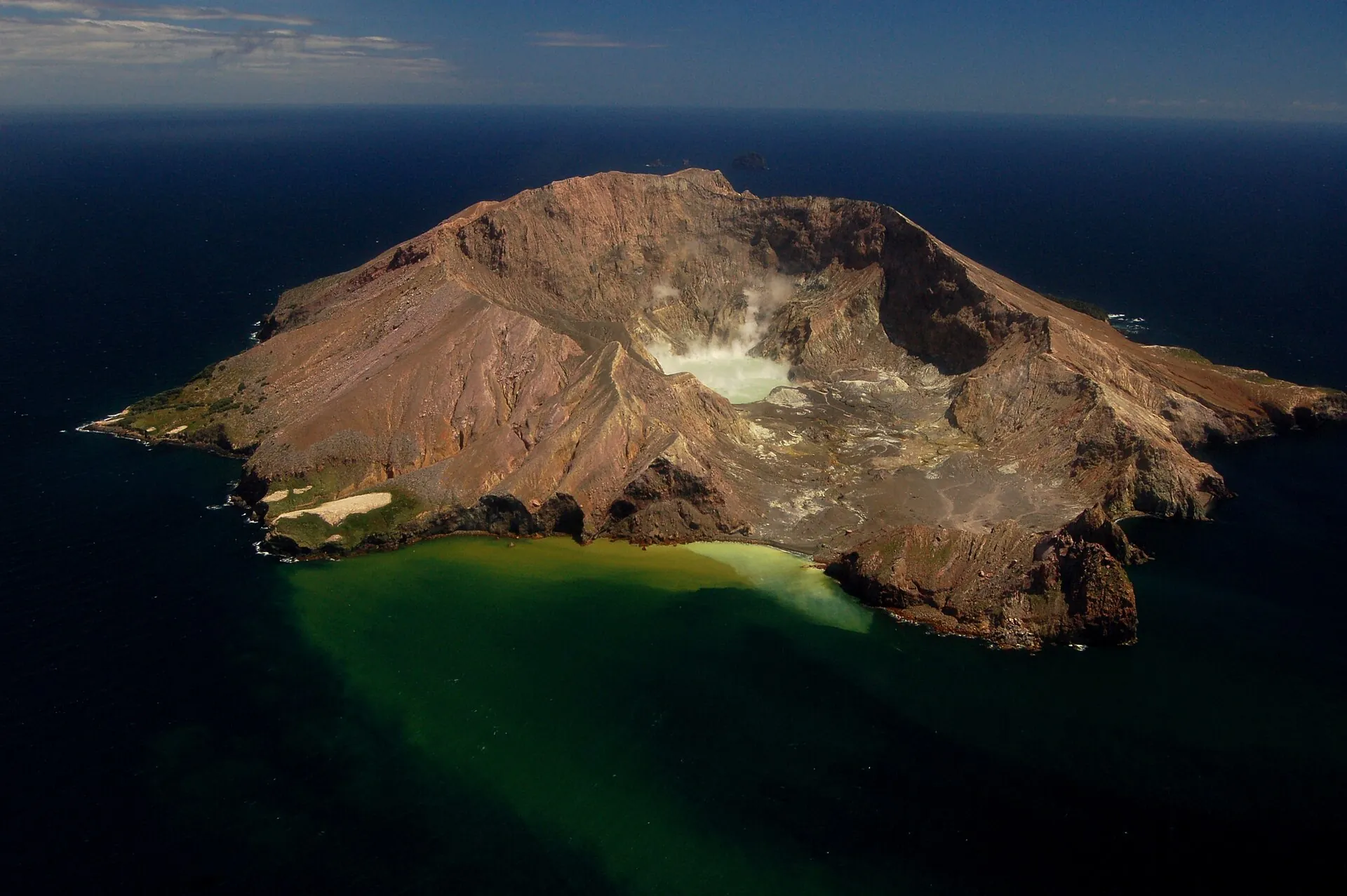
Whakaari lies 48 km (30 miles) off Whakatāne and is New Zealand's most active volcano. Until 2019 you could walk into its crater. At 2:11 p.m. on 9 December 2019 a phreatic explosion killed 22 people; 25 more were severely injured. Nobody has landed there since.
We cover the island here rather than on a page of its own for a simple reason: there is nothing bookable for Whakaari that we could point you to, and it would be wrong to pretend otherwise.
The legal position, briefly and plainly: after the eruption WorkSafe prosecuted thirteen parties. Six prosecutions were dropped, six defendants pleaded guilty, among them all the walking-tour operators. The owning company Whakaari Management Ltd was convicted in 2023 and sentenced in 2024 to a fine and reparation – and on 27 February 2025 the High Court quashed that conviction, holding that the company had neither managed nor controlled the walking-tour workplace. The convictions of the tour operators still stand.
There have been no commercial landings since 9 December 2019 – the official tourism organization of the Whakatāne District still states that no tours on the island are operating. There is, however, no government landing ban published as a regulation: the island is private property of the Buttle family, and since 1953 a private scenic reserve as well, and there never was a public right of access. Workplace safety comes on top of that.
On 21 September 2026 Whakaari sits at Volcanic Alert Level 2, color code Yellow. That does not mean the volcano is growing more restless right now: there have been no sensors on the island since the eruption, and in its bulletin of 3 September 2026 GeoNet states plainly that without instruments on site Level 1 and Level 2 cannot be told apart. So the level stays at 2 at minimum. Gas emissions have been falling since December 2024, and no eruption has been observed since March 2026.
Scenic flights leave from Whakatāne and from Rotorua and circle the crater from the air without landing; fishing and dive charters run in the surrounding waters. One operator quotes NZD 759 per adult from Whakatāne and NZD 1,250 from Rotorua, with a minimum booking of two adults – those are operator figures from 21 September 2026, not official prices, and everything depends on the weather. The free option is the view from the coast: on clear days the steam plume is visible from the Whakatāne Heads and Kōhī Point.
Two if you start early – and one and a half is more pleasant. Wai-O-Tapu in the south and Hell's Gate in the northeast are about three quarters of an hour apart by car, and each park wants one to three hours. The most relaxed combination: a paid park in the morning, then Kuirau Park or Sulphur Bay in the afternoon, both free and walkable from the town center.
Wai-O-Tapu if you want color and landscape: half the price, and you walk it on your own. Te Puia if the Pōhutu geyser and Māori culture matter more and you are happy on a guided tour – which is compulsory there during the day anyway. Wai-O-Tapu is 31 km (19 miles) out of town, Te Puia is on the edge of it.
Doable, yes; relaxed, no. 257 km (160 miles) and a good three hours each way means a 9- to 13-hour tour, of which only part is spent inside the thermal park. Stay a night in Rotorua and you manage two parks instead of half of one.
Yes, arguably better. No park closes for rain, and Hell's Gate even says rain increases activity and steam in the reserve; ponchos are available at the desk. Cold helps too: the cooler the air, the denser the plumes. Waimangu actively promotes the cold season.
Not on foot. There have been no landings since the eruption of 9 December 2019, and the official tourism organization of the Whakatāne District confirms that unchanged. What is possible: scenic flights from Whakatāne and Rotorua, fishing and dive charters in the surrounding waters, and the view from the coast.
On 21 September 2026 one operator quoted NZD 759 per adult and NZD 607 per child from Whakatāne, and NZD 1,250 and NZD 1,000 from Rotorua. At least two adults have to book. These are operator figures, not official prices, and every flight depends on the weather.
Because there have been no sensors on the island since the eruption. In its bulletin of 3 September 2026 GeoNet writes that without instruments on site Level 1 and Level 2 cannot be distinguished – so the level stays at 2 at minimum until equipment is back. Gas emissions have been falling since December 2024.
No. There are about 90 km (56 miles) of land plus 48 km (30 miles) of open sea in between. For a view of the steaming island you drive to Whakatāne – from the Whakatāne Heads and Kōhī Point the plume is visible on clear days, for free. Scenic flights also leave from Rotorua.
Wai-O-Tapu is the cheapest: NZD 47 for adults and NZD 17 for children aged 5 to 15. Te Puia costs NZD 105 for adults and NZD 52.50 for children, Hell's Gate NZD 45 for the geothermal walk. Waimangu tops the list at NZD 180 list price, though on 21 September 2026 it was running a promotional price of NZD 99.
Kuirau Park in the middle of town – New Zealand's only free geothermal public park according to the country's official tourism organization, with a crater lake, mud pools, hot springs and a free thermal foot bath. Plus Sulphur Bay with the boardwalk behind the Government Gardens, the Government Gardens themselves, the village of Ōhinemutu, and further out Maunga Kākaramea and the Te Kopia Walk.
It depends on what you are after. Wai-O-Tapu has the colors and the Champagne Pool, Waimangu the biggest landscape and the fewest people, Te Puia the Pōhutu geyser plus Māori culture and a kiwi enclosure, Hell's Gate the mud volcano and somewhere to bathe. With only one day, combine one paid park with Kuirau Park.
Pōhutu is the largest active geyser in the southern hemisphere according to Te Puia, erupting up to 20 times a day and up to 30 meters (100 ft) high. There is no fixed schedule, but the odds are good over a 90-minute tour – and afterwards you may stay in the valley until 5:30 p.m. and wait for the next one.
No. It is triggered every day at 10:15 a.m. with a surfactant; the operator calls it a 'presentation'. Be at the geyser parking lot, which sits before the visitor center, by 9:45 a.m. The jet reaches 10 to 20 meters (33–65 ft).
One to two hours. The shortest loop takes 30 minutes; allow more for all three walks. The park opens at 8:30 a.m., last entry is 3 p.m. and it closes at 4:30 p.m.
Te Puia requires advance booking, because the tours run hourly with limited places. Waimangu calls bookings essential for the walk-and-cruise combination, because boat capacity is limited. Wai-O-Tapu and Hell's Gate also sell on site but recommend booking online.
Not at Te Puia or Wai-O-Tapu – both are cashless and take cards and EFTPOS. Te Puia also accepts Apple Pay, Google Pay, WeChat Pay, Alipay, UnionPay and JCB.
The rotten-egg smell is hydrogen sulfide. The Bay of Plenty Regional Council writes that the gas disperses quickly outdoors and that the risk is low for anyone careful in enclosed areas; the danger lies in concentrations inside built or confined spaces. A Rotorua study found no evidence of worse lung function or more asthma and COPD at local levels.
Yes. Under 5 is free at Wai-O-Tapu, under 6 at Waimangu, and infants go free at Te Puia. Wai-O-Tapu explicitly requires constant supervision. At Hell's Gate the mud bath has a minimum age of 2.5 years and the sulfur pool 6 months.
The Rotorua City Ride serves Te Puia every 30 minutes until 6 p.m. from the stop opposite the Pullman Hotel. A shuttle runs daily to Wai-O-Tapu from Rotorua i-SITE at 9 a.m., returning at 1:30 p.m.; with entry that costs NZD 119. Hell's Gate picks up from the town center for free, by phone booking, at 9:50 a.m. and 1:50 p.m.
Not in the thermal parks – there the rule is to stay on the paths and behind the barriers. Built for bathing are the mud and sulfur pools at Hell's Gate, plus the spa businesses and the free but unmanaged Kerosene Creek south of town.
Rotorua lies in the Taupō Volcanic Zone. The most recent major eruption in the region was Mount Tarawera on the night of 10 June 1886, which killed more than 150 people, destroyed the Pink and White Terraces and created the Waimangu valley in the first place. GeoNet lists Rotorua at Volcanic Alert Level 0 on 21 September 2026.
Three to three and a half hours for the walk and the cruise. The track runs about four kilometers (2.5 miles) downhill to the jetty on Lake Rotomahana, the cruise takes 45 minutes, and a shuttle bus returns you to the entrance. Note that entry for this combination closes at 1:30 p.m.
Not at Wai-O-Tapu – drones sit alongside smoking and vaping on its list of prohibitions, and a breach means immediate removal. The other operators apply their own house rules; over public land New Zealand's civil aviation rules apply on top.
Sources · accessed on 21 September 2026