Volcano·Guide
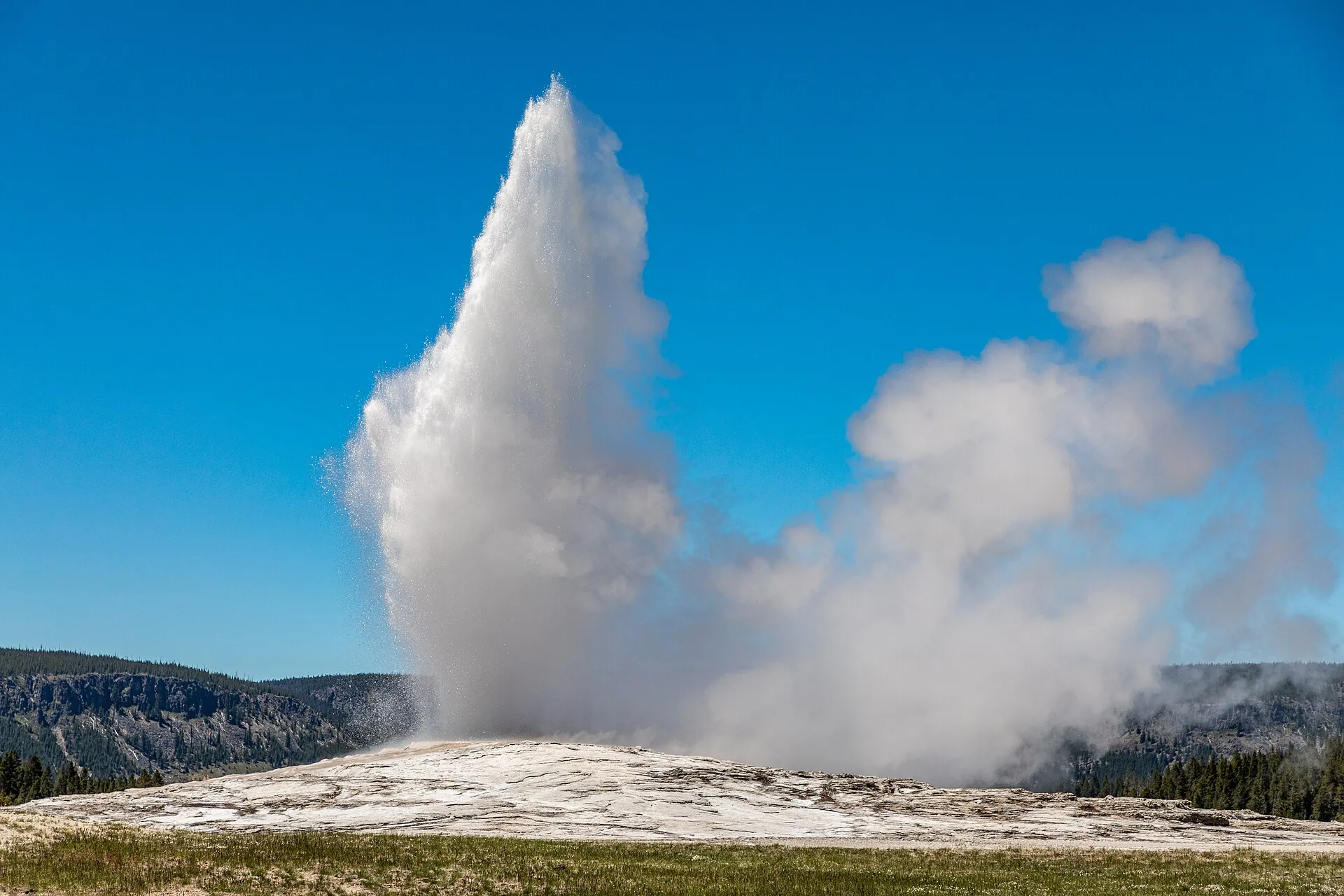
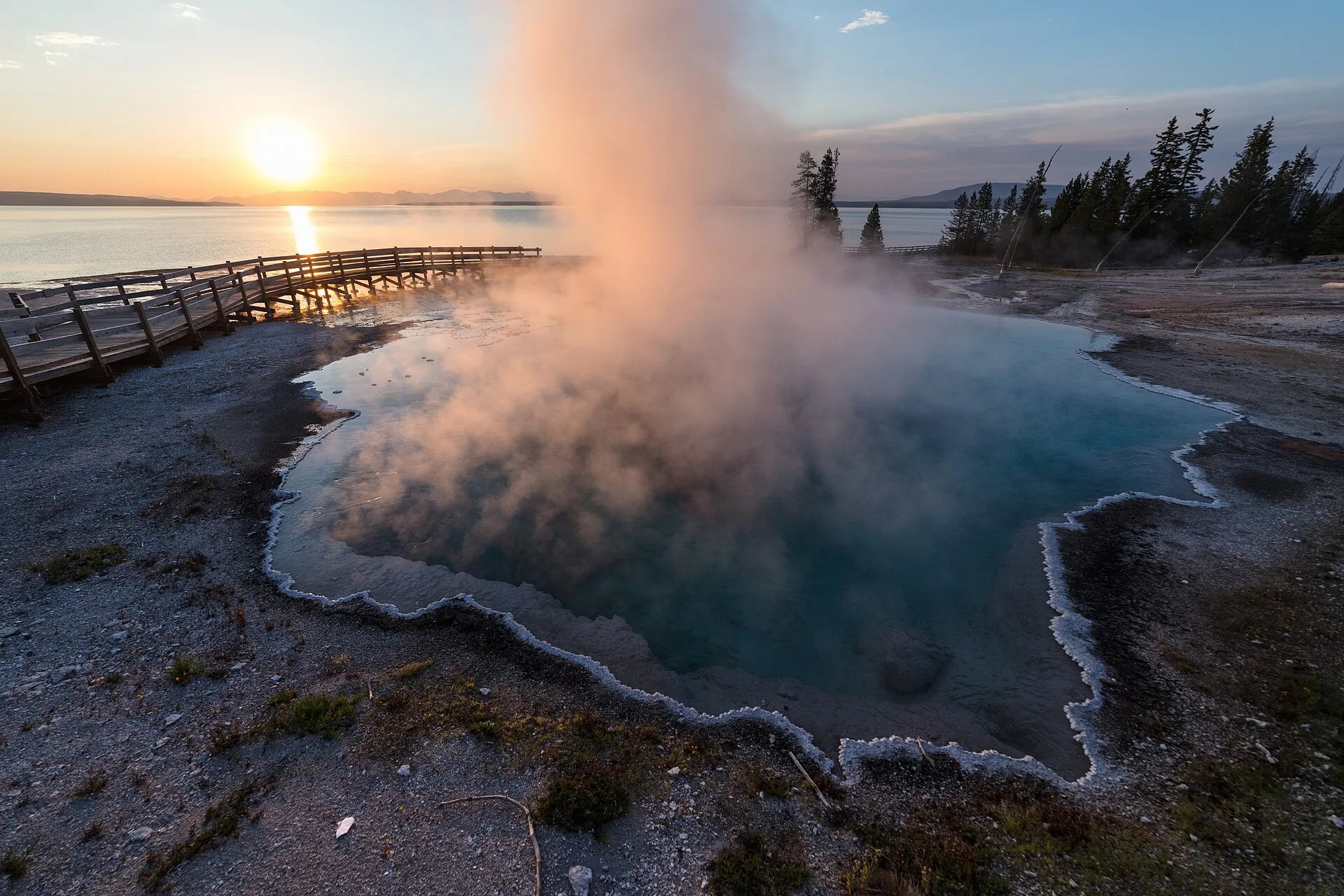
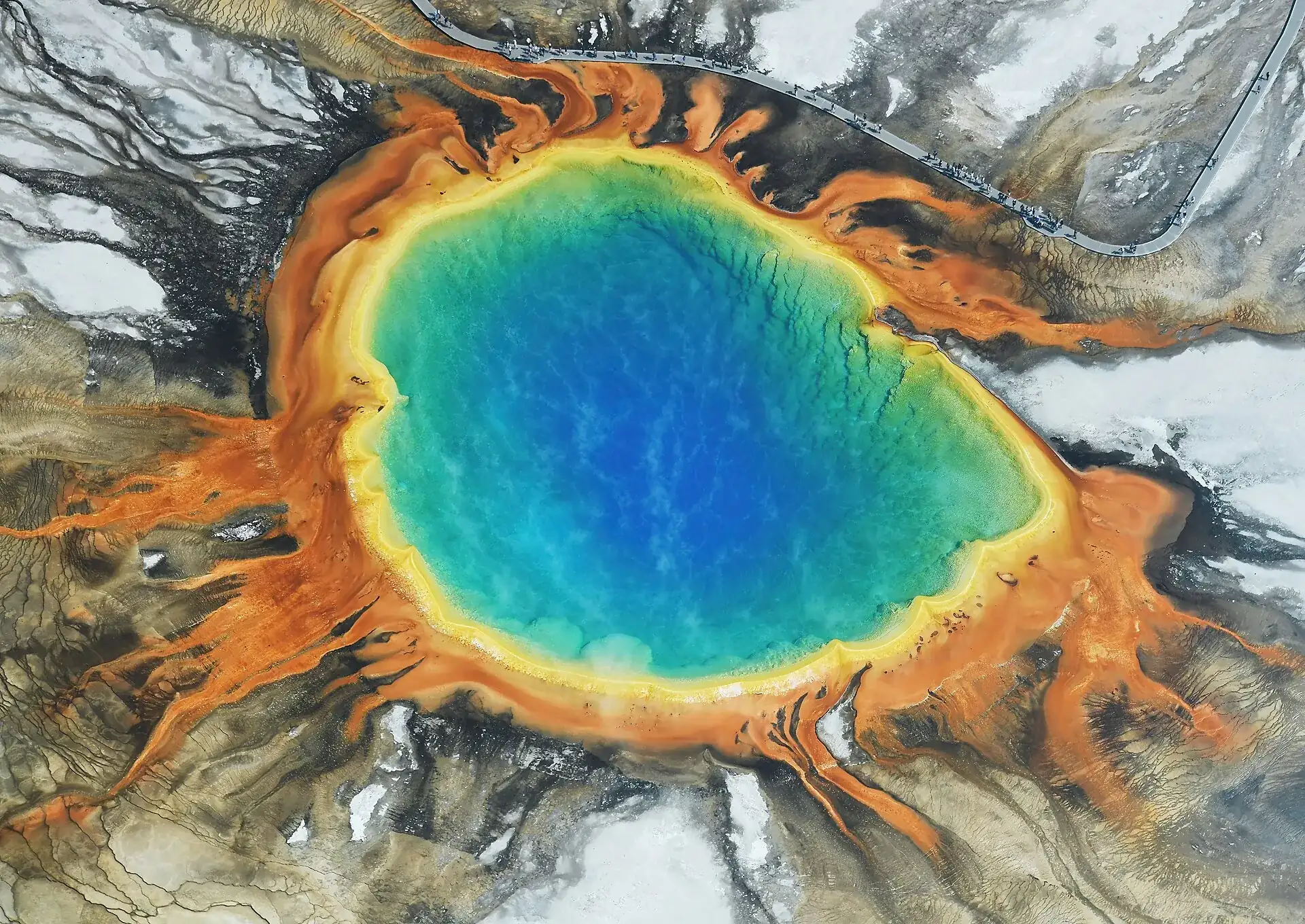
Black Pool in the West Thumb Geyser Basin of Yellowstone at sunrise: steam over the turquoise hot spring, with the boardwalk and Yellowstone Lake behind it Grand Prismatic Spring in Yellowstone seen from above: a blue-green center ringed by yellow and orange bacterial mats Old Faithful erupting in Yellowstone: a white column of water above the pale sinter mound against a blue sky

Yellowstone

Early in the morning the park is one large steam vent.

As the sun climbs, the colors come out.

And every 68 or 94 minutes, water shoots 106 to 184 ft into the air.

Scroll –
the steam thins out

As of 21 September 2026Yellowstone volcano status, closures and fees today

Yellowstone is not a mountain, it is a hole: a caldera roughly 30 by 45 miles (45 by 85 km) over one of the largest magma systems on Earth. Inside it are more than 10,000 hot springs, mud pots and fumaroles, including over 500 geysers – more than the rest of the world combined. The volcano alert level has read NORMAL / GREEN for years. Two other things will actually change your trip: one closed boardwalk loop, and a $100 per-person fee introduced on January 1, 2026.

NORMAL / GREEN
61quakes

The caldera

On September 1, 2026, the Yellowstone Volcano Observatory again reported NORMAL/GREEN. It located 61 earthquakes in August, the largest at magnitude 2.0. The uplift on the northern caldera rim that began in July 2025 ended in mid-January 2026.

USGS/NPS/University of Utah, monthly update of Sept 1, 2026
Closed

Biscuit Basin

The boardwalk and parking lot have been closed since the hydrothermal explosion of July 23, 2024. On June 13, 2026, a second, smaller explosion opened a 60 ft (18.5 m) fissure there. No reopening has been announced – leave it off your route.

Also closed: Boiling River, Firehole River Swim Area
Open
35USD

The five entrances

No timed entry, no reservation: you drive up and pay at the gate, in cash or by card. A private vehicle costs $35 for seven days. Visitors without US residency pay an extra $100 per person age 16 and up, in force since January 1, 2026.

per vehicle, 7 days · surcharge per person+$100
Guided only

Winter

From December 15, 2026 to March 15, 2027 the interior roads are open to oversnow vehicles only – guided snowcoach or snowmobile tours, or a self-guided permit from the lottery. In your own car you can then drive only from Gardiner to Mammoth and on to Cooke City.

non-commercially guided snowmobile permit, per day$40
Sources: YVO monthly update of September 1, 2026 · NPS pages “Fees,” “Park Roads” and “Alerts & Conditions” (as of August 31, 2026) · USGS on the Biscuit Basin explosion of June 13, 2026. Accessed 21 September 2026. All road and opening dates are weather dependent, the NPS says.
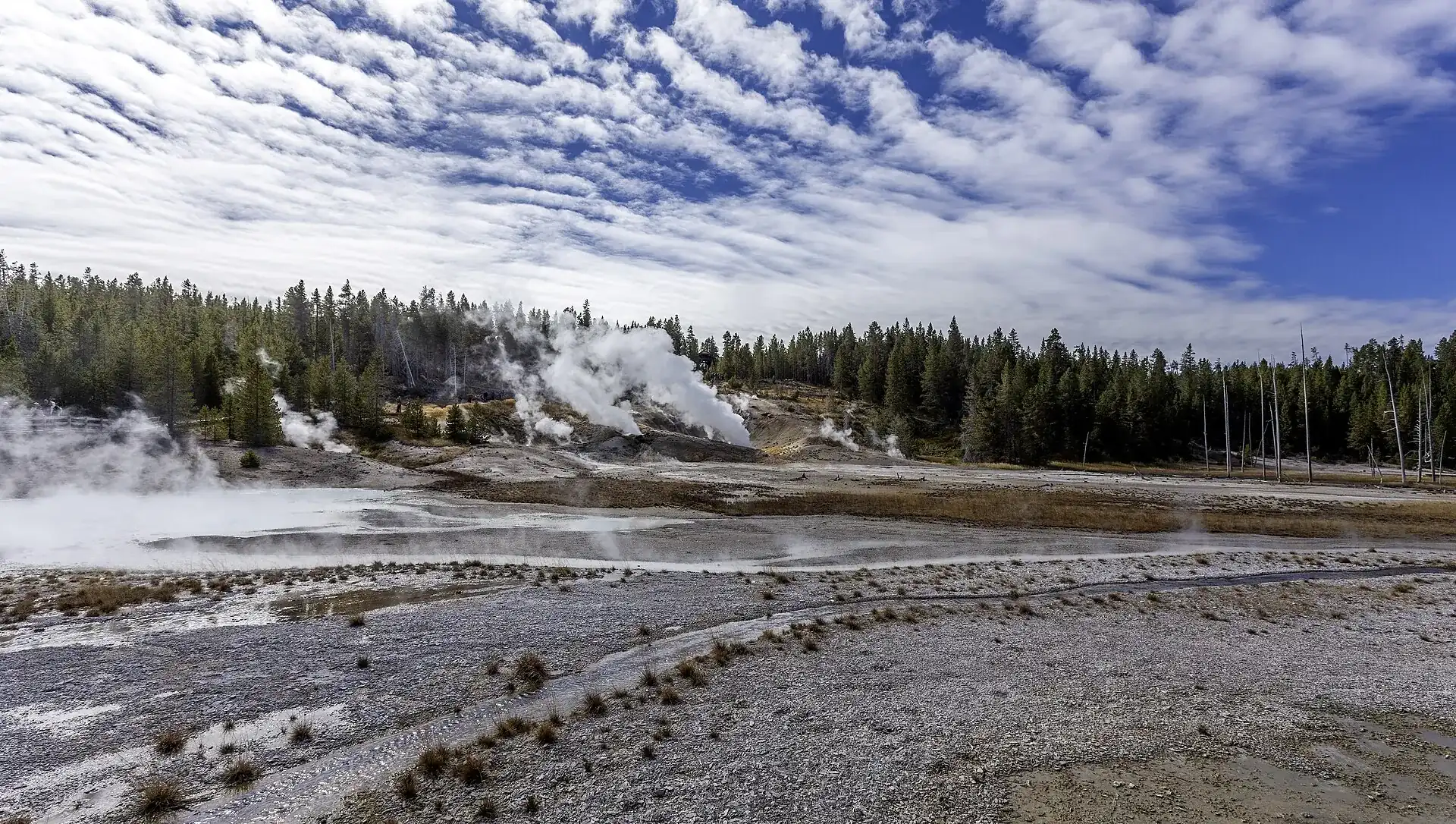
Porcelain Basin in the Norris Geyser Basin of Yellowstone: columns of steam above a white sinter flat, pine forest behind
The hottest ground in the park. You smell it before you see it.

Photo: Acroterion · CC BY-SA 4.0

What you actually seeGrand Prismatic, Old Faithful, Norris and Mammoth

Nobody climbs anything here. You walk on boardwalks, and the volcano works right under the planks: boiling water, sulfur in the air, ground that steams. Four areas carry the visit, and each one looks different depending on the hour.

Upper Geyser Basin. The densest concentration of geysers on Earth. Old Faithful is the best known, not the best: add 90 minutes, walk out to Morning Glory Pool, and you get ten more geysers and far fewer people. Depending on the loop, 30 minutes to 3 hours.

Midway Geyser Basin. About 0.6 miles (1 km) of boardwalk around Grand Prismatic Spring and Excelsior Geyser Crater, 30 to 45 minutes. From the boardwalk you mostly see steam. The famous ring of colors only appears from the higher Grand Prismatic Overlook, reached on foot from the Fairy Falls parking area.

Norris Geyser Basin. The hottest and most acidic thermal area in the park, loops of one to three hours. Steamboat Geyser stands here, the tallest active geyser in the world – its eruptions cannot be predicted. Waiting for it is luck, not planning.

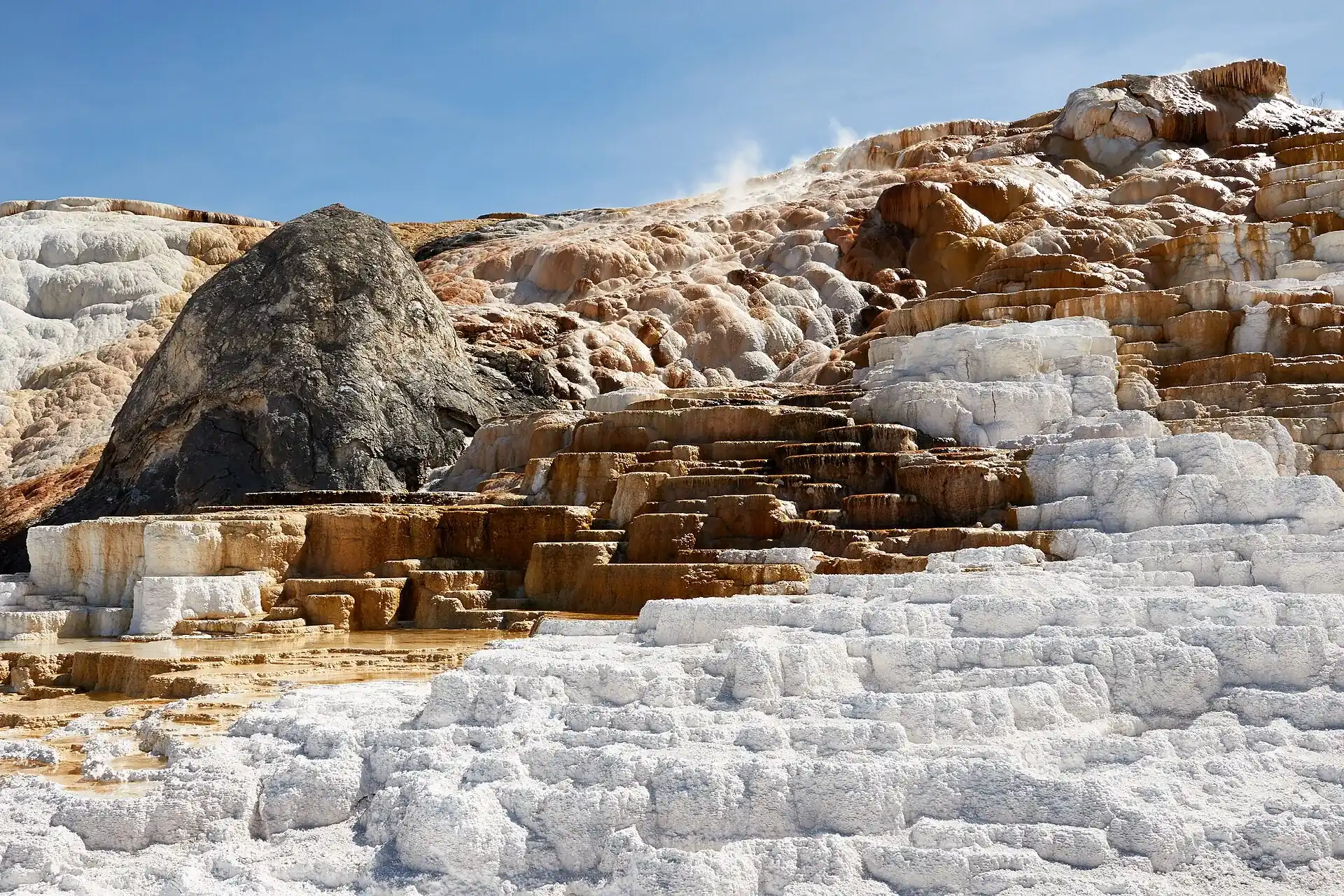
Mammoth Hot Springs. Travertine terraces rather than siliceous sinter, boardwalks with many stairs, one to two hours. Which terrace carries water shifts over the years; dry terraces are normal and not a sign of decline. Mammoth is the only one of the four you can reach by car all year.

Affiliate links to GetYourGuide: if you book, we earn a commission and the price stays the same. Prices and ratings as of 21 September 2026. Whether a geyser goes off while you are standing there is up to the ground – only six of the 500-plus are forecast at all.

The rulesYellowstone entrance fee 2026 and the nonresident fee

This is the point where almost every older guidebook is out of date. Since January 1, 2026, visitors from outside the US pay a surcharge at eleven national parks – and Yellowstone is one of them.

1

$100 per person age 16 and up

The surcharge is charged on top of the normal entrance fee, and it is per person, not per vehicle. Residency is checked at the gate. Besides Yellowstone it applies at Acadia, Bryce Canyon, Everglades, Glacier, Grand Canyon, Grand Teton, Rocky Mountain, Sequoia & Kings Canyon, Yosemite and Zion.

2

The $250 pass waives it

Since early 2026 the America the Beautiful annual pass costs $250 for non-residents instead of $80. In return the surcharge is waived and entry to all federal recreation areas is included, for twelve months.

3

No timed entry, cash accepted

Unlike Arches or Rocky Mountain, Yellowstone has no timed-entry system: just drive up. And unlike many US parks it still takes cash at all five entrance stations, according to its own fee page – a card simply moves the line faster.

Official fees · as of 09/2026
Private vehicle, 7 days$35
Motorcycle, 7 days$30
Pedestrians and cyclists age 16 and up, 7 days$20
Nonresident fee, age 16 and up, on top of the entrance fee$100
Yellowstone annual pass$70
America the Beautiful annual pass, US residents$80
America the Beautiful annual pass, non-US residents – waives the surcharge$250
Non-commercially guided snowmobile permit, per day · plus a $6 application fee$40
For visitors from outside the US: two adults, one car, seven days
Entrance fee for the vehicle, 7 days$35
Nonresident fee, 2 × $100$200
Total for this one visit$235
Instead: one America the Beautiful pass for non-residents, twelve months, all federal parks$250
For Yellowstone alone the pass costs $15 more than paying once. It pays off from the second surcharge park onward – and Grand Teton National Park adjoins Yellowstone to the south. With three people in the car it almost always pays off. Sources: nps.gov/yell – Fees and nps.gov – Nonresident Fees, accessed 21 September 2026.

The rule that matters mostWhy you stay on the boardwalk in Yellowstone

The danger in Yellowstone is not the magma, it is the water above it. Next to the springs the sinter crust is often thin, with superheated water underneath. The National Park Service counts more than 20 deaths from scalding. In thermal areas you may walk on boardwalks and marked trails only – and pets have to stay out entirely, including carried, in a backpack or in a stroller.

Stepping off is not a parking ticket. It is a federal petty offense, “thermal trespass,” and the US Attorney's Office in Wyoming charges it regularly. Two sentences show what that means.

5days in jail

Sentence of March 31, 2026

A 50-year-old visitor from Texas had walked directly on the sinter formations at Mammoth Hot Springs on November 8, 2025 – Canary Spring, Mound Terrace, Palette Hot Spring, Jupiter Terrace. A US magistrate judge sentenced him to five days in jail; the court imposed no fine.

Reported by the US Attorney's Office, Wyoming, and local press
7days in jail

Sentence of June 4, 2024

A 21-year-old from Washington had stepped off the boardwalk at Steamboat Geyser in the Norris Geyser Basin on April 19, 2024. The sentence: seven days in jail, a two-year ban from the park and over $1,500 in fines and fees.

A poor trade for a better photo
The NPS pages do not state a maximum fine; the figures above come from these two specific cases. The official press release on the March 31, 2026 sentence returned no text when we accessed it on 21 September 2026, so the details come from trade press. Basis for the boardwalk rule: nps.gov/yell – Safety.

Ways across the groundThe four big thermal areas and winter access

Every boardwalk is covered by the entrance fee and none of them needs a reservation. What differs is length, season and what you end up looking at.

Area → trail, time, 2026 season
Upper Geyser Basin (Old Faithful)Boardwalks and paved paths from the Old Faithful visitor center, 30 minutes to 3 hours depending on the loop: Old Faithful, Castle, Grand, Riverside, Daisy, Morning Glory Pool. Road access April 17 to October 31, 2026; in winter by oversnow vehicle only.
Midway Geyser Basin (Grand Prismatic Spring)About 0.6 miles (1 km) of boardwalk as a loop, roughly 30–45 minutes, from the parking area on Grand Loop Road. For the colors, walk up to Grand Prismatic Overlook starting at the Fairy Falls lot. Madison–Old Faithful road April 17 to October 31, 2026.
Norris Geyser BasinPorcelain Basin and Back Basin with Steamboat Geyser, loops of 1 to 3 hours. The Mammoth–Norris and Norris–Canyon roads open April 17, 2026; the museum runs May 17 to October 3, 2026.
Mammoth Hot Springs TerracesBoardwalks with many stairs, 1–2 hours: Canary Spring, Palette Spring, Jupiter Terrace, Mound Terrace. The only one of the four reachable by car year-round, through the North Entrance at Gardiner.
Winter access by snowcoach or snowmobileFrom West Yellowstone, Mammoth, Flagg Ranch or Cody to Old Faithful and Canyon, as a day trip or staying at the Old Faithful Snow Lodge. Oversnow season December 15, 2026 to March 15, 2027. Travel hours 7 am to 9 pm (east and south gates from 8 am), speed limit 35 mph, and the group must stay within a third of a mile of the lead vehicle.

SeasonWhen Yellowstone roads open and close in 2026

The park itself is open around the clock – the roads are not. If you come in May or October, plan with this table rather than with a map.

Road section → 2026 opening and closing (weather dependent)
April 17, 2026West Yellowstone–Madison, Madison–Old Faithful, Madison–Norris, Mammoth–Norris, Norris–Canyon
May 1, 2026East Entrance–Fishing Bridge over Sylvan Pass
May 8, 2026South Entrance–West Thumb, the West Thumb sections, Tower-Roosevelt–Tower Fall
May 22, 2026Canyon–Tower Fall over Dunraven Pass, Beartooth Highway, Chief Joseph Scenic Byway
October 12, 2026Dunraven Pass, Beartooth Highway and Chief Joseph Scenic Byway close
October 31, 2026All remaining sections close to cars
open year-roundNorth Entrance Gardiner – Mammoth – Tower – Northeast Entrance Cooke City only
Source: nps.gov/yell – Park Roads, accessed 21 September 2026. Visitor centers in 2026: Albright at Mammoth year-round, Old Faithful and Canyon April 17 to October 31, Norris and Grant May 17 to October 3. The NPS still lists the winter hours for Old Faithful and Canyon as undecided.
The travertine terraces of Mammoth Hot Springs in Yellowstone: white and orange-brown steps, a dark rock outcrop on the left
White means dry, orange means water. Which step is running is not up to you.

Photo: Frank Schulenburg · CC BY-SA 4.0

Good to knowGetting there, best time to go, tips

Getting there

Without a car: There is no scheduled service into the park. Nearest airports: Bozeman (BZN) and West Yellowstone (WYS) to the north and west, Jackson Hole (JAC) to the south, Cody (COD) to the east, Billings (BIL) to the northeast, Idaho Falls (IDA) to the west. A rental car is effectively mandatory.

By car: Parking is free everywhere and covered by the entrance fee, but between 10 am and 4 pm the lots at Midway Geyser Basin, Grand Prismatic Overlook, Old Faithful and Artist Point are regularly full. There is no RV site without a reservation in summer.

  • From Bozeman (MT) · about 1.5–2 hours
    US 191 to West Yellowstone (West Entrance) or US 89 via Livingston to Gardiner (North Entrance, open year-round)
  • From Jackson (WY) · about 1.5 hours to the south gate (May to early November only)
    US 89/191 through Grand Teton National Park to the South Entrance
  • From Salt Lake City (UT) · about 5–6 hours
    I-15 to Idaho Falls, then US 20 to West Yellowstone
  • From Cody (WY) · about 1.5 hours (East Entrance May 1 to October 31, 2026 only)
    US 14/16/20 over Sylvan Pass to the East Entrance
  • From Billings (MT) · about 3.5 hours; Beartooth Highway May 22 to October 12, 2026 only
    via Red Lodge and the Beartooth Highway to the Northeast Entrance

Best time to go

For the thermal areas, early morning is unbeatable: cold air means a lot of steam and few people. For colors (Grand Prismatic) it is the opposite – midday in sunshine, because the steam is thinner then. Best months: mid-May to mid-June (almost all roads open, light crowds, newborn wildlife) and September to mid-October (clear air, cold nights, fewer visitors). July and August are the busiest. To see steam and snow together, come in winter – but then only guided oversnow vehicles reach the park interior.

Who it suits

Children
Very well suited – the thermal areas are boardwalks with no climbing. The NPS asks explicitly that children be kept close and not allowed to run on the boardwalks.
Minimum age
none
Fitness
Normal walking ability is enough for the big thermal areas. Elevations are mostly between 6,900 and 7,900 ft (2,100 and 2,400 m); you notice that on longer hikes.
Altitude
At road elevations up to nearly 8,900 ft (2,700 m) at Dunraven Pass this is usually unproblematic, but the air is drier and thinner than you are used to – drink a lot.
Wheelchair
Parts of the boardwalks are built to be accessible, others are not – we did not verify the details, see “unsicher.”
Dogs
Pets are entirely banned in thermal areas and on boardwalks, including carried, in a stroller or in a backpack. The reason is fatal scalding. Service animals are exempt but must stay leashed.
Clothing
Layers. Even in July it can be near freezing in the morning and above 77 °F (25 °C) at midday. Rain gear, sun protection, and insect repellent in early summer.
Footwear
sturdy shoes are enough; boardwalks do not call for hiking gear

Tips you will need on site

  • If you are coming from abroad and plan to visit more than two of the eleven surcharge parks, do the math: the $250 non-resident pass waives the $100 surcharge and covers entry. With three people in the car, or two affected parks, it almost always pays off.
  • Geyser predictions are in the official NPS app, on a recorded phone line and on GeyserTimes.org – the forecast geysers are Old Faithful, Castle, Grand, Daisy, Riverside and Great Fountain.
  • Old Faithful is not the best thing in the Upper Geyser Basin. Add 90 minutes and walk out to Morning Glory Pool for ten more geysers and far fewer people.
  • For Grand Prismatic in color, do not stop at the boardwalk – hike up to the Grand Prismatic Overlook from the Fairy Falls parking area. From below you mostly see steam.
  • Do not plan on Biscuit Basin at all. It has been closed since July 2024 and was still closed in September 2026.
  • Fill the tank before it drops below half. Between gas stations in the park you can easily face 37 miles (60 km) of two-lane road with a bison jam.
  • Cell service exists only in spots (Old Faithful, Mammoth, Canyon, Grant). Download maps and forecasts offline before you go.
  • In winter the North Entrance at Gardiner is the only way in you can use with your own car – as far as Mammoth and on to Cooke City.

A short history

  • People have used the region for more than 11,000 years; 27 Indigenous nations have a documented connection to the area today.
  • About 2.1 million years ago the Huckleberry Ridge eruption created a caldera roughly 47 miles (75 km) across – the largest of the three known major eruptions.
  • Around 1.3 million years ago came the Mesa Falls eruption, and about 640,000 years ago the Lava Creek eruption, which formed today's caldera of about 30 by 45 miles (45 by 85 km).
  • There has been no magmatic eruption since; the youngest lava flow, the Pitchstone Plateau, is roughly 77,000 years old.
  • In 1872 the US Congress declared Yellowstone the world's first national park – the origin of the national park idea itself.
  • On July 23, 2024, a hydrothermal explosion at Black Diamond Pool destroyed the boardwalk at Biscuit Basin; according to the YVO analysis the cause was water flashing to steam in the shallow hydrothermal system, not magma.
  • On June 13, 2026 at 5:09 am MDT a second, smaller explosion occurred at Biscuit Basin, north of Black Diamond Pool; it opened a fissure 60 ft (18.5 m) long, and by June 16 subsidence had created a new boiling pool about 21 by 17 ft (6.5 by 5.3 m). Nobody was hurt, because the area has been closed since 2024.
  • Since January 1, 2026, visitors without US residency have paid a $100 surcharge per person age 16 and up at Yellowstone – one of eleven parks where the rule applies.

If you would rather not driveYellowstone day tours from Jackson, Bozeman and beyond

No scheduled bus runs into the park. Without a rental car you need a tour, and almost all of them start outside the boundary. What is included is listed in each description.

Affiliate links to GetYourGuide: if you book, we earn a commission and the price stays the same. Prices and ratings as of 21 September 2026.

The question everyone asksIs the Yellowstone supervolcano going to erupt soon?

Nothing points that way. The “high threat” rating in the USGS National Volcano Early Warning System describes what an eruption would do, not how likely it is. Three caldera-forming eruptions are known; the last was about 640,000 years ago, and the youngest lava flow is roughly 77,000 years old.

What is running today is the hydrothermal system: water heated by hot rock. According to the YVO analysis, the Biscuit Basin explosions of 2024 and 2026 had exactly that cause – water flashing to steam in the shallow subsurface, not magma. For visitors the alert level has no practical meaning. The real hazards are hot water, thin sinter crust and wildlife.

  1. 2.1 million years agoHuckleberry Ridge

    The largest of the three known major eruptions. It left a caldera about 47 miles (75 km) across.

  2. 1.3 million years agoMesa Falls

    The second caldera-forming eruption.

  3. 640,000 years agoLava Creek

    The third – it created today's caldera of about 30 by 45 miles (45 by 85 km). No caldera-forming eruption since.

  4. about 77,000 years agoPitchstone Plateau

    The youngest lava flow in the park. There has been no magmatic eruption at all since then.

Sources: USGS – Yellowstone and YVO Volcano Updates, accessed 21 September 2026. The current status is posted there at the start of each month.

Outdated onlineWhat other sites get wrong

“Yellowstone is about to erupt.”
The supervolcano reads NORMAL/GREEN, last confirmed on September 1, 2026. “High threat” describes the consequences, not the probability. There has been no caldera-forming eruption for 640,000 years and no lava at all for about 77,000 years.
“Entry is $35 per car and that is it.”
Not for visitors from outside the US. Since January 1, 2026, another $100 per person age 16 and up is charged. A family of four from abroad pays up to $235 – or buys the $250 annual pass.
“Biscuit Basin and Sapphire Pool belong on every Yellowstone itinerary.”
The boardwalk and parking lot have been closed since July 23, 2024, and a second explosion hit the area on June 13, 2026. As of September 2026 no reopening had been announced.
“Old Faithful erupts every hour.”
The NPS gives intervals of 68 or 94 minutes with about ten minutes of uncertainty, and states plainly that the geyser has never erupted hourly. Six geysers are forecast at all – the times are in the NPS app and on GeyserTimes.org.
“You need a timed-entry ticket like at Arches.”
Yellowstone has no timed-entry system. You drive to one of the five gates and pay there, in cash or by card.
“In winter you can drive a rental car to Old Faithful.”
From mid-December to mid-March every interior road is open to oversnow vehicles only. By car you can reach Mammoth from the North Entrance and continue to Cooke City, and that is all.

Quick answersBefore you go to Yellowstone

Is Yellowstone a volcano?

Yes, but one without a summit. The park sits inside a caldera about 30 by 45 miles (45 by 85 km) over one of the largest magma systems on Earth. You see the volcano as geysers, hot springs, mud pots and fumaroles rather than as a mountain – the park counts more than 10,000 of them.

What does Yellowstone cost for visitors from outside the US in 2026?

$35 for a private vehicle (seven days) plus $100 per person age 16 and up without US residency. Two adults therefore pay $235. The America the Beautiful pass for non-residents costs $250, waives the surcharge and is valid for twelve months in all federal parks.

How much time do you need for the geysers?

Plan three full days for the four big thermal areas – Upper Geyser Basin, Midway, Norris and Mammoth. The Grand Loop Road is about 142 miles (230 km) long, and bison jams are the rule, not the exception.

What is the best time of day for the thermal areas?

For steam and empty boardwalks, early morning: cold air means a lot of steam. For the colors of Grand Prismatic, the middle of the day in sunshine, because the steam is thinner then.

Can you visit Yellowstone in an RV?

Yes, but without reservations it gets tight in summer: campgrounds run mostly through Recreation.gov, and lodges inside the park are often booked a year ahead. Between 10 am and 4 pm the lots at Midway, Grand Prismatic Overlook, Old Faithful and Artist Point are regularly full.

Which entrance is best for the geysers?

The West Entrance at West Yellowstone: Old Faithful and Grand Prismatic are closest from there. For Mammoth Hot Springs or a winter trip, the North Entrance at Gardiner – the only one open to cars all year.

What does it cost to enter Yellowstone National Park in 2026?

A private vehicle costs $35 for seven days, a motorcycle $30, and pedestrians and cyclists age 16 and up $20. Visitors without US residency have paid an extra $100 per person age 16 and up since January 1, 2026. The Yellowstone annual pass costs $70.

Do visitors from outside the US have to pay the $100 fee at Yellowstone?

Yes, if you are 16 or older and do not have US residency. Yellowstone is one of eleven parks with this surcharge – alongside Acadia, Bryce Canyon, Everglades, Glacier, Grand Canyon, Grand Teton, Rocky Mountain, Sequoia & Kings Canyon, Yosemite and Zion. The $250 annual pass for non-residents waives it.

Is the $250 non-resident pass worth it?

It replaces the entrance fee at all federal recreation areas and waives the $100 surcharge. For two adults visiting only Yellowstone it costs $15 more than paying once ($235). From the second surcharge park onward, or with three people in the car, it pays off.

Do you need a reservation or a timed entry for Yellowstone?

No. Yellowstone has no timed-entry system. You drive to one of the five gates and pay there, in cash or by card. Only lodging and campgrounds need reserving – and often months ahead.

When are Yellowstone's roads open in 2026?

Most roads open on April 17, 2026, the East Entrance on May 1, the South Entrance on May 8, and Dunraven Pass and the Beartooth Highway on May 22. They close on October 12 (high passes) and October 31. The only year-round route is Gardiner–Mammoth–Cooke City.

Has Biscuit Basin reopened?

No. The boardwalk and parking lot have been closed since the hydrothermal explosion of July 23, 2024. On June 13, 2026 a second, smaller explosion opened a new fissure 60 ft (18.5 m) long. As of September 2026 no reopening had been announced.

How dangerous are the hot springs in Yellowstone really?

Very. The crust beside the springs is often thin, with superheated water underneath. The NPS counts more than 20 deaths from scalding. So: stay on the boardwalks, do not swim, touch nothing.

What happens if you step off the boardwalk in Yellowstone?

It is a federal offense. In March 2026 a federal court in Wyoming imposed five days in jail for it; in 2024 the sentence was seven days in jail, a two-year park ban and more than $1,500 in fines and fees.

How reliable is Old Faithful?

Very reliable, but not hourly. The NPS gives intervals of 68 or 94 minutes with about ten minutes of uncertainty, roughly 17 eruptions a day, lasting 1.5 to 5 minutes and reaching 106 to 184 ft (32 to 56 m). Current predictions are in the NPS app and on GeyserTimes.org.

Is the Yellowstone supervolcano going to erupt soon?

Nothing points that way. On September 1, 2026 the Yellowstone Volcano Observatory again reported NORMAL/GREEN, with 61 small earthquakes in August, the strongest at magnitude 2.0. The last major eruption was about 640,000 years ago and the youngest lava flow about 77,000 years old.

Does Yellowstone take cash?

Yes. The park's fee page lists cash as well as credit and debit cards for all five entrance stations. A card still moves the line faster.

Are dogs allowed on the boardwalks?

No. Pets are completely banned in thermal areas and on boardwalks – including carried, in a backpack or in a stroller. Service animals are exempt but must stay leashed.
Sources · accessed on 21 September 2026