1
There is no ticket office on the mountain
Tickets are sold online only, by time slot, 30 days ahead. No more than 360 people per hour are allowed up. How to book the right ticket.
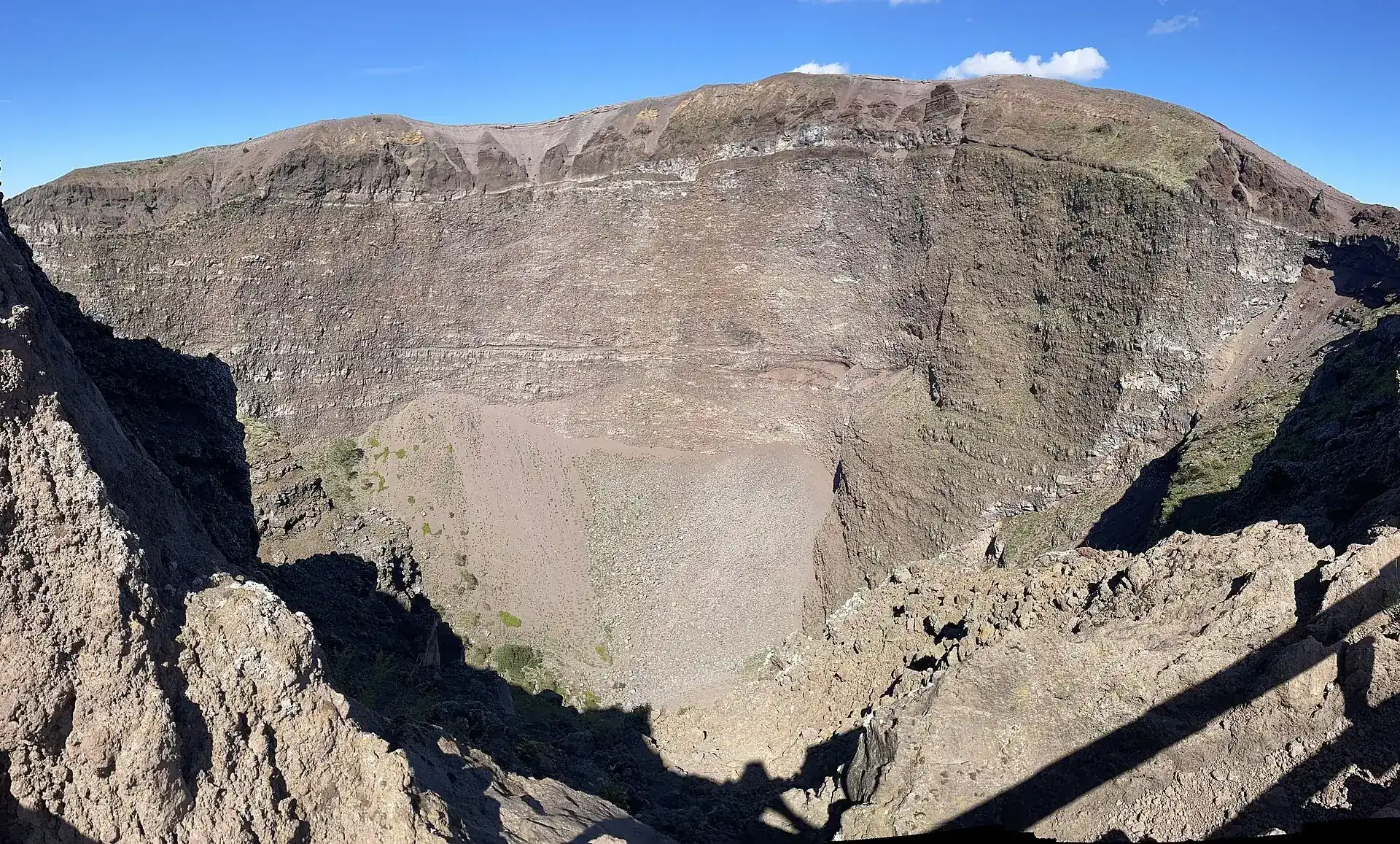
Then the ground
stops.
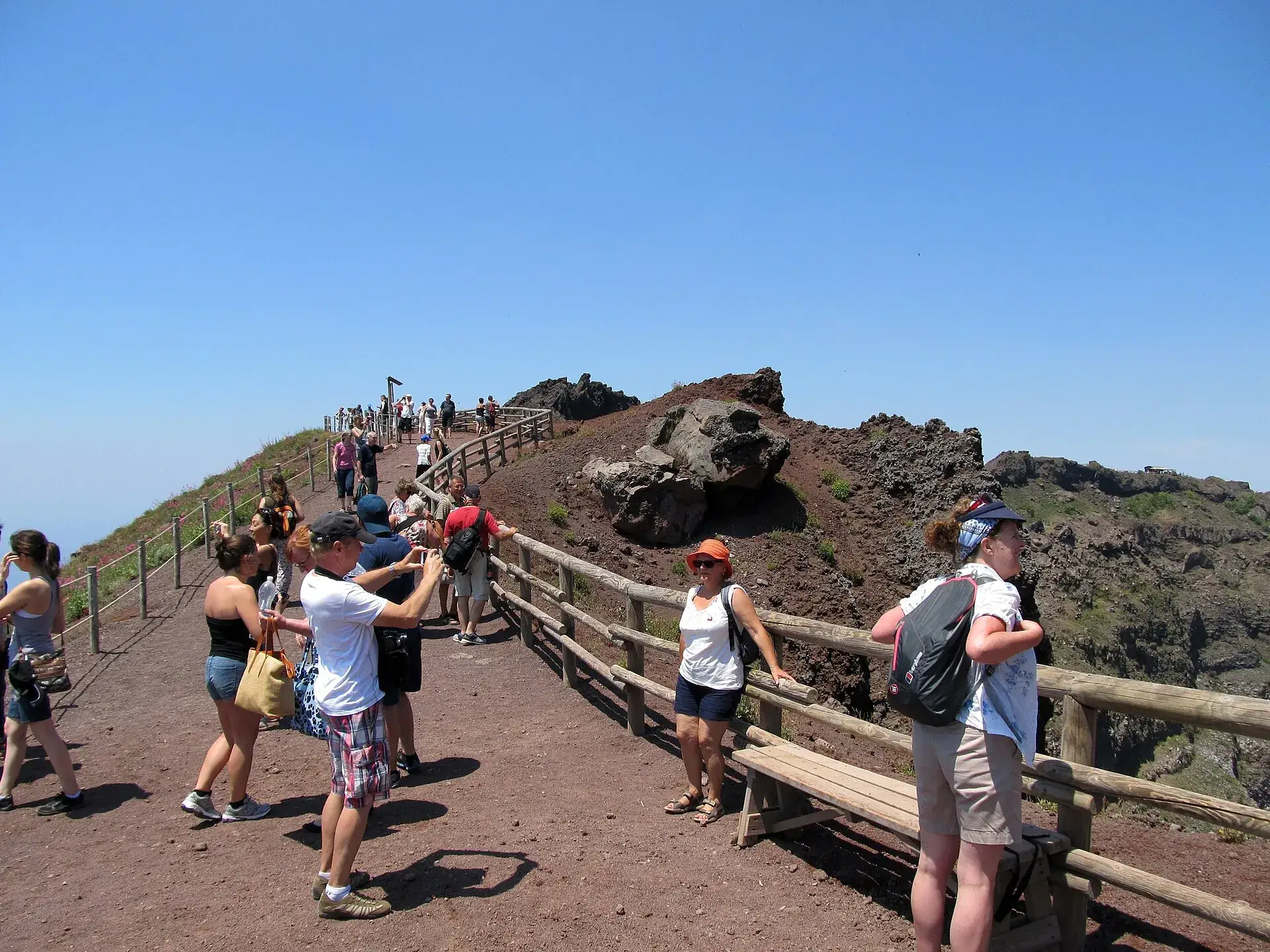
The last few steps. Loose lava gravel, no shade, wind from the side.
It drops 300 meters. Asleep since 1944 – but still steaming.
Move the mouse –
lean over the rim
Photo: daryl_mitchell · CC BY-SA 2.0
The walk to the rim is short: 175 m (about 575 ft) of climbing from the turnstile, roughly 4 km (2.5 miles) there and back. Getting to the turnstile is the harder part. The access rules changed twice in 2026, and older guides still describe the setup from before.
Tickets are sold online only, by time slot, 30 days ahead. No more than 360 people per hour are allowed up. How to book the right ticket.
Parking is only allowed at Quota 800 (800 m), and the space has to be booked in advance (€7, four hours maximum). From there you take the shuttle bus or walk.
The turnstile lets you in from 120 minutes before to 120 minutes after your booked time – as long as the day's last entry has not passed.
Above 1,000 m everyone walks in groups of 20 with the park guides. That is part of the ticket; nobody has to book a tour.
| Crater ticket bought in advance, booking fee included · reduced for under-25s €9.55 | €11.68 |
| Last minute at the entrance: 10 tickets per time slot, only via the Wi-Fi there | €10 |
| Children under 6 – a free ticket still has to be booked online | €0 |
| Car parking space at Quota 800 · shuttle bus to the entrance €1 per ride | €7 |
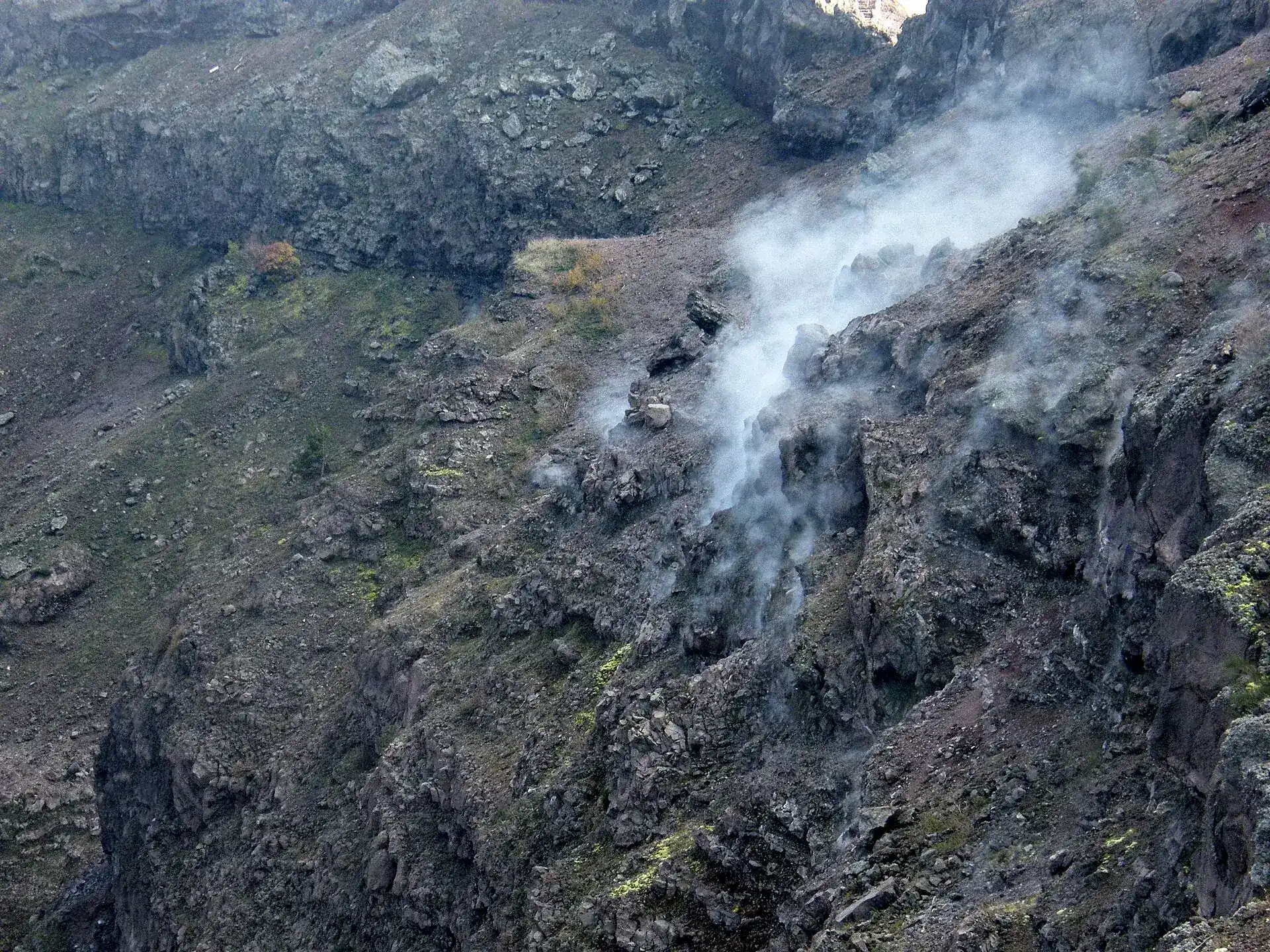
Photo: Pilgab · CC BY-SA 3.0
On vesuviopark.vivaticket.it, with your name and a credit card. The first slot at 9:00 am has the clearest view.
By car: book a parking space at Quota 800 on parkingsuvio.it. Without a car: bus 808 from Pompeii or a shuttle from Ercolano Scavi station.
Show the ticket on your phone – save it offline beforehand, the signal is weak. Entry from two hours before to two hours after the booked time.
The park guides take 20 visitors each. About 175 m of climbing on loose lava gravel: steep, but technically easy.
The view 300 m (about 1,000 ft) down, fumaroles on the inner wall, the Bay of Naples on the other side. The regulations allow two hours for the walk there and back.
The last bus 808 leaves Quota 1000 at 6:15 pm. A parking space is valid for four hours at most.
Doing it yourself is considerably cheaper – but it takes two or three bookings whose times have to line up. A tour makes most sense without a car, in high season, and when Pompeii is on the same day.
Crater ticket €11.68, plus €7 parking and €1 per shuttle ride if you drive – or train and bus 808. You choose the time slot and stay as long as the regulations allow. In return you carry the risk: a sold-out slot, a missed bus, a weather closure (the ticket is refunded, the day is gone).
Bus transfer from Pompeii with entry from €39, day trip from Naples including Pompeii from €49. Tour operators have their own ticket allocations – often the last option when the advance sale is empty. The trade-off: fixed times and less time at the crater.
Ticket, parking space, bus – or one tour that ties it all together. Most people add Pompeii, the city this mountain buried.
Affiliate links to GetYourGuide: if you book, we earn a commission and the price stays the same. Prices and ratings as of 21 September 2026.
In AD 79 Vesuvius buried two cities. Today they are the best reason to stay a second day.
Without a car: Circumvesuviana (EAV) Naples–Sorrento line to Ercolano Scavi, then a private shuttle; or to Pompei Villa dei Misteri and on by EAV bus 808 to Quota 1000 (55 minutes, 11 departures a day). The Campania Express also stops at 'Ercolano Scavi – Vesuvio' but, according to EAV, is suspended from 1 October 2026 until further notice.
By car: A3 Naples–Salerno, Ercolano exit, then the provincial road toward Vesuvio. Private cars may not drive up to the entrance: Via Osservatorio is closed between the Quota 800 turnoff and Piazzale Quota 1000 to all vehicles except public buses, chauffeured rental cars (NCC), taxis and motorcycles, and stopping is prohibited at the Piazzale itself. You park in the municipal areas at Quota 800; the space is bought in advance on parkingsuvio.it with date, license plate and vehicle type (cars €7, four hours maximum).
April to June and September/October; the first time slot at 9:00 am brings the clearest view and the fewest groups, and from midday haze or cloud often drifts into the crater. In high summer the shadeless trail is very hot at midday; in winter, weather-related closures (storms, snow, ice on the access road) are more frequent.
It is active but has been dormant since 1944, and it is one of the most closely monitored volcanoes in the world. The real risks for visitors are heat, wind and loose ground. Alert level on 21 September 2026: green.
About 4 km (2.5 miles) there and back, with roughly 175 m (575 ft) of climbing. The park allows up to two and a half hours for the whole visit.
From Pompeii, EAV bus 808 runs eleven times a day and takes 55 minutes to the entrance; from Ercolano Scavi station there is a private shuttle. The crater ticket is not included in either.
Sturdy shoes with a good tread. Even in summer it is windy and noticeably cooler at the top, and there is no shade: windbreaker, hat, sunscreen, water.
1,281 meters (4,203 ft). Visitors reach the crater rim at about 1,175 meters; the actual summit on the north and east side is permanently closed.
No. Without a time-slot ticket bought online in advance, the turnstile will not open. There is no ticket office on the mountain, only ten last-minute tickets per slot sold via the Wi-Fi at the entrance.
The standard ticket is exactly that: it includes only the mandatory safety escort by the park guides, not a booked guided tour. A guided tour is optional.
Yes. The crater trail is only accessible with a time-slot ticket bought online in advance; the only authorized seller is vesuviopark.vivaticket.it. The advance sale opens 30 days ahead, payment is by credit card, and the ticket costs €11.68 in advance (reduced €9.55).
There is no ticket office. For each 10-minute slot, 10 last-minute tickets are released 30 minutes beforehand; they can only be bought via the Wi-Fi at the entrance (€10, reduced €8, five per email address at most, issued in the buyer's name). In season you should not rely on them.
No, but you do not have to book one either. Above 1,000 m, an escort by the guides of the Presidio Permanente Vulcano Vesuvio is mandatory; they take visitors in groups of 20 and are included in the ticket price.
No. Private cars have to be left in the municipal parking areas at Quota 800, and the space is booked in advance on parkingsuvio.it (cars €7, max. 4 hours). A shuttle bus covers the last 200 m of elevation to the entrance in about 4 minutes; on foot it is roughly 30 minutes along the road.
The volcano is at alert level green, and there are no closures caused by the volcano. It closes when a weather warning of level orange or higher is in force, and in the event of snow, ice or landslides; the national park posts the current status at parconazionaledelvesuvio.it in the Alert section. Unused tickets are refunded automatically in the event of a closure.
Yes, the trail is short and technically easy, though steep. Children under 6 go free but need a free ticket booked online; the reduced price applies to anyone under 25.
Entry is daily from 9:00 am. Depending on the month, the last entry is between 3:00 pm (November to February) and 6:00 pm (July and August); in spring and September it is 5:00 pm. The trail has to be cleared one hour after the last entry.
For most people, yes – if you know what to expect: not a lava show, but a quiet crater about 300 m (1,000 ft) deep with a few fumaroles, and a wide view over the Bay of Naples. The physical effort is small (about half an hour on foot from 1,000 m); the organizing is not: without a time-slot ticket bought online in advance nobody gets through the turnstile, and private cars have to park at 800 m. In cloud or haze you see very little – in that case the time is better spent in Herculaneum or Pompeii.
No authority gives a percentage. Italy's Civil Protection Department lists Vesuvius at the lowest alert level, green; since its last eruption in 1944 it has been dormant with a closed conduit, and according to Civil Protection there are no signs of an imminent reawakening. The most likely future event is considered to be a violent Strombolian eruption (VEI 3); as a precaution, the emergency plan assumes a sub-Plinian eruption like that of 1631, while a Plinian eruption like the one in AD 79 is considered unlikely. What makes Vesuvius dangerous is above all the roughly 700,000 people living on its slopes – for day visitors, green means no restrictions caused by the volcano.
Etna is the more active one: Civil Protection has it at yellow, and it erupts almost every year, mostly with lava flows and lava fountains at uninhabited altitudes. Vesuvius nevertheless carries the greater risk, even though it has been dormant since 1944 and stands at green: its eruptions after long periods of rest are explosive, and around 700,000 people live on its slopes – which is why Civil Protection counts it among the highest-risk volcanoes in the world. For visitors: on Etna the authorities regularly close areas because of the volcano, on Vesuvius practically only because of the weather.
Mount Vesuvius stands on the Bay of Naples in Campania, southern Italy – according to Civil Protection less than 12 km (7.5 miles) southeast of Naples and about 10 km (6 miles) from Pompeii. Vesuvius National Park covers 13 municipalities; the visitor access to the crater (Quota 1000) is reached via Ercolano. The emergency plan's red zone comprises 25 municipalities.
Sources · accessed on 21 September 2026
.jpg)

