Volcano·Guide
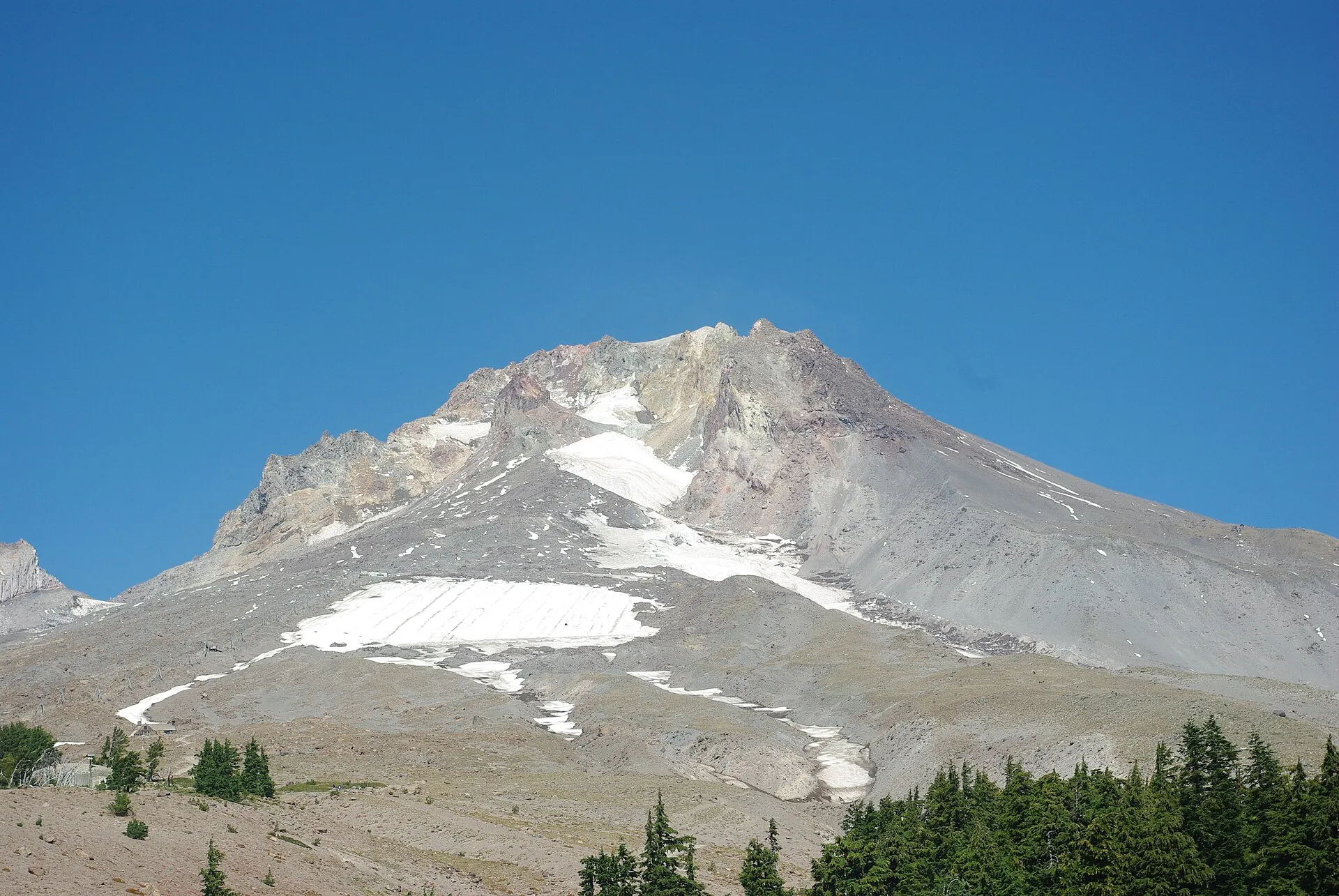
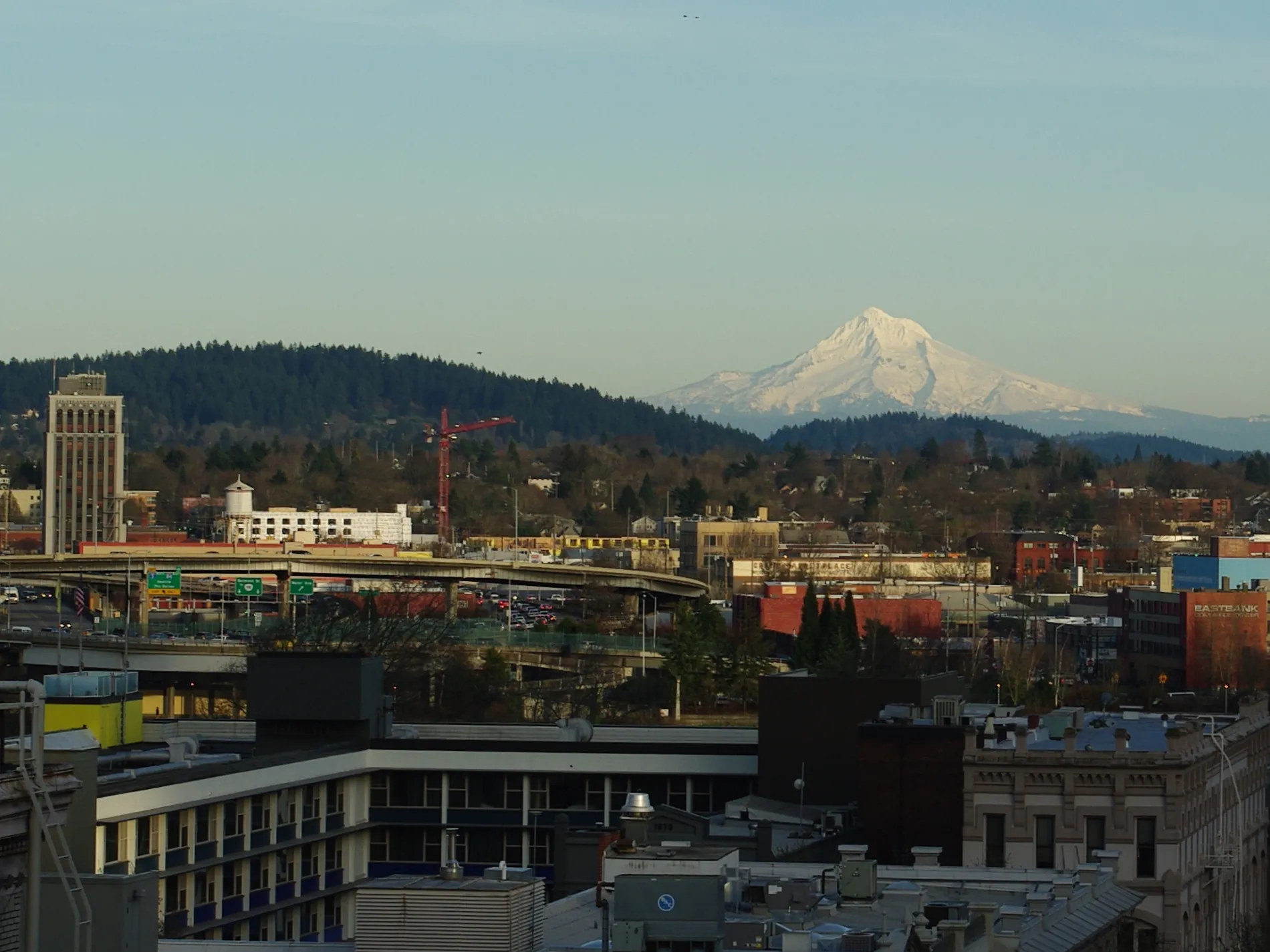
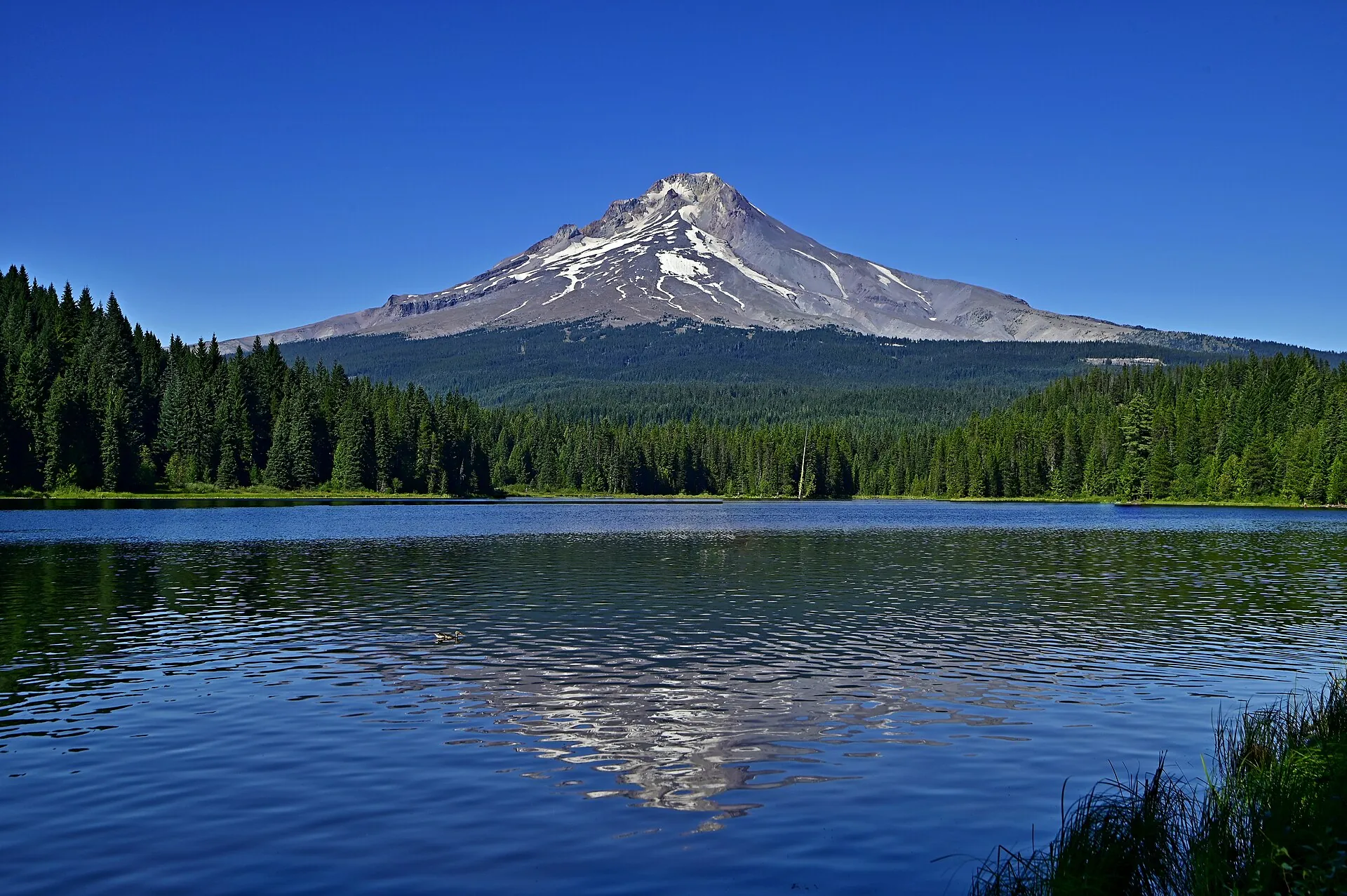
Mount Hood as a white peak above the rooftops of downtown Portland, with buildings, an elevated freeway and wooded hills in front Mount Hood reflected in Trillium Lake: the snow-streaked cone above dark conifer forest, with rippled blue water in front The summit zone of Mount Hood in late summer: only patches of snow remain above the Palmer Snowfield, the flanks grey, rocky and cut by gullies

Mount Hood

From Portland it is a white peak above the rooftops.

Ninety minutes later it is reflected in Trillium Lake.

And above 9,500 feet, every step needs a permit.

Scroll –
you are getting closer

As of 21 September 2026Mount Hood today: no entrance fee – and four fees anyway

Mt. Hood is a national forest, not a national park. There is no entrance gate and no admission ticket, and parking at Timberline Lodge is explicitly free in summer. The mountain still costs money – at individual day use sites, above 9,500 feet, and in winter at every parking lot. And what actually closes trails in 2026 is not the volcano but the fire.

Free
0$

Entry to the national forest

No gate, no ticket: roads, Government Camp, Timberline Lodge and almost every trail are freely accessible. The Forest Service states explicitly that no recreation pass is needed for the lodge parking lot in summer. The mountain is open to walk on up to 9,500 ft – above every ski area and above the Timberline Trail.

USDA Forest Service, Mt. Hood National Forest · as of 09/2026
Required
20$

Climbing permit above 9,500 ft

Anyone going above 9,500 ft (2,896 m) needs the Mt. Hood Climbing Permit – year round, per person, whatever the route. $20 for three days, $50 a year, through Recreation.gov only. There is no quota: the permit cannot sell out, is valid the moment you buy it and can be bought right up until you set off. The only cap is group size, at twelve people.

non-transferable, non-refundable
Partly closed

Fire, not the volcano

Campfires and open flame have been banned across the whole forest since 1 July 2026. On top of that come two fire closure areas: the Grasshopper Fire on the east and southeast side, and the Austin and Narrows fires in the Clackamas River district. After better containment along Oregon Route 35, the Timberline Trail, Rock Creek Campground and the trail to Tamanawas Falls reopened.

Forest Orders 06-06-00-26-03, 06-06-01-26-15 and 06-06-05-26-17 · check the alerts page before you drive
NORMAL / GREEN

The volcano itself

The USGS status report of 18 September 2026 lists Mount Hood at NORMAL / GREEN, with all Cascade volcanoes in Oregon and Washington at background levels. The national early warning system still ranks it a «very high threat» volcano – because of the glaciers, the lahar hazard in the populated valleys and the proximity to Portland, not because it erupts often. For a visit the status means no restriction today.

Last eruptive period from 1781 · hot fumaroles in Devil's Kitchen to this day
Sources: USDA Forest Service – Climbing Mt. Hood (permit requirement, prices, group size, no quota), Mt. Hood National Forest – Alerts & Notices (fire ban, closure areas) and the USGS overview of volcano status reports dated 18 September 2026 – retrieved 21 September 2026. The dedicated USGS page for Mount Hood answered with HTTP 403 that day.
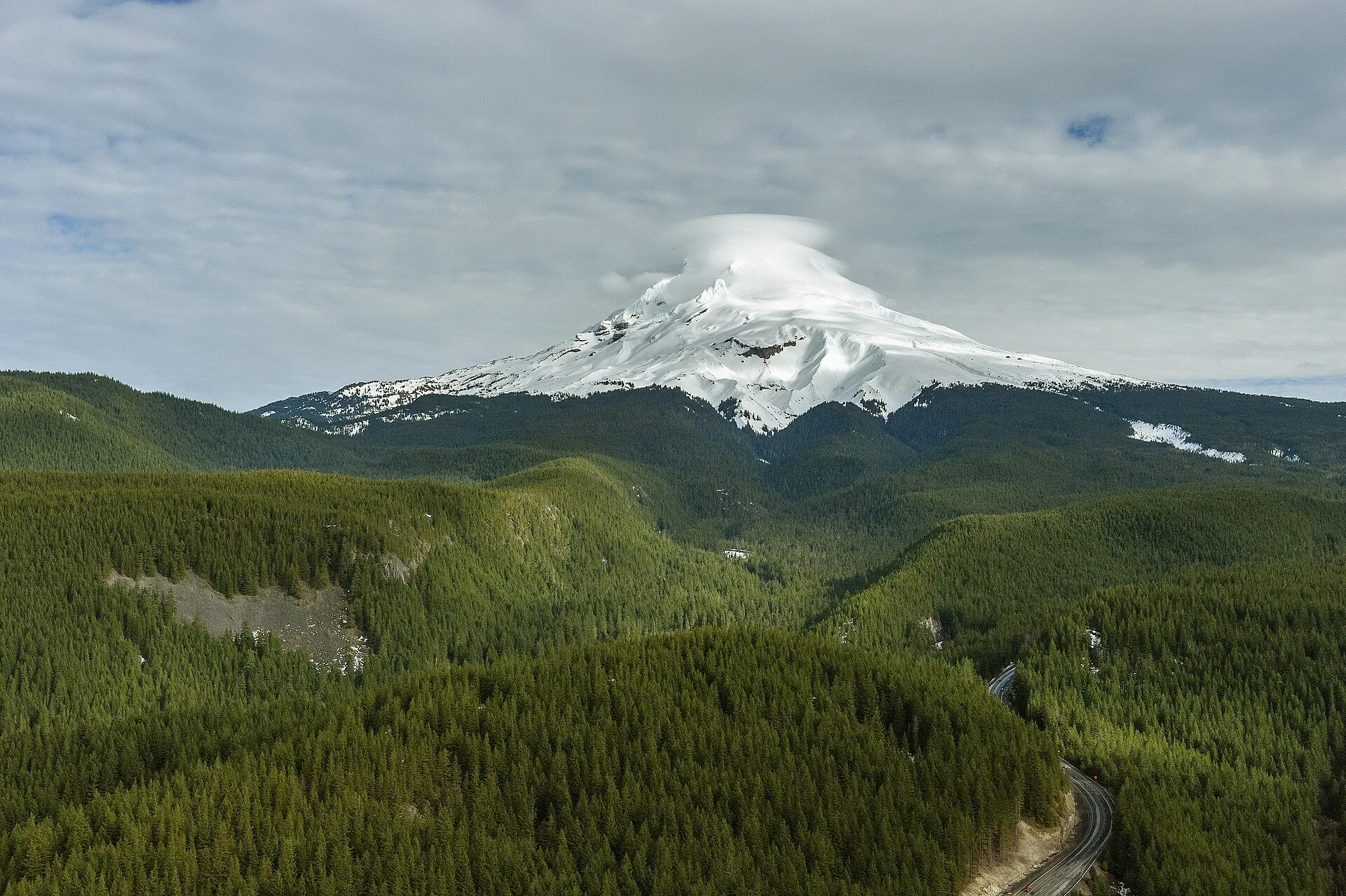
Mount Hood in winter with a lenticular cloud over the summit, wooded ridges in front and the switchbacks of US 26 below
From November to April every parking lot on the mountain needs a Sno-Park permit – including the one at Timberline Lodge.

Photo: Oregon Department of Transportation · CC BY 2.0

From PortlandDay trips to Mount Hood: mostly Columbia Gorge with a mountain stop

If you come without a car, what you will find from Portland are loop tours through the Columbia River Gorge with Mount Hood as one item on the itinerary – not mountain trips. The waterfalls usually take up more of the day than the volcano does. For a summit attempt this is the wrong route entirely: that calls for permitted mountain guides, not a day tour.

Affiliate links to GetYourGuide: if you book, we earn a commission and the price stays the same. Prices and ratings as of 21.09.2026. All four leave from Portland and pair the Columbia River Gorge waterfalls with a stop at the mountain, usually at Timberline Lodge. If you specifically want Trillium Lake or a stretch of the Timberline Trail, a rental car gives you more freedom – or take the Mt. Hood Express for $5 a day. Whether a tour routes around the fire closures is the operator's call, made at short notice.

Fees in 2026What actually costs money at Mount Hood

Instead of one park entrance fee there is a patchwork of individual charges, passes and winter parking permits – with one trap in it: the America the Beautiful pass that gets you into every national park is not honoured at popular Trillium Lake. Only the Northwest Forest Pass counts there.

Official prices · as of 09/2026
Mt. Hood Climbing Permit, three days, per person$20
Mt. Hood Climbing Permit, annual, per person$50
Northwest Forest Pass, day pass$5
Northwest Forest Pass, annual · valid in Oregon and Washington$30
Trillium Lake day use, per vehicle per day · Northwest Forest Pass only, not America the Beautiful$10
Oregon Sno-Park permit · 1 day / 3 days / season$4 / $9 / $25
Fine: parking at a Sno-Park without a permit$30
America the Beautiful annual pass · US residents / non-residents$80 / $250
Mt. Hood Express · single ride / day pass$2 / $5
Parking at Timberline Lodge in summerfree
WAG bags at the Climbers Registrationfree, year round
Sources: Forest Service – Climbing Mt. Hood, Recreation.gov – Mt. Hood Climbing Permit, Oregon DMV – Sno-Park Permits and Mt. Hood Express – retrieved 21 September 2026.

Timberline LodgeYou can reach the lodge by car, by bus – or not at all

Most visitors get no further than 6,000 ft. That is enough: it is where the timber WPA building of 1937 stands, where the Timberline Trail begins, and where the one chairlift in the country that still reaches snow in summer runs.

Open year round

Timberline Lodge, 6,000 ft

Built 1936–38 by the Works Progress Administration, dedicated by President Roosevelt on 28 September 1937, a National Historic Landmark since December 1977. The Forest Service lists it as «open 24 hours a day». From Government Camp it is about six miles of mountain road and roughly 15 minutes.

Entry and parking free in summer · Sno-Park permit required 1 November – 30 April
Snow permitting

Palmer Snowfield: summer skiing

The chairlift tops out at about 8,500 ft, below the 9,500 ft boundary – so no climbing permit is needed for it. Timberline advertises skiing all year, and the Palmer area counts as the only summer ski area in the United States. Operating dates and prices are set by the lodge, not the Forest Service.

Lift rates are not official – check timberlinelodge.com
Seven days a week
5$

Mt. Hood Express: up without a car

The Clackamas County bus runs six times a day from Sandy via Government Camp to Timberline Lodge. From Portland: MAX to Gresham Central, then the Sandy Area Metro to Sandy. The $5 day pass covers both buses – which makes the mountain reachable without a rental car.

single ride $2 · late run 1 Dec – 31 Mar · no service on Thanksgiving or Christmas Day
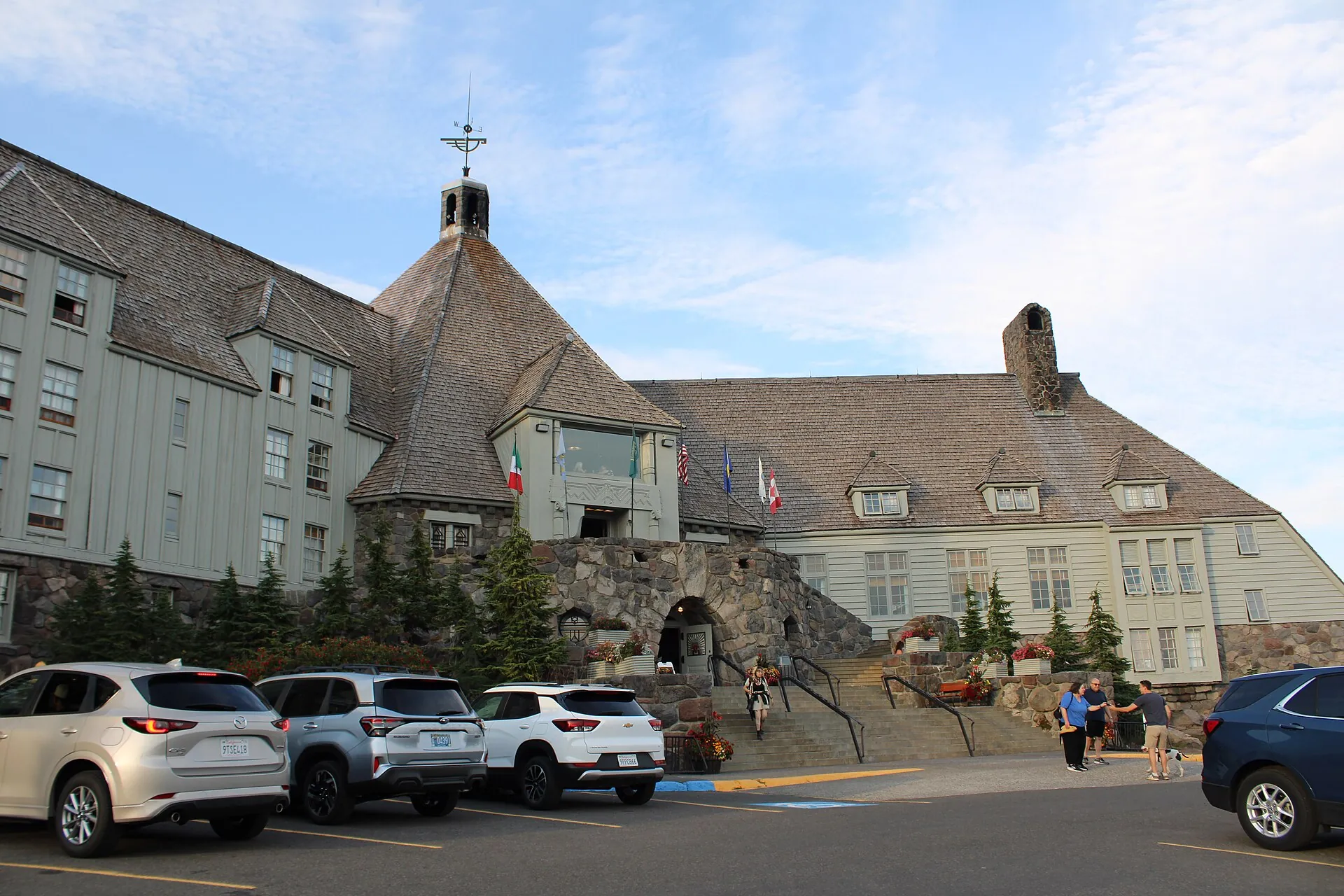
Timberline Lodge at Mount Hood seen from the drive: a long timber building with a steep shingled roof and a stone chimney tower, cars parked in front and visitors on the steps
Only the exterior shots of the «Overlook Hotel» came from Timberline Lodge – the interiors in «The Shining» were built in a studio.

Photo: Chris Light · CC BY-SA 4.0

The summitClimbing Mount Hood: $20, crampons – and a warning in September

The south side route counts as the standard way up, but it is not a hike: it crosses glacial snow, passes fumaroles and climbs a steep chute. The Forest Service expects up to 10,000 attempts a year.

No guide required

The standard route

From Timberline Lodge across the Palmer Snowfield, Devil's Kitchen and the Hogsback to the Pearly Gates or Old Chute – from 6,000 ft up to 11,249 ft. Common practice is a start between midnight and 3 a.m. while the snow is still frozen, with eight to twelve hours for the round trip. There is no guide requirement.

Duration is not an official figure · group size twelve people maximum
Required

Permit and sign-in

The climbing permit applies above 9,500 ft, on the south route above the Triangle Moraine. It has been mandatory since 1 January 2024 under the Federal Lands Recreation Enhancement Act. Voluntary but expressly recommended: signing the climbing register in the Wy'East Day Lodge – it helps if a rescue is needed. WAG bags are free there.

$20 for three days, $50 a year · Recreation.gov only
Advised against

Timing decides

On 8 September 2026 the climbing rangers explicitly advised against summit attempts: open crevasses, little snow, a great deal of loose rock and fast weather changes. That is not a closure, but it is an official warning. Late spring is more reliable, while snow still covers the rockfall zones and crevasses.

Gear per the rangers: crampons, ice axe, transceiver, probe, shovel, self-rescue equipment
Sources: Forest Service – Climbing Mt. Hood (route, permit boundary, equipment, climbing register, condition report of the climbing rangers dated 8 September 2026) – retrieved 21 September 2026. None of the official pages retrieved gave a start date for the permit requirement; what is documented is the requirement, not when it began.

November to AprilWinter at Mount Hood: without a Sno-Park permit it gets expensive

Winter is not a special case here but the normal one – Timberline is open all year. What changes fundamentally is parking, and it changes at every lot at once.

1 Nov – 30 Apr

Sno-Park permit required

From 1 November to 30 April every vehicle at a Sno-Park needs an Oregon Sno-Park permit – that includes all Timberline lots and the Tilly Jane Sno-Park. It is not sold at the parking lot but at Oregon DMV offices and by vendors at ski areas, sporting goods stores and shops along the access roads, who may add a service charge.

$4 for one day, $9 for three, $25 for the season
$30

Park without one and you pay

The State of Oregon puts the fine for parking at a Sno-Park without a valid permit at $30 – more than the season pass costs. It is the most common avoidable mistake on the mountain, because visitors arrive from the national parks with an America the Beautiful pass that is no use here.

State of Oregon figure · as of 09/2026
Chains required

Getting there in winter

The Oregon Department of Transportation requires chains or traction tires on the mountain roads, and the Timberline Road closes temporarily in storms. Between December and May, Trillium Lake is reachable only from the Trillium Sno-Park on US 26 – on foot, skis or snowshoes, about 4.4 miles round trip.

Current road conditions at tripcheck.com

The mountain as a volcanoIs Mount Hood extinct? No – just quiet

Look at the mountain and you see a ski hill. The USGS sees an active stratovolcano in the country's second-highest hazard class – and the difference lies not in how likely an eruption is, but in what one would do.

Last eruptive period: from 1781

According to the USGS the most recent eruptive period began in 1781, and residents still reported weak explosive activity in the mid-19th century. The mountain has been quiet since. Hot fumaroles persist in Devil's Kitchen below the summit – the sulphur smell on the standard route comes from there.

USGS – Mount Hood

«Very high threat»

In the National Volcano Early Warning System the USGS places Mount Hood in the highest hazard class. The reason is not frequent eruptions but the glaciers: the main hazard is lahars – mudflows that would run down the populated valleys. The same logic applies at Mount Rainier.

The rating is independent of the day's status

Five stations within twelve miles

The mountain is monitored by the USGS Cascades Volcano Observatory together with the Pacific Northwest Seismic Network; the USGS reports five seismic stations within twelve miles. Reporting runs on two scales side by side: the Volcano Alert Level for conditions on the ground and the Aviation Color Code for air traffic.

As of 18 September 2026: NORMAL / GREEN
Sources: USGS – Mount Hood (eruptive history, fumaroles, monitoring, hazard rating) and the USGS volcano status reports of 18 September 2026 – retrieved 21 September 2026.

PracticalGetting there, best time, who it suits, and tips

Getting there

Without a car: The Mt. Hood Express run by Clackamas County goes from Sandy via Government Camp to Timberline Lodge, seven days a week, six runs a day. From Portland take the TriMet MAX line to Gresham Central, then the Sandy Area Metro to Sandy; the $5 Mt. Hood Express day pass is valid on both buses. The mountain is therefore reachable without a car – though on a fixed timetable and with no connection to the trailheads on the north side.

By car: Free in summer at Timberline Lodge; Trillium Lake and some other day use sites charge a day fee or require a Northwest Forest Pass. From November 1 to April 30 an Oregon Sno-Park permit is required at every Sno-Park, including all Timberline lots and the Tilly Jane Sno-Park. In winter the Oregon Department of Transportation requires chains or traction tires on the mountain roads.

  • From Portland · about 1.5 hours by car
    US 26 east through Sandy and Government Camp, then about six miles up the Timberline Road; or by bus (MAX – Sandy Area Metro – Mt. Hood Express)
  • From Hood River · about 1 hour
    Oregon Route 35 south along the eastern foot of the mountain – the more scenic half of the Mt. Hood Scenic Byway
  • From Portland Airport (PDX) · about 1.5–2 hours
    rental car via I-84 and US 26

Best time to go

For hiking and photography: July to early October, when the trails are clear of snow and the alpine meadows are in bloom. For the summit: late spring, while enough snow still covers the loose rock – in late summer and early fall crevasses are open and rockfall is the main problem, and on September 8, 2026 the climbing rangers explicitly advised against summit attempts. For snow and sledding: December to March, but then with a Sno-Park permit and winter tires. A special case is summer skiing on the Palmer Snowfield, which makes Mount Hood a training hill for national ski teams from June to August. In Oregon you now have to reckon with a second season: in 2026 the forest burned from July onwards, fire bans applied forest-wide, and several popular destinations stayed closed for months.

Who it suits

Children
Mount Hood is a very good destination with children – as long as you stay low: Timberline Lodge, Trillium Lake with its view of the mountain, short forest trails, sledding at the Sno-Parks in winter. The summit climb, by contrast, is serious mountaineering and not suitable for children. There is no official minimum age for the climbing permit.
Minimum age
none found officially; the Forest Service regulates only group size (twelve people maximum on the summit climb)
Fitness
Everyday fitness is enough for the lodge, the viewpoints and the lakes. The summit means about 5,300 ft (1,600 m) of ascent on snow, mostly at night, with crampons on steep ground in the upper section.
Altitude
The summit stands at 11,249 ft (3,429 m) – altitude sickness is rare, but anyone coming straight from Portland at sea level and climbing in a single night will feel the height in the last third.
Heart and lungs
Hot sulphur gases vent in Devil's Kitchen below the summit, and the climbing rangers count them among the hazards of the route. Anyone with respiratory problems should skip the summit climb. There is no restriction for the lodge and the trails.
Wheelchair
Timberline Lodge and the Trillium Lake day use site have accessible facilities; the Forest Service specifically lists accessible facilities and a fishing pier at Trillium Lake. The mountain itself above the lodge is not accessible.
Dogs
Dogs are allowed in the national forest; a forest-wide leash rule is not documented in the sources reviewed (see «unsicher»). Day use sites and ski areas have their own rules.
Clothing
At 6,000 ft it is noticeably cooler and windier than in Portland even at the height of summer; keep a windproof jacket and a hat in the car. For the summit the climbing rangers list crampons, ice axe and helmet, plus avalanche transceiver, probe and shovel and gear for self-rescue.
Footwear
Sturdy shoes for the trails; crampon-compatible mountaineering boots for the summit.

Tips you will need on site

  • The climbing permit costs little and can still be bought on Recreation.gov the evening before – but it is not a sign-in: the Forest Service also recommends signing the climbing register at the Wy'East Day Lodge and leaving your plan with someone who is not on the mountain.
  • Read the Mt. Hood National Forest alerts page before you drive. In 2026 fire closures shut far more trails than any volcanic situation ever has.
  • At Trillium Lake only the annual Northwest Forest Pass is accepted – the America the Beautiful pass expressly is not. If you pay cash, bring the right change for the machine.
  • Between November 1 and April 30 the $25 season Sno-Park permit pays for itself from the seventh day; day permits are sold at gas stations and sporting goods stores along US 26, not at the parking lot itself.
  • You can do it without a car: the Mt. Hood Express runs seven days a week to the door of Timberline Lodge, $5 day pass including the feeder bus from Sandy.
  • For the classic reflection photo go to Trillium Lake early – in the afternoon the sun is wrong and the wind ruffles the water.
  • The lodge itself is open to the public, with no room and no lift ticket: the fireplace, the ironwork and the ground-floor exhibit cost nothing, and neither does parking in summer.

A short history

  • October 29, 1792: Lieutenant William Broughton of the Vancouver expedition names the mountain after the British admiral Samuel Hood. The Chinook and Multnomah had long known it as Wy'east.
  • The most recent eruptive period began in 1781 according to the USGS; residents still reported weak explosive activity in the mid-19th century. The volcano has been quiet since, while the fumaroles of Devil's Kitchen keep working.
  • July 11, 1857: first documented ascent of the summit, by Henry Pittock and three companions.
  • 1936–1938: the Works Progress Administration builds Timberline Lodge as a Depression-era jobs project; local craftspeople make the furniture, ironwork and textiles. Dedicated by Franklin D. Roosevelt on September 28, 1937.
  • December 1977: Timberline Lodge becomes a National Historic Landmark. It now counts more than two million visitors a year.
  • May 1986: seven students and two adults of an Oregon Episcopal School party die in a storm during a climb – after the 1981 avalanche on Mount Rainier the second-deadliest mountaineering accident in North America. An inquiry concluded that the group was trained but pushed on despite an oncoming blizzard.
  • In recent years the Forest Service has required a paid climbing permit for everything above 9,500 ft – bought through Recreation.gov, with no quota.
  • Summer 2026: wildfire defines the season. A forest-wide fire ban takes effect on July 1, 2026, and in August and September the Grasshopper Fire and the Austin and Narrows fires close large parts of the Barlow, Hood River and Clackamas River districts.

Setting it straightWhat other sites get wrong

“Mount Hood is a national park.”
No. It lies in Mt. Hood National Forest, administered by the US Department of Agriculture, not the National Park Service. That is not a quibble: there is no entrance gate and no park admission, but there are individual fees at day use sites – and the America the Beautiful pass is not honoured at popular Trillium Lake.
“You can climb the summit freely.”
Since the Mt. Hood Climbing Permit was introduced, every person above 9,500 ft (2,896 m) needs a paid permit – year round, $20 for three days or $50 a year, through Recreation.gov only.
“The summit is a strenuous day hike.”
The route crosses glacial snow, passes fumaroles and climbs a steep chute. The climbing rangers list crampons, ice axe, avalanche transceiver, probe, shovel and self-rescue gear. In September 2026 they advised against summit attempts altogether.
“High summer is the best time for the summit.”
In high summer and early fall there is too little snow, crevasses are open and loose rock is the main hazard. Late spring is the more reliable window.
“You can tour the inside of the hotel from «The Shining».”
Only the exterior shots of the Overlook Hotel came from Timberline Lodge; the interiors were built in a studio. The lodge is still worth the stop – for the WPA-era craftsmanship, not for a hedge maze that never existed there.
“You buy the winter parking permit at the lot.”
Sno-Park permits are not sold at the parking lot but at Oregon DMV offices and vendors. Park without one and you risk $30.
“Mount Hood is extinct.”
The USGS lists it as an active volcano rated «very high threat». The status is NORMAL / GREEN (as of 18 September 2026), but the last eruptive period began only in 1781.

Before you drive upFrequently asked questions about Mount Hood

Is there an entrance fee for Mount Hood?

Not for the national forest – there is no gate and no admission ticket, and parking at Timberline Lodge is free in summer. You pay only at individual day use sites such as Trillium Lake ($10 per vehicle), above 9,500 ft (climbing permit), and from November to April at every Sno-Park lot.

Is Mount Hood worth a day trip from Portland?

Yes. It is about 50 miles and an hour and a half on US 26. Start early and you can fit in Trillium Lake, Timberline Lodge and a stretch of the Timberline Trail in one day. Without a car: MAX, Sandy Area Metro and the Mt. Hood Express – $5 day pass.

Is Mount Hood closed in 2026 because of the wildfires?

Not as a whole. Two fire areas are closed – the Grasshopper Fire on the east and southeast side and the Austin/Narrows fires in the Clackamas River district – and a forest-wide fire ban has applied since 1 July 2026. The south side with Government Camp, Timberline Lodge and Trillium Lake was not affected. Check the Forest Service alerts page for the day you travel.

Do I need a permit for Mount Hood?

Not for hiking, Timberline Lodge or the viewpoints. Anyone going above 9,500 ft (2,896 m) needs a Mt. Hood Climbing Permit year round: $20 for three days or $50 a year, from Recreation.gov. There is no quota, and you can buy it right up until you start.

How much does it cost to visit Mount Hood?

Nothing – Mt. Hood National Forest has no entrance gate. You pay at specific points: $10 per vehicle at Trillium Lake, $5 a day or $30 a year for the Northwest Forest Pass at fee sites, and from November to April a Sno-Park permit for winter parking.

Is Mount Hood open right now?

The mountain itself, yes. In summer 2026 wildfires closed large areas: the Grasshopper Fire on the east and southeast side, the Austin and Narrows fires in the Clackamas River Ranger District. Parts reopened in September. A forest-wide fire ban has been in effect since July 1, 2026. Check the Forest Service alerts page for the day you travel.

What is Mount Hood's current alert level?

NORMAL, with an Aviation Color Code of GREEN – as of the USGS status report of September 18, 2026. The Cascades Volcano Observatory reports all Cascade volcanoes in Oregon and Washington at background levels. Even so, the USGS early warning system ranks Mount Hood as a very high threat volcano.

How hard is it to climb Mount Hood?

It is a mountaineering route, not a hike: about 5,300 ft (1,600 m) of ascent from Timberline Lodge, usually started at night, with steep firn and ice higher up. The climbing rangers list crampons, ice axe, avalanche transceiver, probe and shovel among the required gear. If that is not your skill set, go with a guide or do not go.

How do I get from Portland to Mount Hood without a car?

Take the MAX to Gresham Central, the Sandy Area Metro to Sandy, and from there the Mt. Hood Express to Government Camp and Timberline Lodge. The bus runs seven days a week, six times a day; the day pass costs $5 and is valid on both lines.

Can I just visit Timberline Lodge?

Yes. The Forest Service lists it as open around the clock, parking is free in summer and no recreation pass is needed for it. You can see the historic interiors of the 1937 building without staying the night. In winter the parking lot needs a Sno-Park permit.

What is a Sno-Park permit and when do I need one?

It is an Oregon state parking permit, required from November 1 to April 30 at every Sno-Park, including all Timberline lots. It costs $4 a day, $9 for three days or $25 for the season, and is bought at DMV offices and vendors, not at the lot. Parking without one risks a $30 fine.

When is the best time to visit Mount Hood?

July to early October for hiking and clear views, late spring for the summit climb, December to March for snow. Now factor in fire season: in 2026 the forest was under a fire ban from July, and large areas were closed in August and September.

Is Mount Hood doable with children?

Below treeline, very much so: Timberline Lodge, Trillium Lake, short forest trails, sledding hills at the Sno-Parks in winter. The summit is not suitable for children. There is no official minimum age for the climbing permit, but there is a group limit of twelve people.

Do I really have to pay extra at Trillium Lake even with a national park annual pass?

Yes. For Trillium Lake day use the Forest Service states explicitly that only the $30 annual Northwest Forest Pass is accepted and that America the Beautiful passes do not apply there. The day fee is $10 per vehicle.

When can you ski at Mount Hood in summer?

On the Palmer Snowfield above Timberline Lodge, the only summer ski area in the United States. The Forest Service lists Timberline as year round; the exact operating dates of the Palmer lift depend on snow cover and are posted on the lodge's own site.

How dangerous is Mount Hood?

Volcanically, not at all at the moment – the status is NORMAL. As a mountain, distinctly so: in 1986 nine members of a school party died in a storm, the second-deadliest mountaineering accident in North America after the 1981 Mount Rainier avalanche. The hazards are rockfall, open crevasses, sudden weather and the gas vents of Devil's Kitchen.
Sources · accessed on 21 September 2026