20,000
Visitors a day, then sales stop
The cap applies on free Sundays too. Once the allocation is gone, the park refers visitors to Oplontis, Boscoreale and Stabiae.
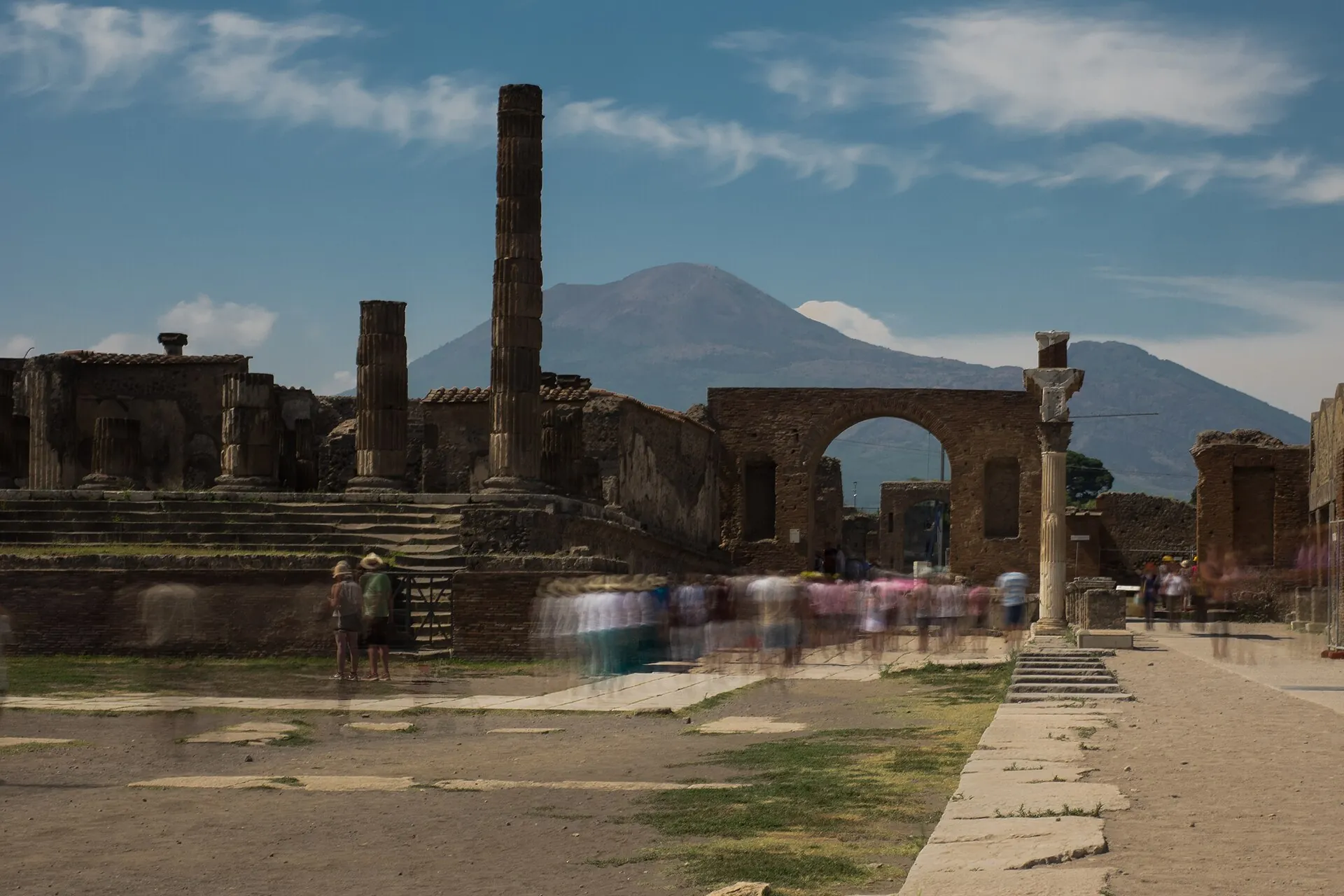
The mountain is still there. The city lay beneath it for almost 1,700 years.
In 1748 the digging began.
Today you walk its streets – with the volcano always in view.
Wipe the ash away –
or keep scrolling
Photo: Sarahhoa · CC BY-SA 2.0
Pompeii is not a ruin behind a fence but a city of 98 hectares (about 240 acres) – and since 2024 one with an admission cap. Turn up unplanned in high season and you may find the gates closed to you.
The cap applies on free Sundays too. Once the allocation is gone, the park refers visitors to Oplontis, Boscoreale and Stabiae.
March 16 to October 14: a maximum of 15,000 admissions from 9:00 am to 1:00 pm, and 5,000 from 1:00 to 5:30 pm. In winter only the daily cap applies.
Give the names of everyone in your party when you buy, and bring photo ID. Official shop: pompeii.vivaticket.it. All Pompeii tickets compared.
Porta Marina, Piazza Anfiteatro, Piazza Esedra. Every stand at the station and along the street is a reseller.
| Pompeii Express – the city area only | 20 € |
| Pompeii+ – with the suburban villas (Villa of the Mysteries) and Boscoreale | 25 € |
| 3-day ticket for all sites of the park, shuttle included | 30 € |
| EU citizens aged 18 to 24 · free under 18 | 2 € |
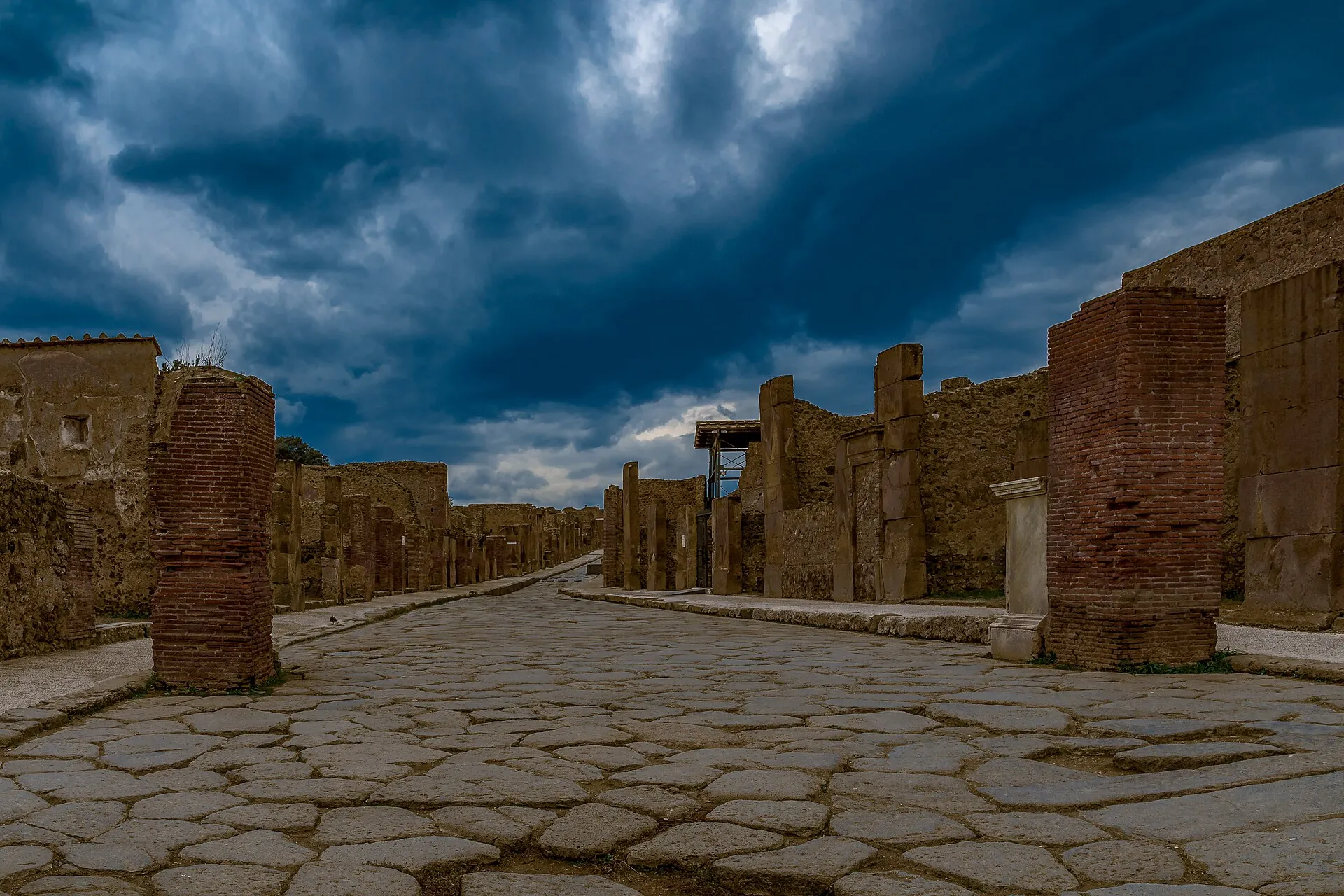
Photo: Rabax63 · CC BY-SA 4.0
Guides are not mandatory. But Pompeii does not explain itself – without a guide you see walls, with one you see a bakery, an election notice, a brothel. These tours include the ticket; you are asked for the names when you book.
Affiliate links to GetYourGuide: if you book, we earn a commission and the price stays the same. Prices and ratings as of September 21, 2026.
Pleasant temperatures, long opening hours. July and August are tough because of the heat and the lack of shade.
In the morning before the day-trip groups, or on summer afternoons when they leave and the second allocation applies.
For the main axes with the Forum, baths, theaters and amphitheater. Sturdy, flat shoes: the paving is uneven and slippery when wet.
Three routes for two hours, half a day and a full day – plus today's status: which houses are open in Pompeii changes every few weeks.
The essentials in 2 hours. For anyone short on time, for instance on a stopover between Naples and Sorrento. The route stays in the western part of the city: from Porta Marina past the Temple of Apollo and the Basilica onto the Forum, behind the Temple of Jupiter into the Forum Baths, on to the House of the Faun, then via the bakery and the Lupanar down to the Stabian Baths on Via dell'Abbondanza. Return along Via dell'Abbondanza and across the Forum to Porta Marina or Piazza Esedra. The amphitheater and the Villa of the Mysteries are left out on purpose – they lie at opposite ends of the site. The Express ticket is enough.
Temple of Apollo → Basilica → Forum → Temple of Jupiter → Forum Baths → House of the Faun → Bakery of Popidius Priscus → Lupanar → Stabian Baths
Half a day: straight across the city. For the classic first visit. First the Forum and its buildings, then a loop north to the three big houses (Tragic Poet, Faun, Vettii – do the House of the Vettii as early as possible, before the groups arrive). Via the bakery and the Lupanar to the Stabian Baths, a detour into the theater district, then east along Via dell'Abbondanza to the thermopolium, the Garden of the Fugitives and across the Palaestra to the amphitheater. You leave the site at Piazza Anfiteatro and save yourself the walk back of a good kilometer (over half a mile). The Express ticket is enough.
Temple of Apollo → Basilica → Forum → Temple of Jupiter → Forum Baths → House of the Tragic Poet → House of the Faun → House of the Vettii → Bakery of Popidius Priscus → Lupanar → Stabian Baths → Large Theater and Odeon → Via dell'Abbondanza and the Thermopolium of Vetutius Placidus → Garden of the Fugitives → Large Palaestra → Amphitheater
Full day with the Villa of the Mysteries. For anyone who wants to see Pompeii in full – this requires the Pompeii+ ticket. The route runs from east to west: the amphitheater and the quiet eastern part in the morning, along Via dell'Abbondanza into the center, the Forum and the Antiquarium at midday (there is shade there), the houses of Regio VI in the afternoon, and finally through Porta Ercolano and the Street of Tombs to the Villa of the Mysteries. Keep an eye on the clock: in summer the last passage through Porta Ercolano is at 5:30 pm, and the villa closes at 6:30 pm. The houses with admission from 9:15 am already close at 6:20 pm – which is why they come before the villa.
Amphitheater → Large Palaestra → Garden of the Fugitives → Via dell'Abbondanza and the Thermopolium of Vetutius Placidus → Stabian Baths → Large Theater and Odeon → Lupanar → Bakery of Popidius Priscus → Forum → Basilica → Temple of Apollo → Antiquarium → Temple of Jupiter → Forum Baths → House of the Tragic Poet → House of the Faun → House of the Vettii → Villa of the Mysteries
The park's museum sits just above Porta Marina, beneath the terrace of the Temple of Venus. Giuseppe Fiorelli had it built in 1873–74; it shows finds from everyday life in the city and casts of victims of the eruption, arranged as a walk through the city's history from its beginnings to AD 79. Start here and the ruins make a lot more sense afterward.
One of the oldest sanctuaries in the city: excavations have identified a predecessor from the 6th century BC. What you see is a podium temple in a colonnaded courtyard with an altar at the center; the bronze figures of Apollo and Diana are copies, and the originals are in the National Archaeological Museum in Naples. It lies right on the way from Porta Marina to the Forum and takes hardly any time.
At about 1,500 square meters (16,000 sq ft), the most elaborate building on the Forum: this is where business deals were struck and justice was administered. You enter the three-aisled hall from the Forum through five entrances and see the judges' raised tribunal at the western end. The building dates from 130–120 BC, which makes it one of the oldest basilicas in the Roman world.
The city's main square, around which the administration, the courts, the market and the most important temples were grouped. You stand on a long square framed by colonnades, its axis running toward the Temple of Jupiter and, behind it, Vesuvius – the best-known view of Pompeii. Part of the travertine paving from the imperial period is still in place.
The temple dominates the north side of the Forum, with Vesuvius directly behind it. After the Roman colony was founded in 80 BC, it was enlarged into a Capitolium with the cult images of Jupiter, Juno and Minerva. The high podium with its staircase and column stumps survives; equestrian statues once stood to the left and right.
Public baths just behind the Temple of Jupiter, built shortly after 80 BC, with separate sections for men and women. In the men's baths you can follow the sequence of rooms from the changing room through the cold bath to the hot bath, along with stucco vaults, niches with terracotta telamons and a large bronze brazier. More compact and usually less crowded than you would expect – the best place to understand how a Roman bathhouse worked.
A fairly small atrium house, famous for the mosaic at the main entrance showing a chained dog and the warning CAVE CANEM, now under glass. Visitors come in through a side entrance straight into the peristyle with the household shrine; in the living room you can still see the wall painting of Ariadne abandoned by Theseus. The remaining mosaics and paintings are in the museum in Naples.
At about 3,000 square meters (32,000 sq ft), one of the largest houses in Pompeii – it fills an entire city block and goes back to the 2nd century BC. The inscription HAVE greets you on the sidewalk; inside come two atria and two colonnaded gardens. The dancing faun in the water basin and the Alexander Mosaic are copies; the originals are in Naples.
The house of two freedmen who grew rich through trade, Aulus Vettius Restitutus and Aulus Vettius Conviva, and one of the most lavishly painted in the city. A painted Priapus stands at the entrance as a symbol of prosperity; the centerpiece is the colonnaded garden with statues and fountains, next to it the hall with the frieze of cupids at work. Because of the crowds, this is where you are most likely to have to wait.
Mill and bakery in one: five well-preserved millstones of lava rock – a cone-shaped lower stone and an hourglass-shaped upper stone turned by slaves or animals – stand next to the large oven. There is no sales counter; the bread was probably sold to order, wholesale or through street vendors. A short stop that brings everyday life in the city across better than many a house.
The city's brothel, a small two-story corner building: on the ground floor, five cubicles with masonry beds open off a corridor, and small erotic wall paintings hang above the doors. You walk through one way – in on Vicolo del Lupanare, out on Vicolo del Balcone Pensile. The visit takes just minutes; the line outside often takes longer.
Pompeii's oldest bath complex, from the 2nd century BC, and one of the oldest in the Roman world. From the entrance on Via dell'Abbondanza you reach a large courtyard with a swimming pool and a colonnade; in the men's section, the raised floors and wall flues show how the hot-air heating worked. The women had their own, plainer section with a separate entrance.
The Large Theater, from the mid-2nd century BC, uses the natural slope for its seating and was the first large public building to be fully excavated. Right next to it is the small, once-roofed Odeon for music and mime, and behind that the colonnaded courtyard that last served as gladiators' barracks. From the top tier the view reaches over the stage and out across the plain.
Via dell'Abbondanza is the main shopping street and the natural route from the Forum to the amphitheater, lined with shops, cookshops and election notices on the facades. The best example is the snack bar of Vetutius Placidus: a masonry counter with colorful facing and built-in storage jars, and on the back wall a painted household shrine with Mercury and Dionysus. One of the jars held almost three kilos (about 6.5 lb) of coins – probably the last takings.
A former residential quarter that had been turned into a vineyard with an outdoor dining area under a pergola before the eruption. Thirteen people were found here, adults and children, who fled toward Porta Nocera over a pumice layer already 3.5 meters (11 ft) deep and were overtaken by the pyroclastic flow. Their plaster casts lie in a glass case against the back wall of the garden – the most affecting place on the site.
A huge sports ground framed by colonnades, about 140 by 140 meters (460 by 460 ft), with a swimming pool in the middle, laid out at the beginning of the 1st century AD for training the city's youth. Of the plane trees, only the casts of the roots remain; the walls and columns carry plenty of graffiti. In the colonnades the park shows a permanent exhibition of casts and organic finds.
The oldest known amphitheater in the Roman world, built around 70 BC for up to 20,000 spectators – which is why it stands at the edge of town, where there was room for the crowd. External staircases lead to the upper tiers, a sloping passage down into the arena. In AD 59 a show here ended in a bloody brawl with visitors from Nuceria, after which the Senate had the arena closed for ten years.
A suburban villa outside Porta Ercolano with the most famous wall painting in Pompeii: a continuous frieze across three walls shows a ritual of the cult of Dionysus, with almost life-size figures against a bright red background. The other rooms are also decorated in the Second Style with painted illusionistic architecture, and the working part of the villa has a reconstructed wooden wine press. The route leads along the Street of Tombs past the Villa of Diomedes and is worth the detour.
Without a car: Circumvesuviana (EAV) Naples–Sorrento line to “Pompei Scavi – Villa dei Misteri” for the Porta Marina and Piazza Esedra entrances; Naples–Poggiomarino line to “Pompei Santuario” for Piazza Anfiteatro; Trenitalia Naples–Salerno to “Pompei” (from there the Pompei Link combined offer with a bus, about 15 minutes). SITA buses from Naples and Salerno, Busitalia lines 4 and 50 from Salerno. According to EAV, the Campania Express is suspended from October 1, 2026 until further notice.
By car: A3 Naples–Salerno, exit Pompei Scavi. The park does not run a large parking lot of its own; there are private lots around Porta Marina.
March to May and October; right at 9:00 am, or in summer from 3:00 pm, when the day-trip groups leave and the afternoon allocation (from 1:00 pm) applies. July and August are tough because of the heat and the lack of shade. Free Sundays are the busiest days of the month.
It is not mandatory; the official ticket offices at the three entrances still sell tickets. But with the daily cap, buying online at pompeii.vivaticket.it is the safe option in season.
Yes, guides are not mandatory. Guided tours and audio guides are optional extras.
Take the Circumvesuviana from Napoli Garibaldi toward Sorrento to “Pompei Scavi – Villa dei Misteri”, about 35 to 40 minutes. The Porta Marina entrance is right by the station.
Yes, and it costs nothing for under-18s. But the site is big, hot and short on shade, and the ancient paving is hard going with a stroller.
Only small dogs up to 10 kg (22 lb) and 40 cm (16 in) at the shoulder, on a leash; inside buildings they must be carried.
Vesuvius is at green, the lowest alert level, and is monitored continuously. The real risks of a visit are the heat and the uneven paving.
Online only at pompeii.vivaticket.it; on site only at the ticket offices inside the Porta Marina, Piazza Anfiteatro and Piazza Esedra entrances. Every stand at the station and along the street is a reseller.
The Pompeii Express ticket for the city area costs €20, Pompeii+ with the suburban villas and Boscoreale €25, and the 3-day ticket for all sites €30. EU citizens aged 18 to 24 pay €2; admission is free for under-18s. These prices have applied since January 12, 2026.
Yes. Since November 15, 2024, every ticket carries the visitor's name. That is why you have to give the names of everyone in your party when buying; keep photo ID handy at the entrance.
In the summer season from March 16 to October 14, yes: a maximum of 15,000 people are admitted from 9:00 am to 1:00 pm, and a maximum of 5,000 from 1:00 to 5:30 pm. In winter only the daily cap applies.
The urban area covers about 98 hectares (240 acres), of which roughly two thirds have been excavated and are accessible. Allow at least half a day for the main axes with the Forum, the baths, the theater and the amphitheater.
From March 16 to October 14, daily 9:00 am to 7:00 pm (last admission 5:30 pm); in winter 9:00 am to 5:00 pm (last admission 3:30 pm). The site is closed on December 25 and January 1.
No. Bags may measure no more than 30 × 30 × 15 cm (about 12 × 12 × 6 in); anything larger, including suitcases, has to go to the baggage check at the entrance.
About 240 km (150 miles) by road. By train you go to Naples first: according to Trenitalia, Frecciarossa trains take “a little more than an hour”, with more than 100 connections a day, and Italo covers the same route in just over an hour as well. At Napoli Centrale you change on the lower level (Napoli Garibaldi) to the Circumvesuviana, which takes another 35–40 minutes or so to “Pompei Scavi – Villa dei Misteri” – about 2 to 2.5 hours in total. On Sundays there is also a direct Frecciarossa, Roma Termini 8:53 am – Pompei 10:40 am (return 6:40 pm – 8:55 pm); from Pompei station the “Pompei Link” bus runs to the excavations.
Sources · accessed on September 21, 2026
.jpg)
.jpg)