Volcano·Guide
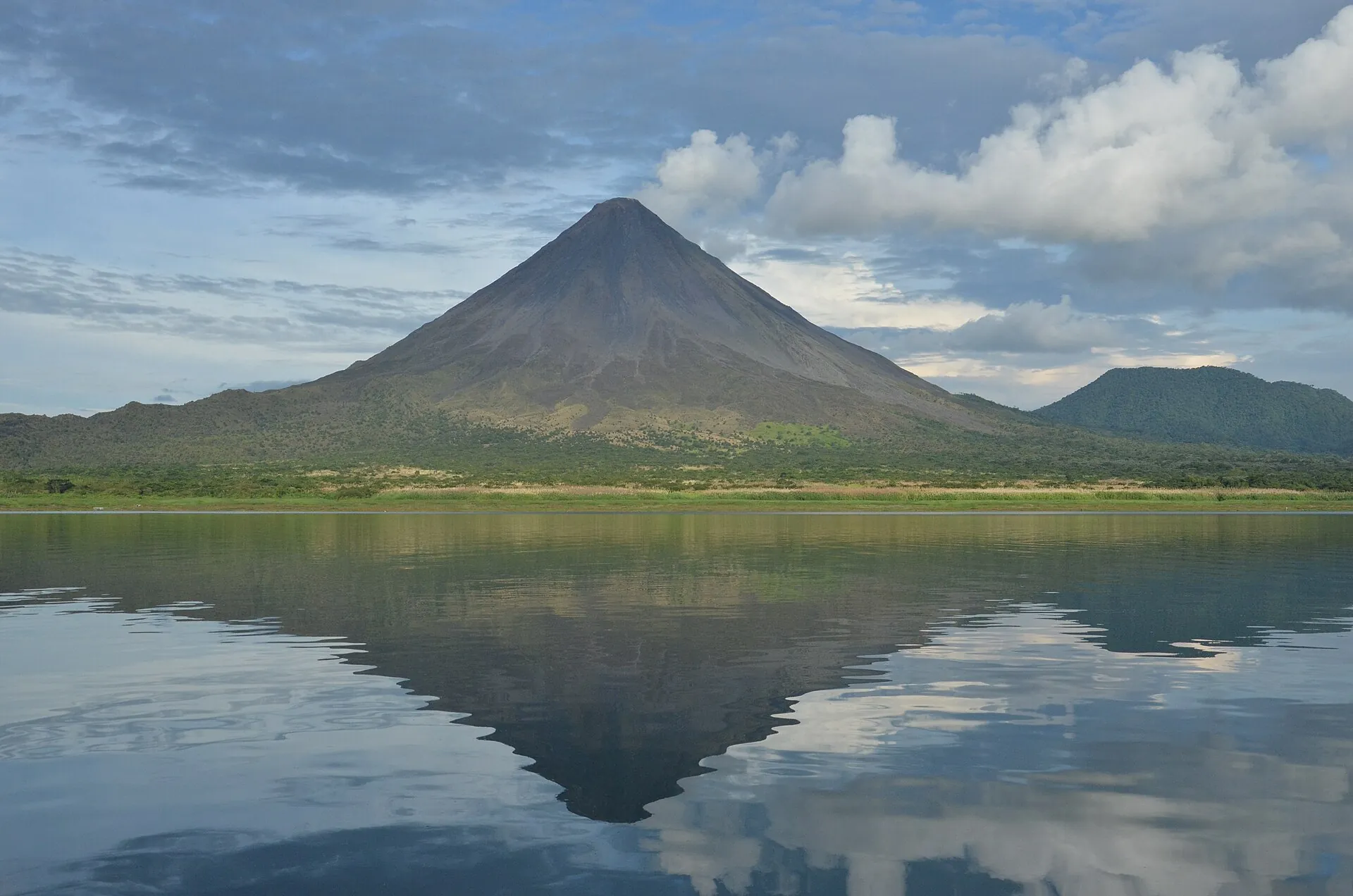
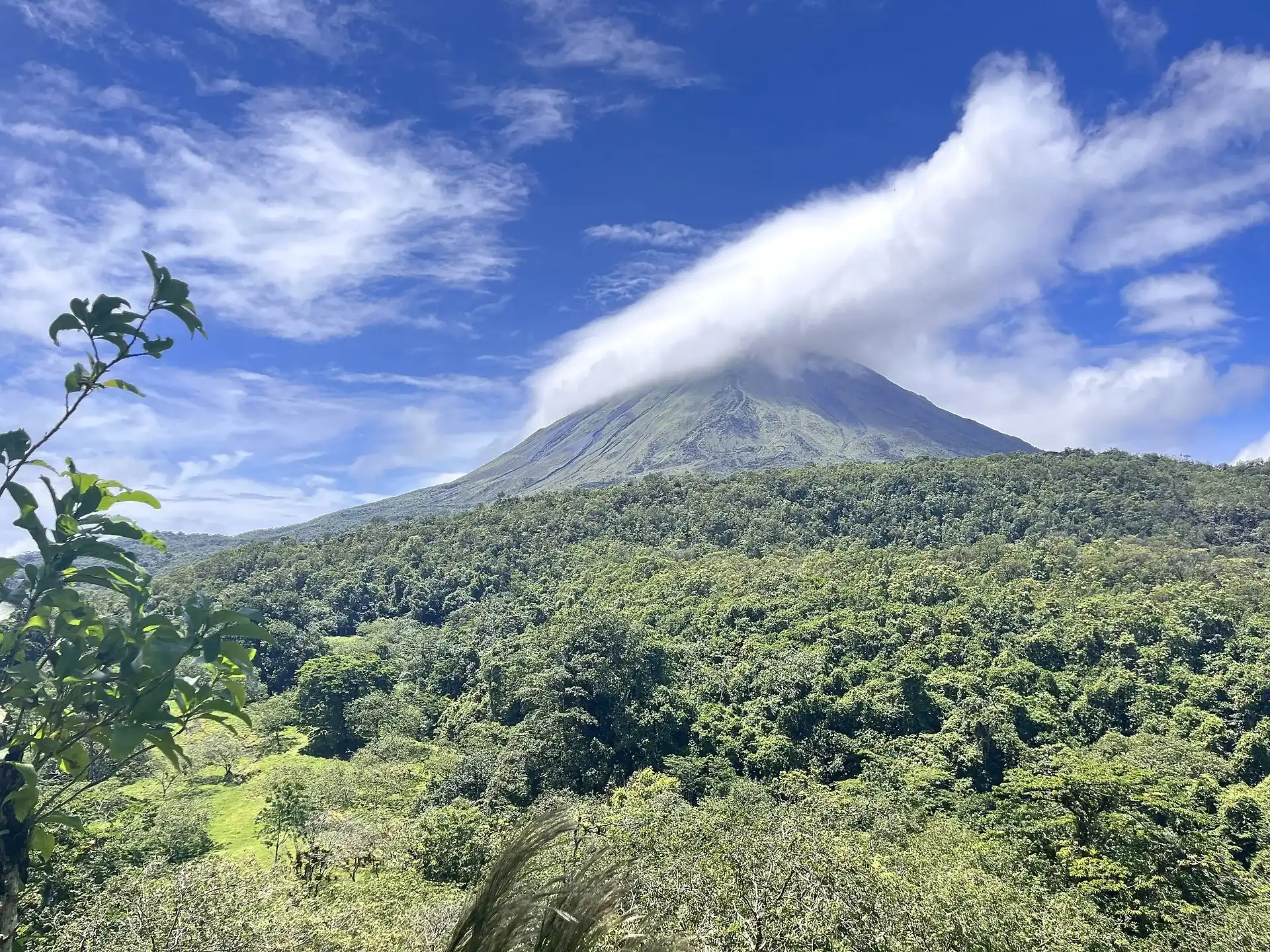
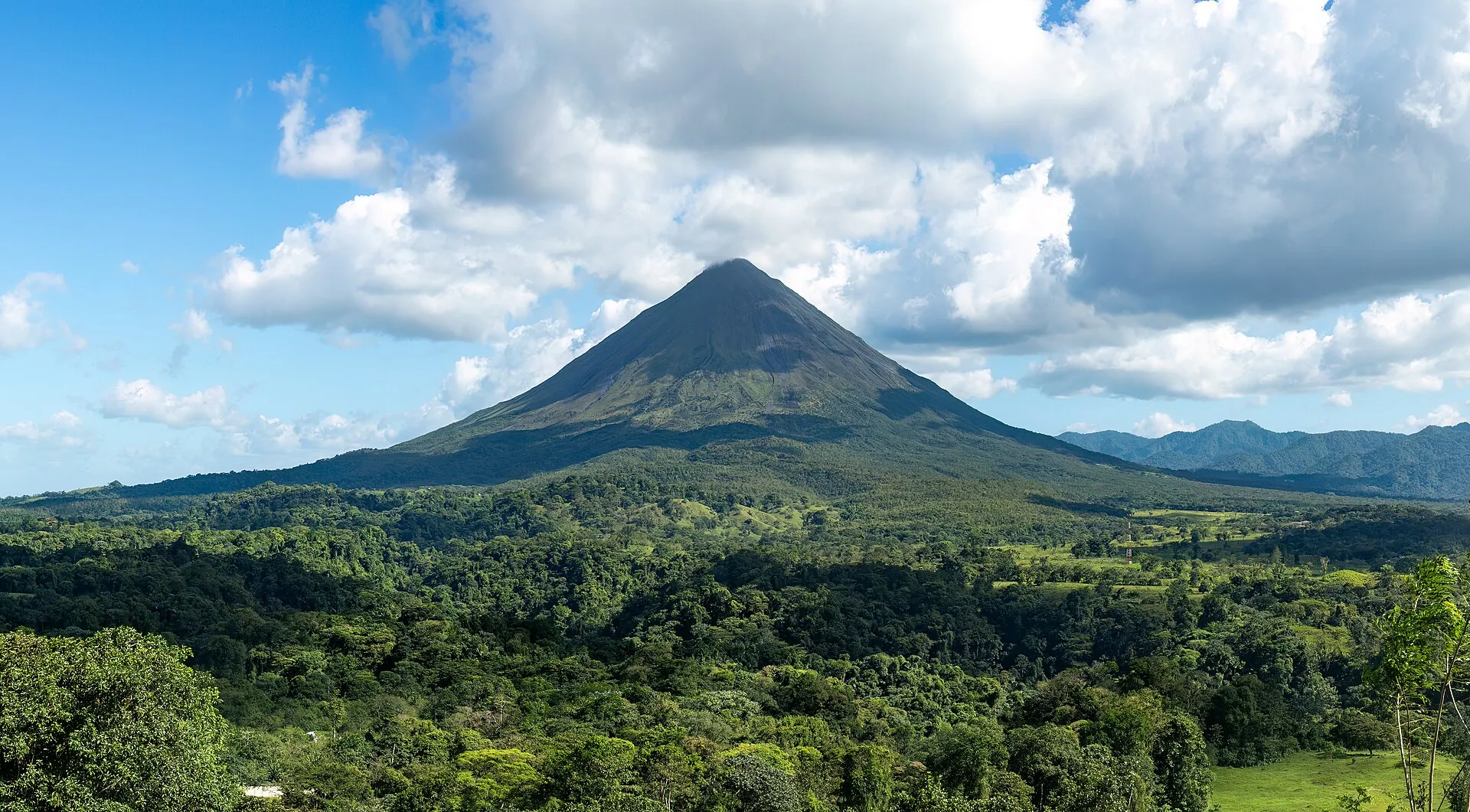
Arenal Volcano rising above the rainforest near La Fortuna, its summit wrapped in a plume of cloud The cloud-free cone of Arenal Volcano above rainforest and pasture, Costa Rica Arenal Volcano reflected in the still water of Lake Arenal

Arenal Volcano

Most of the time it wears a cloud. Sometimes all day.

Early in the morning it stands clear: a cone like a drawing, in the middle of the rainforest.

It no longer glows. It has been quiet since 2010 – and is still the reason to come.

Scroll –
wait for it to appear

As of 21 September 2026Arenal Volcano today: no lava, no summit – and still worth the trip

First, what many old guidebooks leave out: nothing glows at Arenal anymore. Continuous activity ended in 2010, the last lava flow stopped in January 2011, and no glow has been observed since. If you come for red lava at night, you'll be disappointed. What you do get: a nearly perfect cone above the rainforest, trails over the solidified 1968 and 1992 flows, Lake Arenal, and hot springs. The volcano institute OVSICORI has the mountain at level 1 "Calma," the lowest activity level.

Banned

Summit and Cerro Chato

The volcano's cone and neighboring Cerro Chato with its green lagoon are completely closed – guided or not. There is no legal way up and no permit available on request. Since 30 April 2026, press reports say fines apply under Law No. 10.861.

Fine for participants, per La Nación₡1,386,600
Open

Arenal Volcano National Park

Both entrances – Sector Volcán with the 1992 lava field and the lakeside Sector Península – are open daily from 8 am to 4 pm, including holidays. You pay at the ticket booth on site. There is no online ticket or time slot for Arenal.

Foreign visitors 13+, incl. 13% VAT$16.95
Open

Private reserves around the mountain

Arenal 1968, the Arenal Observatory Lodge, the Místico hanging bridges and the hot springs along Route 142 each have their own admission and hours – some longer than the national park. Místico requires a reservation.

Observatory Lodge Entrance Pass$22
Sources: OVSICORI-UNA, activity levels (chart from 24 July 2026) · National Seismological Network (last lava January 2011) · ICT tourism board (hours, net rate $15) · SINAC online system SICORE, accessed 21 September 2026 (Arenal not included). The official SINAC park page was unreachable on 21 September 2026. We did not review the wording of Law No. 10.861; amounts per La Nación and San Carlos Digital.
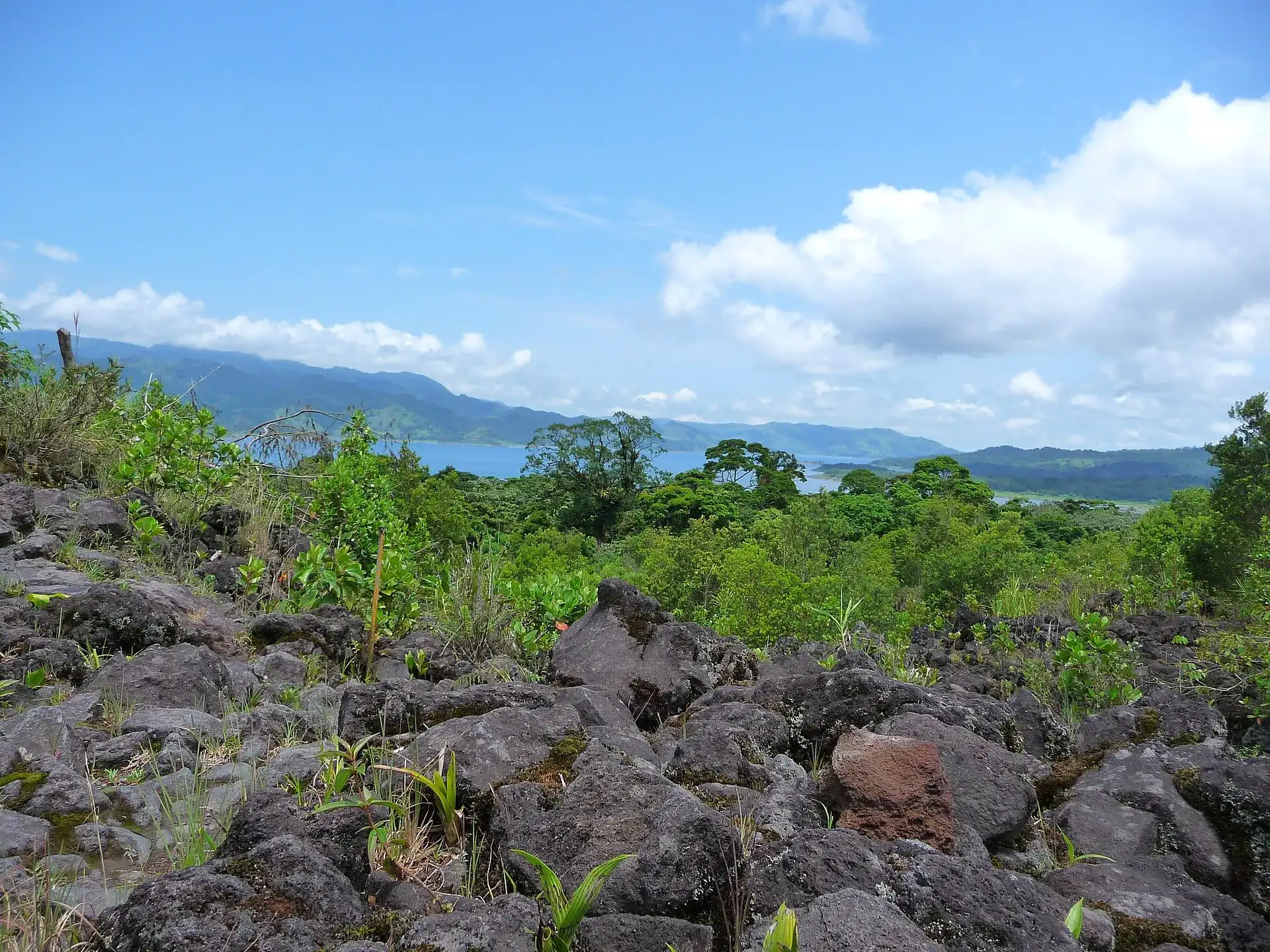
Coarse black lava blocks of a solidified flow at Arenal Volcano, young green growth between them, Lake Arenal in the background
Lava once flowed here. Now the forest is growing back over it – and you walk right through.

Photo: Yricordel · CC BY-SA 3.0

What to expectArenal hike: across the 1968 and 1992 lava fields

Every trail ends at the foot of the mountain. That sounds like little – until you're standing on the lava field.

From the park's control house it's about 1.5 km (0.9 miles) to the 1992 flow: first secondary forest, then a short, uneven climb over coarse black blocks. There's no shade up top, but a clear view – the cone ahead, Lake Arenal behind. Ferns and young trees are already growing back on the blocks; you can watch the forest reclaiming it.

The El Ceibo loop (2.3 km/1.4 miles, largely flat) runs through the forest to an old ceiba tree. With luck you'll hear howler monkeys before you see them. Whether the summit is clear is up to the weather: La Fortuna sits on the rainy Caribbean side, and most travelers find clouds build up through the morning. Being at the ticket booth by 8 am gives you the best odds. No month and no tour can guarantee a clear cone.

Affiliate links to GetYourGuide: if you book, we earn a commission and the price stays the same. Prices and ratings as of 21 September 2026. None of these tours goes to the summit – that would be illegal. Whether the cone is clear is up to the weather.

The rulesAdmission, tickets, and the summit ban

Arenal is one of the few major parks in Costa Rica without an online ticket. If you're coming from Poás or Río Celeste, you'll search the SINAC system in vain – Arenal isn't on the list. But on the mountain itself, the country's strictest rule applies.

1

Ticket booth on site, no online ticket

You buy admission right at the park's ticket booth. Per SINAC, parks without the online system take credit or debit card; whether Arenal also accepts cash is not documented. Bring a card.

2

$16.95, not $15

The often-quoted $15 is the net rate. A 13% VAT is added to every SINAC admission. Children 2 to 12 pay $5.65, younger children nothing. There's no refund for clouds or rain.

3

No guide needed

All trails in the national park and the private reserves are marked and can be walked alone. A nature guide is worthwhile for spotting wildlife but isn't required. Dogs are banned in all SINAC areas.

4

Summit: not a guide requirement, a ban

Anyone offering an "Arenal summit hike" or "Cerro Chato" tour is acting illegally. Per press reports, since 30 April 2026 guests are fined too – and anyone who needs rescuing pays extra. SINAC has announced stepped-up checks, including at night.

Official prices · as of 09/2026
Arenal Volcano National Park, foreign visitors 13+ ($15 + 13% VAT)$16.95 (approx. €15)
National park, foreign children 2–12 · free under 2$5.65 (approx. €5)
National park, Costa Ricans and residents: adults / children₡1,000 / ₡500
Arenal Observatory Lodge: Entrance Pass / Day Pass with lunch$22 (approx. €19) / $40 (approx. €35)
Místico Hanging Bridges, self-guided: morning / afternoon, plus taxfrom $32 / from $28
Fines under Law No. 10.861 – amounts per press reports, 2026 base salary: ₡462,200
Entering a closed zone (3 base salaries) – also applies to advertising banned tours, including on social media₡1,386,600
Operators who sell such tours (7 base salaries)₡3,235,400
Guides and operators who take guests into high-risk zones (10 base salaries), plus confiscation of equipment₡4,622,000
Surcharge per person rescued (5 base salaries); repeat offenders pay 50% more and get a one-year park ban₡2,311,000
Sources: ICT tourism board (rates, hours) · Guanacaste Conservation Area (gross price of the $15 rate: $16.95) · SINAC online system FAQ (card payment) · arenalobservatorylodge.com · misticopark.com. Fines: La Nación and San Carlos Digital on Law No. 10.861, in force since 30 April 2026 – we did not review the law's wording itself, and colón amounts are not converted for lack of a verified rate. First case: on 2 May 2026, SINAC caught four people on the Arenal summit.

Trails at the foot of the mountainNational park or private reserve? All the trails compared

None of them go up. But four trail networks bring you close to the cone – two state entrances, two private neighbors.

Arenal trails · length, duration, admission
National park, Sector Volcán – Las Coladas, El Ceibo, Heliconias, Los Tucanes, Los Miradores trails. About 1.5 km (0.9 miles) to the 1992 lava field with its viewpoint; El Ceibo loop 2.3 km (1.4 miles), largely flat. Daily 8 am–4 pm.2–3 hours · $16.95
National park, Sector Península – second entrance on Lake Arenal: two paved trails to the shore, a multi-level viewing tower, one trail built for limited mobility. Whether one ticket covers both sectors the same day is unclear – ask at the booth.1–1.5 hours · same rate
Arenal 1968 (private) – Sendero Colada 1968 (2.5 km/1.6 miles) over the 1968 lava flow, Sendero Bosque 1968 (4.5 km/2.8 miles) around Los Patos lagoon. Price and hours come from a travel portal; the operator's own website lists no price.1.5–2.5 hours per trail · about $25, unconfirmed
Arenal Observatory Lodge & Trails (private) – 11 km (6.8 miles) of trails on the south slope with Danta waterfall, hanging bridges, two viewing towers and a museum; 800 m (0.5 miles) wheelchair accessible. Daily 5:30 am–5:30 pm, trails until 5 pm.half day to full day · $22

Around the mountainHanging bridges, hot springs, viewing towers

If the cone is stuck in cloud, the day isn't wasted. These four spots work in any weather – and since the national park has no time slots, you can push your visit to the next clear morning.

Arenal 1968

Right next to the national park access road: two loop trails over the 1968 flow and through forest to Los Patos lagoon, about 7 km (4.3 miles) combined. Per a travel portal, open longer than the park (8 am–5 pm, last entry 4 pm).

per a travel portal, not officially confirmedabout $25

Arenal Observatory Lodge

The closest legally reachable viewpoint to the crater with infrastructure: towers, a café, wide trails. Online booking recommended, payment at the gate possible.

Entrance Pass · with lunch $40$22

Místico Hanging Bridges

A 3.2 km (2 mile) loop with six hanging bridges and ten fixed bridges through the rainforest, about two hours. Admission every 30 minutes from 6:00 am to 3:50 pm, reservation required, closed shoes mandatory.

afternoon · morning from $32, plus taxfrom $28

Hot springs on Route 142

The Río Tabacón is warmed by the volcano; several thermal resorts with day passes line the road. Spots are capped – reserve ahead. We did not verify official prices.

ask the resort for pricing
Sources: arenalobservatorylodge.com/day-passes · misticopark.com (self-guided hanging bridges) · arenal1968.com (trails, no prices) · mytanfeet.com as a secondary source for Arenal 1968. All accessed 21 September 2026.
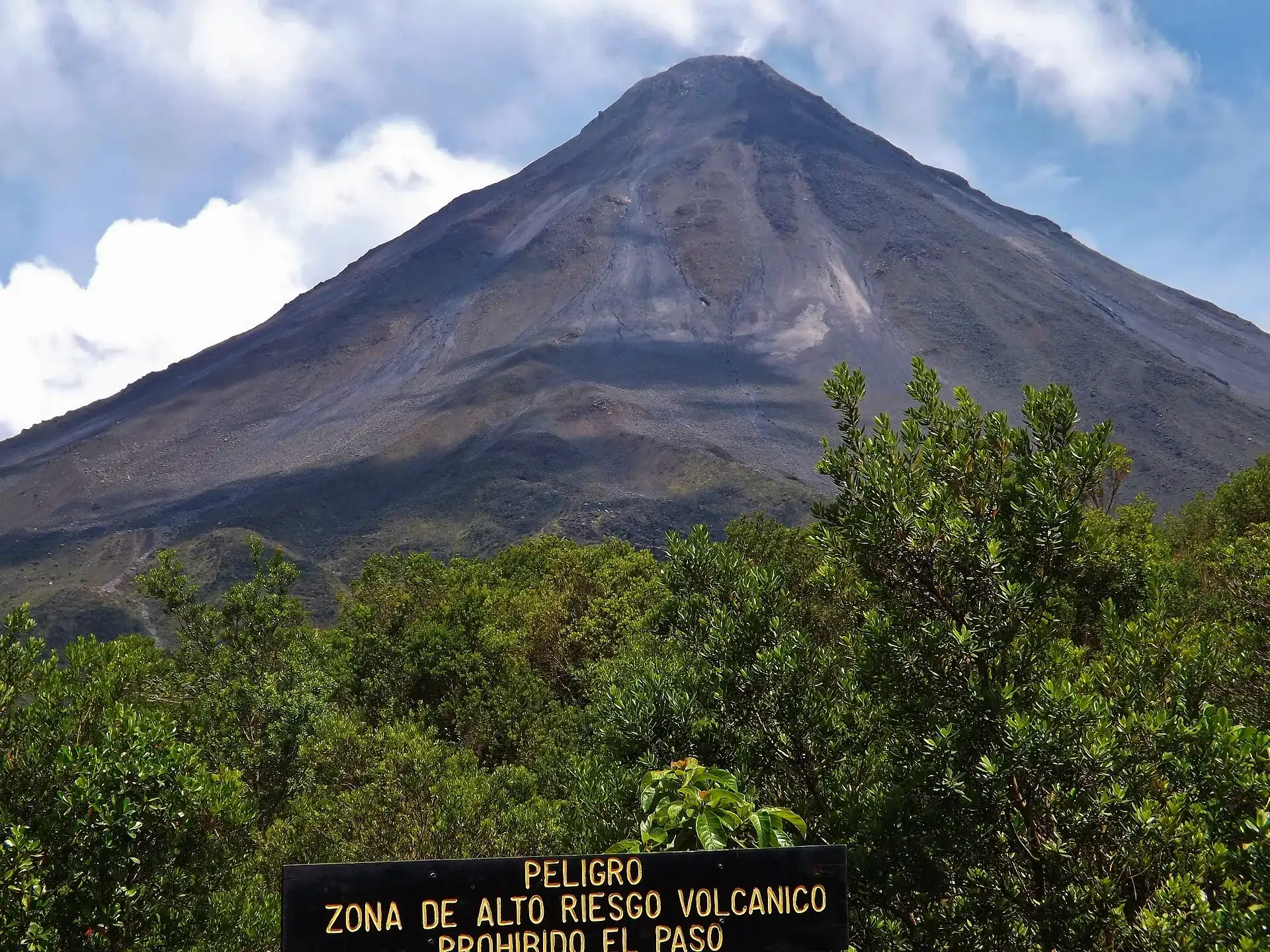
The gray cone of Arenal Volcano above scrubby forest, a warning sign in the foreground reading: Peligro, Zona de alto riesgo volcánico, prohibido el paso
"Prohibido el paso." The sign means it – and since 2026, financially too.

Photo: Peloy (Allan H.M.) · CC BY-SA 3.0

Good to knowGetting there from La Fortuna, best time, tips

Getting there

By car: From La Fortuna on Route 142 toward Tilarán/Nuevo Arenal, after about 15 km (9 miles) turn left to the national park ticket booth. The same gravel road continues to Arenal 1968 and the Observatory Lodge. Parking at the ticket booth; the Sector Península lot is small.

  • From La Fortuna · 20–25 minutes
    rental car or taxi via Route 142; no scheduled bus runs to the ticket booth
  • From San José · about 3–3.5 hours
    Pan-American Highway to San Ramón, then via Los Ángeles, La Tigra and Chachagua to La Fortuna (ICT route description)
  • From Liberia · about 2.5–3 hours
    via Cañas and Tilarán along the north shore of Lake Arenal

Best time to go

You are most likely to see the free cone early in the morning, between sunrise and about 9 am; clouds build up through the day almost every time. The drier months are February to April, but La Fortuna sits on the rainy Caribbean side of the divide and has no sharp dry season – it rains regularly even in the "summer," and in September/October the weather here is often better than on the Pacific coast. Staying several days significantly raises your odds of a cloud-free morning.

Who it suits

Children
Good for kids: short, marked trails with no fall hazards; children 2 to 12 pay $5.65 at the national park. The lava field is coarse and blocky – hold small children's hands.
Minimum age
none
Fitness
Easy to moderate. El Ceibo is largely flat; the climb onto the lava field is short but uneven.
Heart and lungs
No official restrictions found; no gases escape along the visitor trails.
Wheelchair
In Sector Península one trail is built for limited mobility; the Observatory Lodge lists 800 m (0.5 miles) of wheelchair-accessible trail, Místico a barrier-free 250 m (820 ft) route and electric carts.
Dogs
Banned in all SINAC protected areas.
Clothing
A rain jacket in any season – the Caribbean side is humid even in the dry season. Sun protection for the shadeless lava field.
Footwear
Sturdy, closed-toe shoes with tread; Místico requires closed shoes.

Tips you will need on site

  • Bring a credit card: per SINAC, parks without the online system take card payment at the booth. There is no advance online sale for Arenal.
  • Be at the ticket booth by 8 am. Clouds usually roll in as the morning goes on, and the lava field has no shade.
  • The national park and Arenal 1968 share the same access road – don't mix them up. The park is cheaper ($16.95); the private reserve has longer hours and covers the older 1968 flow.
  • If you just want a viewpoint with a tower, café and wide trails, the Observatory Lodge's Entrance Pass ($22) is a good fit.
  • Skip offers for an "Arenal summit hike" or "Cerro Chato": both are closed, and since 2026 the guest is on the hook too, for a fine of about ₡1.39 million.
  • If the cone doesn't show on the first morning: do the hanging bridges or hot springs first and save the park for the next clear morning – there are no fixed time slots.
  • Leave dogs at the lodging; pets are banned in SINAC areas.

A short history

  • Arenal is geologically very young – less than 7,500 years old – and was considered an extinct, forested mountain until 1968.
  • On 29 July 1968 it erupted on the west flank without warning after centuries of dormancy; three new craters opened. The villages of Tabacón, Pueblo Nuevo and San Luis were destroyed. The RSN puts the death toll at 81 – the highest of any Costa Rican volcano – other sources say 78 or 87.
  • From 1968 to 2010, Arenal was almost continuously active: lava flows, explosions, glowing rock avalanches. It was one of the longest eruptions in the world since 1750.
  • The national park was established in 1991; the 1992 lava field is now the main trail's destination.
  • From July 2010 – exactly 42 years after it woke up – activity dropped off sharply. The last lava flow stopped in January 2011; no glow has been observed since.
  • Today the observatories register only microquakes and gas emissions. The RSN names landslides on the steep, loose cone and possible reactivation as the main hazards.
  • Between late 2025 and early 2026, SINAC counted 408 illegal entries into protected areas; according to La Nación, black-market operators charged about ₡40,000 per person for the Arenal summit. That led to the fine law, No. 10.861 (in force 30 April 2026).

More than the mountainLa Fortuna tours: day trip from San José, sloths, night walk

Per the ICT route, it's about three to three and a half hours each way from San José – so day tours run about 14 hours. If you're already in La Fortuna, fill a cloudy afternoon with wildlife instead of views.

Affiliate links to GetYourGuide: if you book, we earn a commission and the price stays the same. Prices and ratings as of 21 September 2026. At night at Arenal you'll see frogs and snakes, not lava.

Outdated onlineWhat other sites get wrong

“You can see glowing lava at Arenal at night.”
Not since 2010/2011. The National Seismological Network states that no glow has been observed since January 2011; OVSICORI has the volcano at level 1 "Calma." The evening lava tours from old guidebooks no longer exist.
“You have to buy Arenal tickets online through SINAC in advance.”
Mixed up with Poás, Tenorio or Manuel Antonio. Arenal isn't in the online system; admission is at the park ticket booth, by card per SINAC.
“You can climb Arenal with a local guide.”
Illegal. The cone and Cerro Chato are closed; per press reports, fines of ₡1,386,600 have applied to participants since 30 April 2026, and up to ₡4,622,000 for guides, plus rescue costs. Older blogs date from before then, when the ban carried no penalty.
“Admission costs $15.”
That's the net rate. With 13% VAT you pay $16.95. Some older sites still list $10.
“Cerro Chato with its green lagoon makes a great day hike.”
Still found in plenty of older travel guides. SINAC has explicitly banned access to both the Arenal and Chato cones.

Quick answersBefore you go to La Fortuna

Is Arenal Volcano still worth it without lava?

Yes, if you know what you're getting: one of Central America's most striking volcanic cones, trails across young lava fields, rainforest with hanging bridges, and hot springs. No, if you want to see glowing lava – that hasn't existed since 2010/2011.

How tall is Arenal Volcano?

Sources disagree: La Nación and OVSICORI give 1,670 m (5,479 ft), Wikipedia 1,633 m (5,358 ft), the National Seismological Network about 1,750 m (5,741 ft). It doesn't matter for visitors – every trail lies at the foot of the mountain.

How many days should I plan for La Fortuna?

Several. There are no fixed time slots at Arenal, so you can save the national park for the clearest morning and spend other days on hanging bridges, a waterfall, or hot springs.

Which Arenal tour from La Fortuna is right for me?

Full-day tours combine a waterfall, a hike near the volcano and hot springs (about 10 hours); the 6-hour morning tour is the cheapest option. What's actually included – admission fees, food, the hot spring – is listed in the operator's description; check before booking.

Can you combine Arenal and Río Celeste?

Yes, Tenorio National Park and the Río Celeste are a common day trip from La Fortuna. Unlike Arenal, you need an online ticket there – details on our Río Celeste page.

Can you climb Arenal Volcano?

No. The cone is completely closed because of gases, loose rock and landslide risk, as is neighboring Cerro Chato. Since 30 April 2026, an illegal climb carries a fine of at least ₡1,386,600 under Law No. 10.861, up to ₡4,622,000 for guides.

Can you still see lava at Arenal?

No. Continuous activity ended in 2010, and the last lava flow stopped in January 2011. The volcano has been at the lowest activity level ever since; what you see are the solidified lava fields and, occasionally, a plume of steam.

Do I need to buy Arenal National Park tickets online?

No. Unlike Poás, Rincón de la Vieja or Tenorio, Arenal is not in the SINAC online system. You pay at the park ticket booth, by credit or debit card per SINAC, and you don't need a time slot.

What does admission to Arenal National Park cost in 2026?

Foreign adults pay $15 plus 13% VAT, so $16.95 (about €15). Children 2 to 12 pay $5.65; younger children are free.

When is Arenal National Park open?

Daily from 8 am to 4 pm, with no closing day, including holidays. That applies to both entrances, Sector Volcán and the lakeside Sector Península.

Do I need a guide at Arenal?

No, the trails in the national park and the private reserves are marked and can be walked alone. A nature guide is worthwhile for spotting wildlife but not required.

How long does a visit to the national park take?

Plan two to three hours for the 1992 lava field with its viewpoint and the El Ceibo loop (2.3 km/1.4 miles). Sector Península on the lake takes one to one and a half hours.

What's the difference between the national park and Arenal 1968?

The national park is state-run, costs $16.95 and leads to the 1992 lava flow. Arenal 1968 is a private reserve next door with two loop trails (2.5 and 4.5 km/1.6 and 2.8 miles) over the 1968 flow and longer hours; admission runs about $25.

When is the best time to see Arenal?

Early morning, before the clouds build up. February to April are a bit drier, but La Fortuna sits on the Caribbean side and has no reliable dry season – staying several days is your best insurance.

Is Arenal dangerous?

Not on the official trails: OVSICORI has the volcano at level 1 "Calma," and the CNE has issued no warning. The closed cone, with its gas vents and unstable slopes, is dangerous. Still, the 1968 eruption, which killed around 80 people, struck without warning – which is why the mountain is monitored continuously.

Is Arenal suitable for children?

Yes. The trails are short with no fall hazards, and children 2 to 12 pay a reduced rate. The lava field's surface is coarse, so sturdy shoes are needed.

How do I get from La Fortuna to the national park?

By rental car or taxi, about 15 km (9 miles) on Route 142 toward Tilarán, then left to the ticket booth. The same gravel road continues to Arenal 1968 and the Observatory Lodge.
Sources · accessed on 21 September 2026