Volcano·Guide
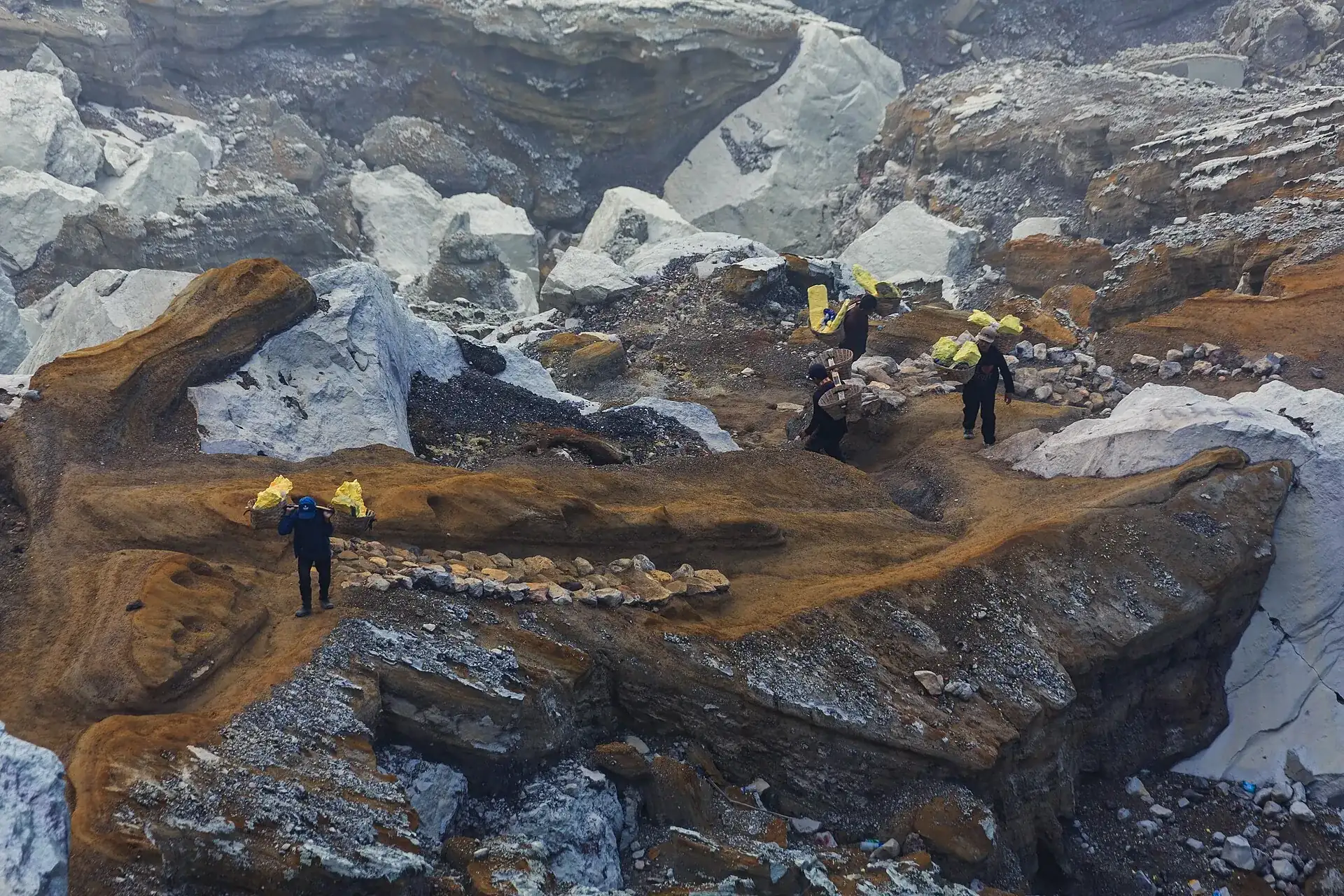
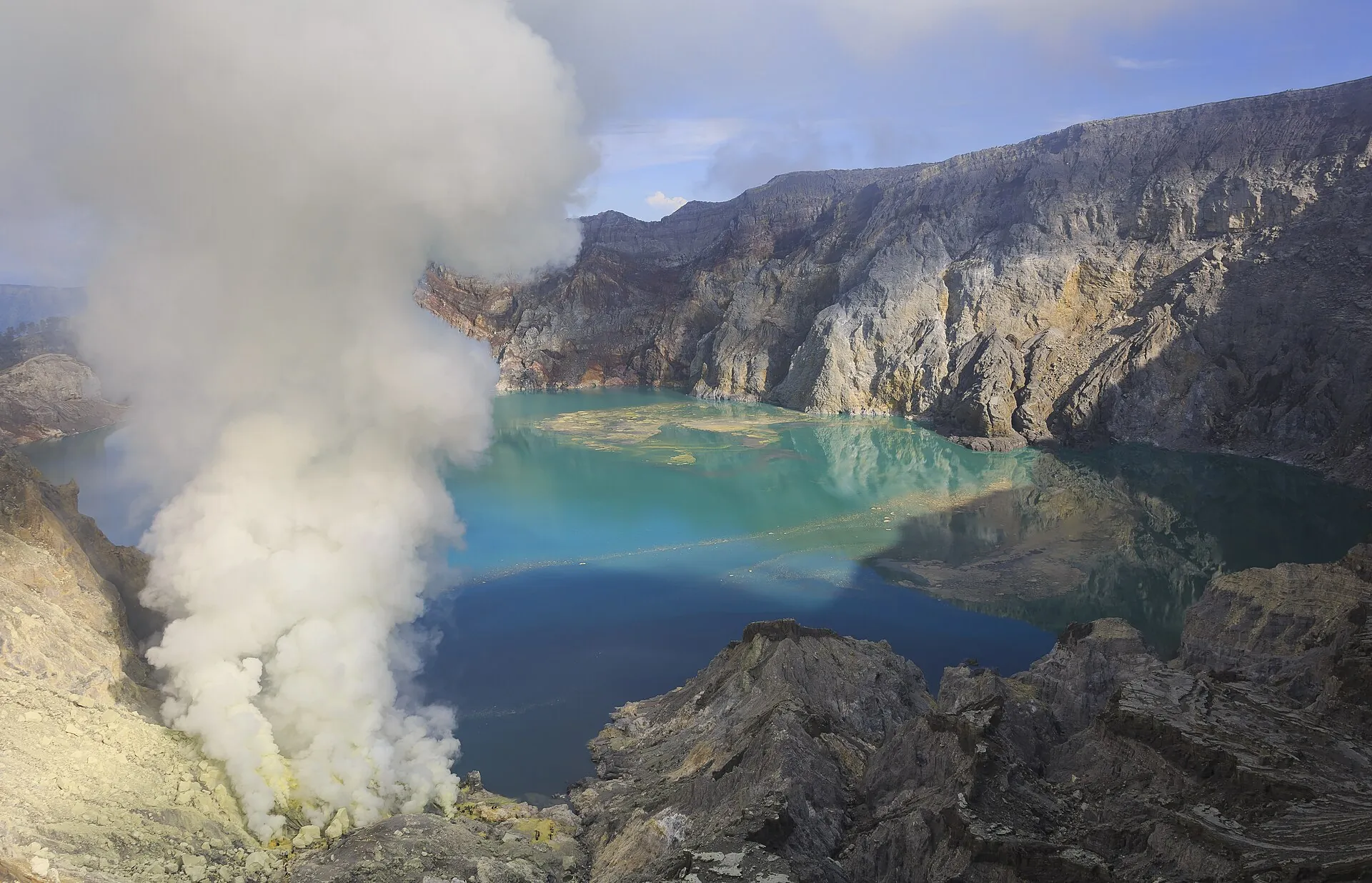
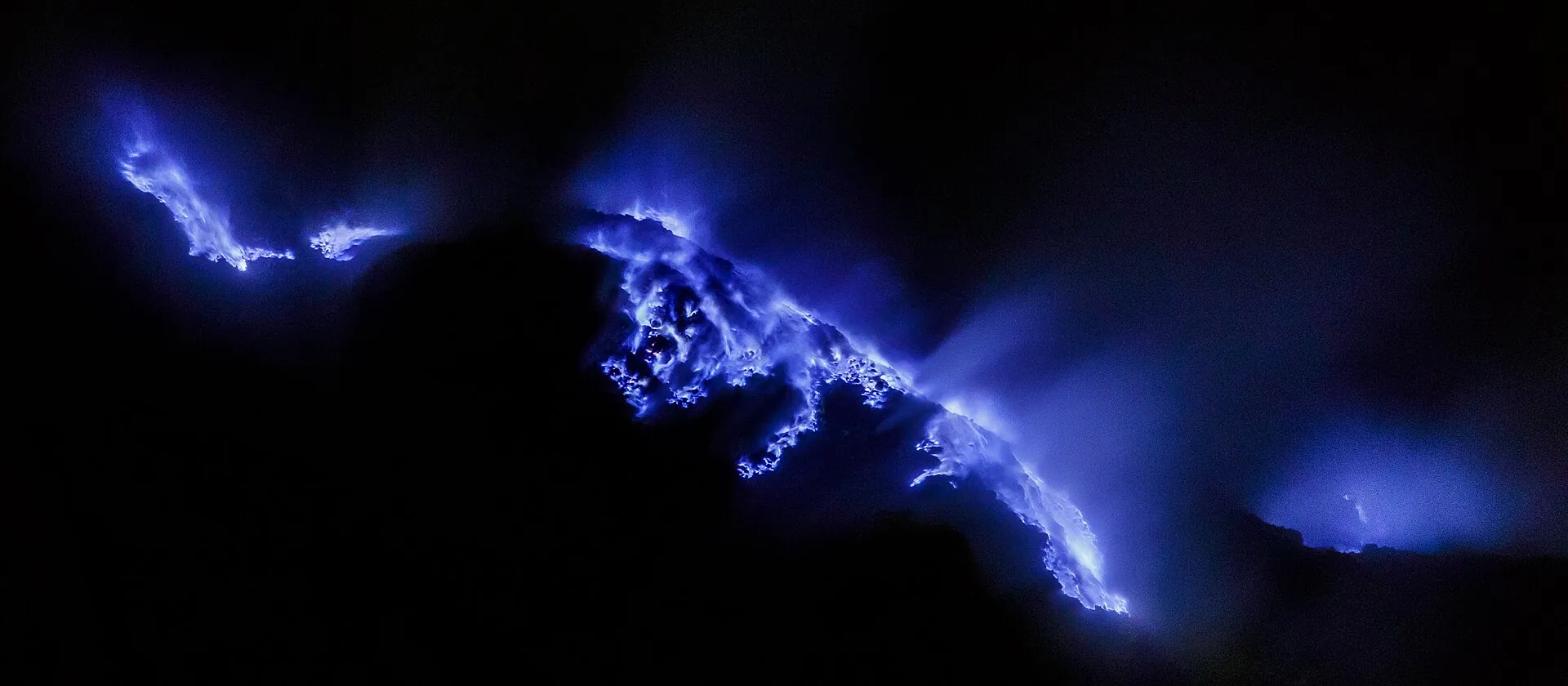
Blue flames from burning sulfur gas in the pitch-black crater of Kawah Ijen The turquoise acid lake of Kawah Ijen in the morning light, steam drifting over the water, more volcanic cones in the background Sulfur carriers with yellow-filled baskets on the rocky path in the crater of Kawah Ijen

Kawah Ijen

At night something blue burns in the crater. It isn't lava – it's gas.

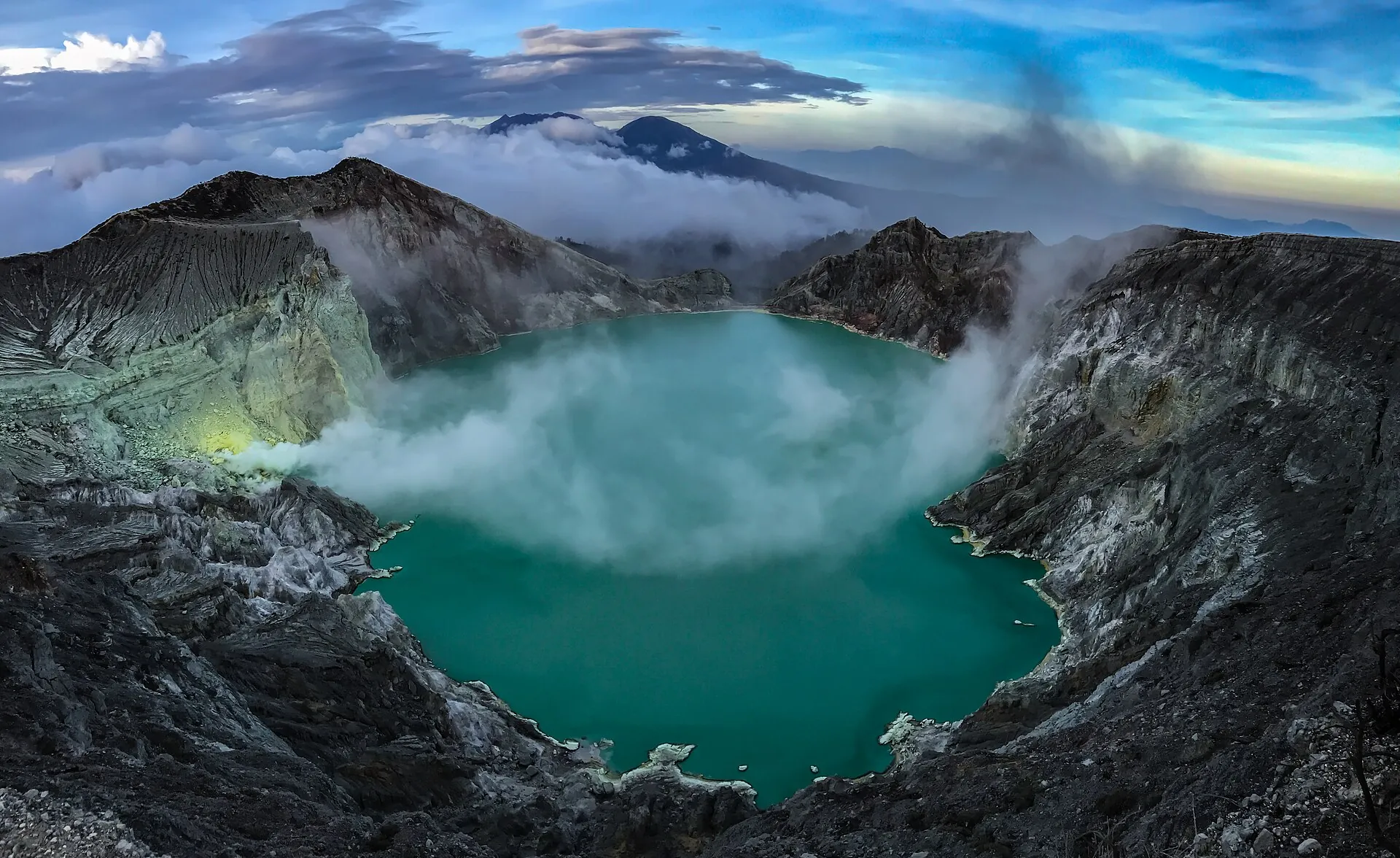
When it gets light, a turquoise lake lies beneath it. It's acid.

And on the path you pass men carrying 75 kilograms (165 lb) of sulfur.

Scroll –
from night into morning

As of 21 September 2026Kawah Ijen today: closed since 4 September 2026 for a wildfire

Kawah Ijen is closed. The conservation authority BBKSDA Jawa Timur closed the park on 4 September 2026 “until further notice” because of a forest and brush fire. On 17 September, the news agency Antara reported: fire extinguished, visits still closed, no circular yet on reopening; the authority spoke of cooling and remaining hotspots. We found no reopening as of 21 September.

That doesn't mean it's still closed on your travel date – it means you have to check before you book. Hotels and drivers in Banyuwangi usually know fastest; the BBKSDA circular is what's binding. Tours keep being sold in the meantime.

This has nothing to do with the volcano itself: the volcano authority PVMBG has Ijen at Level I (Normal), the lowest of four levels. Everything below describes normal operation.

Closed since Sept 4
2,386m

Paltuding hiking trail – crater rim

The entire nature park is closed, so this includes the standard route to the rim and the sunrise point. According to press reports, the fire reached as far as the hiking trail. The authority named no reopening date on 17 September.

BBKSDA Jawa Timur · Antara, 17 September 2026
Closed · also not recommended otherwise

Crater floor and blue fire

Even under normal operation, PVMBG recommends at the lowest alert level against descending to or approaching the crater floor – meaning where the sulfur is mined and the blue fire burns.

PVMBG daily report, 20 September 2026
Freely accessible
1,850m

Paltuding parking lot and base camp

You can reach the gate at Paltuding, about 1,850 m (6,070 ft), without a ticket. Beyond it the park begins – and it's currently closed. A trip only pays off again once BBKSDA reopens.

Park fee per official fee schedule
Always closed

Every first Friday of the month

Regardless of the fire: on the first Friday of every month, Ijen is closed for 24 hours – trash collection, trail maintenance, a rest for the ecosystem (“Ijen Rijik,” since January 2019). Next date: 2 October 2026.

12:00 am–11:59 pm
Sources: Bisnis.com, 4 September 2026 (BBKSDA Jawa Timur's closure letter) · Antara, 17 September 2026 · Kilas Jatim, 17 September 2026 · MAGMA Indonesia / PVMBG, daily report of 20 September 2026. The official ticket portal tiket.bbksdajatim.org and the authority's site were unreachable from here on 21 September 2026; prices, the certificate requirement and opening hours are therefore based on press reports about BBKSDA's announcements.
View from the crater rim of Kawah Ijen: a dense yellow-white cloud of sulfur steam rises next to the turquoise acid lake
Beautiful is the right word. Harmless is not.

Photo: CEphoto, Uwe Aranas · CC BY-SA 3.0

The experience – once it reopensKawah Ijen: night ascent, acid lake, sunrise at the crater rim

Around midnight your driver picks you up in Banyuwangi. The gate at Paltuding opens at 2 am, and then it's uphill by headlamp: about 3 km (1.9 miles), a good 500 m (1,640 ft) of elevation gain, an hour and a half to two hours.

The path is wide and sandy, flat at first, then steep. Six rest posts line the route. It's cold and windy up on the rim, and you smell the mountain before you see it: sulfur. If the wind turns, the cloud drifts across the path – then mask on, breathe calmly, walk out crosswise to the wind.

With the first light, the lake appears below. Turquoise, a kilometer (0.6 mile) wide, with a pH under 0.5 – it's considered the largest strongly acidic crater lake in the world. Solfataras smoke yellow-white along the shore. The sunrise over this lake is the reliable part of the tour. The whole visit takes four to six hours; the park closes at noon.
Let's be honestIjen blue fire: what it is – and why it doesn't burn every night

The blue fire is not lava. It's sulfur gas that escapes from fissures at up to 600°C (1,112°F) and burns in the air; part of it condenses into liquid sulfur that flows off burning blue. It's only visible in complete darkness, roughly between 2 and 4:30 am.

Whether it burns isn't only up to nature. The gases are part of sulfur mining – and burning sulfur reduces the yield. From 1 November 2025 to about March 2026 the blue fire was out for months: the concession holder PT Candi Ngrimbi was replacing the sulfur pipes, and the descent to the crater floor was closed. Press reports say it was visible again from about 10 March 2026.

On top of that: the fire burns on the crater floor, and PVMBG advises against the descent there. If the wind turns, the basin can fill with sulfur dioxide within seconds. Only a gas mask with a filter helps against that – not a surgical mask, not a cloth mask. BBKSDA lists a mask, a light and warm clothing as mandatory gear. We could not determine whether there is a current official ruling that permits or bans the descent. A tour with “Blue Fire” in the title cannot guarantee it.

Check the status first, then bookKawah Ijen tour from Banyuwangi

As of 21 September 2026, Ijen is closed – the tours below are still being offered regardless. Book only once the reopening is confirmed, and choose a rate with free cancellation. Under normal operation, a tour from Banyuwangi takes care of the night drive to Paltuding for you; there's no scheduled transport to Paltuding.

Affiliate links to GetYourGuide: if you book, we earn a commission and the price stays the same. Prices and ratings as of 21 September 2026. Ijen was closed on 21 September 2026: check the status first, choose a cancellable rate. Whether entrance (150,000 IDR), the certificate and a gas mask are included in the price is stated in each tour's description – worth checking for prices around €11. No operator can guarantee whether the blue fire will be burning.

The rules under normal operationKawah Ijen entrance, online ticket and health certificate

Two documents, without which nobody gets through the gate at Paltuding: the BBKSDA's online ticket and a doctor's health certificate. The second one surprises a lot of people – and it's taken seriously.

1

Online ticket: 150,000 IDR

About €7.30 per person per day, the same on weekdays and weekends. Booked at tiket.bbksdajatim.org; the barcode is exchanged for the ascent ticket at the gate. Tickets are, per BBKSDA, neither rebookable nor refundable. Many travelers let their driver or hotel book it.

2

Health certificate – since Jan 6, 2024

The “surat keterangan sehat” is required at the barcode exchange. Anyone with a history of asthma or heart disease is not admitted. Get it the day before from a doctor, clinic or health post in Banyuwangi; per press and blogs it costs about 25,000–40,000 IDR (not official).

3

Open from 2 am to 12 pm

Set by a BBKSDA circular of 9 August 2023. The 1 am you often see cited is the departure time from Banyuwangi – not the gate opening. Closed all day every first Friday of the month; there was most recently a multi-day annual closure in early January.

4

The crater rim is the limit

Even at Level I, PVMBG recommends: don't descend to the crater floor, don't camp within 500 m of the crater, watch for toxic gases at the crater and for CO2 along the Banyupait river. Mandatory gear per BBKSDA: light, mask, warm clothing.

Official prices · in effect since 30 Oct 2024, as of 09/2026 · 1,000 IDR ≈ €0.049
Entrance for foreign visitors, per person per day · same on weekdays and weekends150,000 IDR (approx. €7.30)
Entrance for Indonesian citizens, weekday / holiday20,000 / 30,000 IDR
Hiking activity fee per the fee schedule, per person · whether it's charged on top of entrance is unclear20,000 IDR (approx. €1)
Camping, per person per day · PVMBG recommends against camping within 500 m of the crater5,000 IDR
Parking fees per day, from horses to vehicles with six or more wheels1,500–50,000 IDR
Sources: Detik on BBKSDA's fee notice (from 30 October 2024, PP No. 36/2024) · Liputan6 on the certificate requirement from 6 January 2024 · Circular SE.247/K.2/BIDTEK.1/KSA/8/2023 of 9 August 2023 on opening hours (cited by an operator) · Tempo on the conditions of 26 February 2026. Guide requirement unclear: after a missing-person case, BBKSDA named a licensed guide as a condition in February 2026; we found no published wording. Check with your driver beforehand about what's required at the gate.

One way up, one way downKawah Ijen hike: Paltuding – crater rim

Lengths, elevations and walking times come from press and operator reports – nothing here has been officially surveyed.

Route → path, duration, notes
Standard route, Paltuding (about 1,850 m / 6,070 ft) – crater rim (2,386 m / 7,828 ft)About 3 km (1.9 miles), 1.5–2 hours up, a good 500 m (1,640 ft) of elevation gain. Six rest posts; the first three sections are flatter, then up to about 25% grade. Sandy, slippery when wet. Total visit 4–6 hours. Carriers offer wheelbarrow “taxis” (prices not official).
Descent from the crater rim to the sulfur field (“Blue Fire”) · not officially recommendedAbout 30 minutes each way on the steep, rocky path used by the sulfur carriers. PVMBG recommends against it even at Level I. From 1 Nov 2025 to about March 2026 the path was closed; afterward, press reports say thousands descended again. If the wind turns, the basin can fill with sulfur dioxide within seconds.
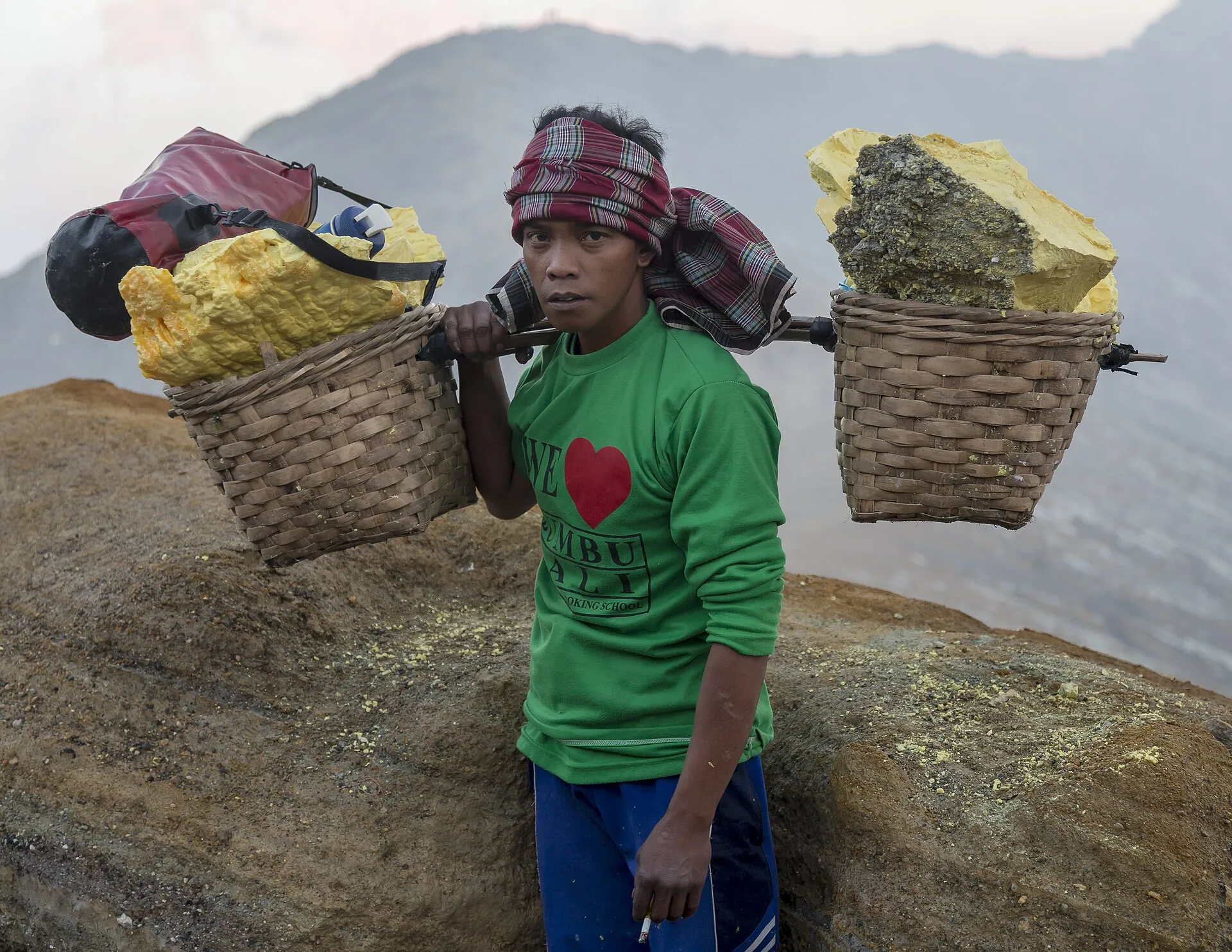
A sulfur carrier at Kawah Ijen carries two baskets filled with yellow sulfur chunks on a pole over his shoulder
For you it's a day trip. For him it's the commute.

Photo: CEphoto, Uwe Aranas · CC BY-SA 3.0

The people on the mountainThe sulfur carriers of Kawah Ijen

Ijen isn't an open-air museum, it's a workplace. Sulfur is mined by hand in the crater: workers channel the gases through pipes, break the hardened sulfur and carry it out of the crater in baskets – 75 to 90 kilograms (165 to 200 lb) per trip.

Per Wikipedia, about 200 workers mine roughly 14 tons a day; the concession holder is PT Candi Ngrimbi. The path visitors take down to the blue fire is their commute.

The takeaway is small but important: always give the carriers the right of way on the narrow path. Ask before you take a photo. Many sell small figurines made of sulfur – buying one pays the man directly.

Good to knowGetting there from Banyuwangi and Bali, best time, tips

Getting there

Without a car: Train to Banyuwangi (Karangasem/Banyuwangi Kota stations, or Ketapang at the ferry port to Bali). There is no scheduled service to Paltuding; a driver, jeep tour or scooter from Banyuwangi or from Sempol (Bondowoso) is standard.

By car: Paved road to the fee-based parking lot at Paltuding; parking fees follow the official fee schedule.

  • From Banyuwangi · 1–1.5 hours
    Driver/tour via Licin to Paltuding, departure around midnight to 1 am
  • From Bondowoso / Sempol · 2–2.5 hours from Bondowoso
    Via the Ijen Plateau (Sempol) to Paltuding
  • From Surabaya · 6–7 hours by train
    Train to Banyuwangi, up the mountain the following night
  • From Bali (Gilimanuk) · ferry about 45–60 minutes plus a 1.5-hour drive
    Ferry Gilimanuk–Ketapang, then a driver to Paltuding

Best time to go

Dry season, April to October: a drier path and more frequently clear nights. In the rainy season (roughly November to March, per the German Foreign Office), fog, mud and closures are more likely. Fire risk rises toward the end of the dry season – in September 2026 fire burned right up to the hiking trail. The blue fire is visible only in complete darkness (roughly 2 to 4:30 am) and only when the mining operation lets the gases burn; avoid the first Friday of the month.

Who it suits

Children
No official minimum age was found. Because of gas, darkness and steepness, it is not suitable for small children; the descent into the crater is off-limits for children.
Minimum age
none officially found
Fitness
Moderate: about 500 m (1,640 ft) of elevation gain over 3 km (1.9 miles), a wide but at times steep path. Carriers offer wheelbarrow “taxis” (prices not official).
Altitude
Rarely a problem at 2,386 m (7,828 ft).
Heart and lungs
Exclusion criterion: BBKSDA does not admit people with a history of asthma or heart disease; the certificate must confirm good health. PVMBG warns of toxic gases at the crater and of CO2 along the Banyupait river.
Wheelchair
not possible
Dogs
no rule found (protected area – assume not allowed if in doubt)
Clothing
Cold and windy at night on the rim; PVMBG measured 18–29°C (64–84°F) during the day at the post on 20 September 2026, with it noticeably cooler at the crater. BBKSDA requires a flashlight or headlamp, a mask and warm clothing. Only a gas mask with a filter protects against sulfur dioxide, not a surgical mask.
Footwear
Sturdy hiking shoes with tread; the path is sandy and slippery when wet.

Tips you will need on site

  • Check the status before you travel: as of 21 September 2026, Ijen is closed because of the fire, and no reopening date had been set as of 17 September. Hotels and drivers in Banyuwangi usually know first; BBKSDA's circular is the binding word.
  • Never plan around the first Friday of the month – it's closed for 24 hours then.
  • Arrange the health certificate the day before in Banyuwangi or through your hotel, and have the online ticket booked in advance; without both, no entry. If you have asthma or heart problems, be honest and skip it.
  • Rent a gas mask with a filter (at Paltuding or through your driver) and keep it within reach. In a gas cloud: mask on, breathe calmly, move out of the cloud crosswise to the wind.
  • The blue fire is not a guaranteed sight: it depends on the mining operation, the wind and the authorities, and PVMBG advises against the descent. Sunrise over the turquoise lake from the rim is the reliable part of the tour.
  • Always give way to the sulfur carriers on the narrow path and ask before taking photos; many sell small sulfur figurines.
  • Plan Bromo and Ijen with a buffer day – in September 2026 both were closed at the same time for a while.

A short history

  • Kawah Ijen is the active crater of a large volcanic complex; the complex's highest point is Gunung Merapi (2,769 m / 9,085 ft). The crater lake is about a kilometer wide and is considered the largest strongly acidic crater lake in the world; pH readings of 0.5 at the rim and 0.13 in the middle were measured in 2008.
  • The blue fire is burning sulfur gas that escapes from fissures at up to 600°C (1,112°F); part of it condenses into liquid sulfur that flows off burning blue. It is not lava.
  • Sulfur is mined by hand: workers channel the gases through pipes, break the hardened sulfur and carry 75–90 kg (165–200 lb) loads out of the crater per trip; per Wikipedia, about 200 workers and roughly 14 tons a day. The concession holder is PT Candi Ngrimbi (operating, per press reports, since 1970).
  • January 2019: BBKSDA introduces the monthly closure day on the first Friday (“Ijen Rijik”).
  • 2023: Ijen Geopark becomes a UNESCO Global Geopark. In August 2023, BBKSDA moves the opening time from 4 am to 2 am.
  • 6 January 2024: the health certificate becomes mandatory; people with a history of asthma or heart disease are excluded. 30 October 2024: a new flat rate of 150,000 IDR for foreign visitors.
  • 1 November 2025 to about March 2026: descent to the crater floor closed, blue fire extinguished – PT Candi Ngrimbi replaces the sulfur pipes; press reports describe a conflict of interest between mining (burning sulfur reduces the yield) and tourism.
  • 19–26 February 2026: closure after a search for a missing person. 4 September 2026: closure because of a wildfire, still not lifted as of 17 September.

From Bali or combined with BromoIjen tour from Bali and Bromo Ijen tour

From Bali it's a ferry (Gilimanuk–Ketapang, 45–60 minutes) and about a 1.5-hour drive. Travelers coming from Surabaya usually combine Ijen with Bromo, six to seven hours to the west – the same combined tours also appear on our Bromo page. The same applies here: Ijen was closed on 21 September 2026. Check the status first, book only with free cancellation.

Affiliate links to GetYourGuide: if you book, we earn a commission and the price stays the same. Prices and ratings as of 21 September 2026. Build in a buffer day for combined tours: in September 2026, Bromo and Ijen were closed at the same time for a while. You need the certificate for a tour from Bali too.

Outdated onlineWhat other sites get wrong

“The blue fire is glowing blue lava.”
It's burning sulfur gas that escapes from fissures at up to 600°C (1,112°F); part of it condenses into liquid sulfur that flows off burning. It is not lava.
“You can see the blue fire every night.”
From 1 November 2025 to about March 2026 it was out for months – the mining operation had throttled the gases for pipe work, and the descent was closed. Otherwise, wind, gas, the mining operation and the authorities all decide.
“Entrance is 100,000 IDR on weekdays, 150,000 IDR on weekends.”
Out of date. Since 30 October 2024, foreign visitors pay a flat 150,000 IDR every day.
“The descent into the crater is part of the visit.”
PVMBG recommends against descending to or approaching the crater floor even at the lowest alert level (report of 20 September 2026).
“A surgical or cloth mask is enough.”
Only a filter mask protects against sulfur dioxide. BBKSDA lists the mask as mandatory gear in its conditions.
“You no longer need a certificate.”
The requirement from 6 January 2024 still applies; BBKSDA reiterated it after the missing-person case in February 2026.

Quick answersBefore you go to Kawah Ijen

When will Ijen reopen after the wildfire?

That wasn't settled as of 21 September 2026. The park has been closed since 4 September; the fire was out by 17 September, but the authority still mentioned hotspots and didn't want to reopen too soon. BBKSDA Jawa Timur announces the reopening by circular – accommodations and drivers in Banyuwangi usually find out first.

Should I book a Kawah Ijen tour now?

Only with free cancellation, and only if you check the status again shortly before your date. Tours are still being sold despite the closure. The park authority's own tickets are neither rebookable nor refundable.

What is the blue fire at Ijen?

Burning sulfur gas, not lava. The gas escapes from fissures on the crater floor at up to 600°C (1,112°F) and burns in the air with a blue flame. You only see it in complete darkness, roughly from 2 to 4:30 am – and only when the mining operation lets the gases burn.

Where do I get the health certificate for Ijen?

From a doctor, clinic or health post (Puskesmas) in Banyuwangi or Bondowoso, ideally the day before. A March 2026 press report also mentions a clinic at the Paltuding parking lot; that's not officially confirmed, so we wouldn't rely on it.

What kind of mask do you need at Ijen?

A gas mask with a filter. Surgical and cloth masks don't block sulfur dioxide. Masks are rented at Paltuding or through your driver; one operator quotes about 45,000 IDR.

Can you visit Ijen from Bali?

Yes: ferry from Gilimanuk to Ketapang (45–60 minutes), then about a 1.5-hour drive to Paltuding. A night in Banyuwangi makes sense, so you can get the certificate and start rested.

Is Kawah Ijen currently open?

No, as of 21 September 2026: BBKSDA Jawa Timur closed Ijen on 4 September 2026 until further notice because of a wildfire. The fire was out by 17 September, but the closure had not been lifted. The authority announces reopening through a circular.

What does Ijen entrance cost for foreign visitors?

150,000 IDR per person per day, about €7.30 (as of September 2026) – the same on weekdays and weekends. The fee schedule also lists a 20,000 IDR hiking fee. The often-cited 100,000 IDR is out of date.

Do you need a health certificate for Ijen?

Yes, since 6 January 2024. A doctor's certificate is required when you exchange your online barcode for the ticket. Anyone with a history of asthma or heart disease is not admitted.

Sources · accessed on 21 September 2026