Volcano·Guide
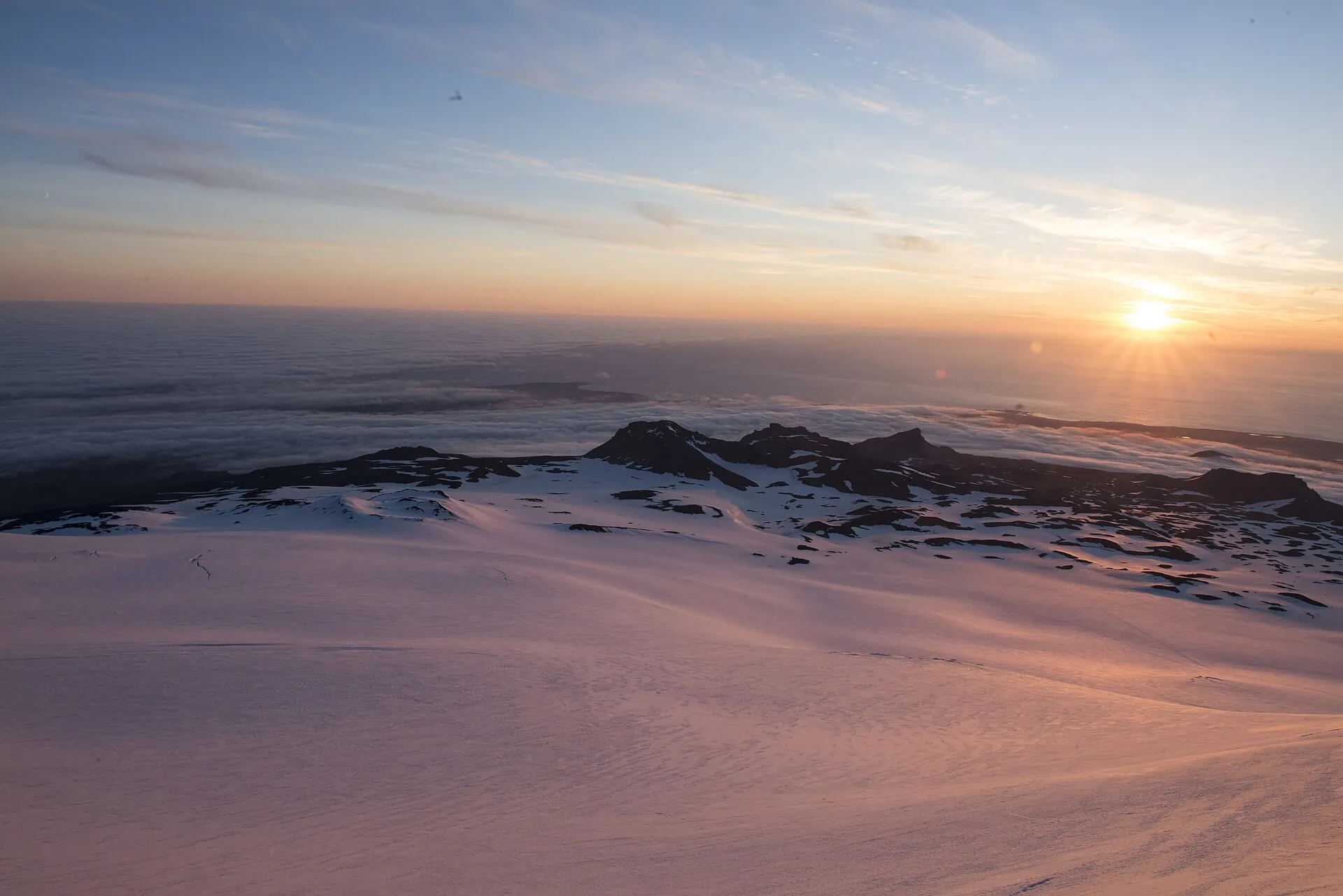
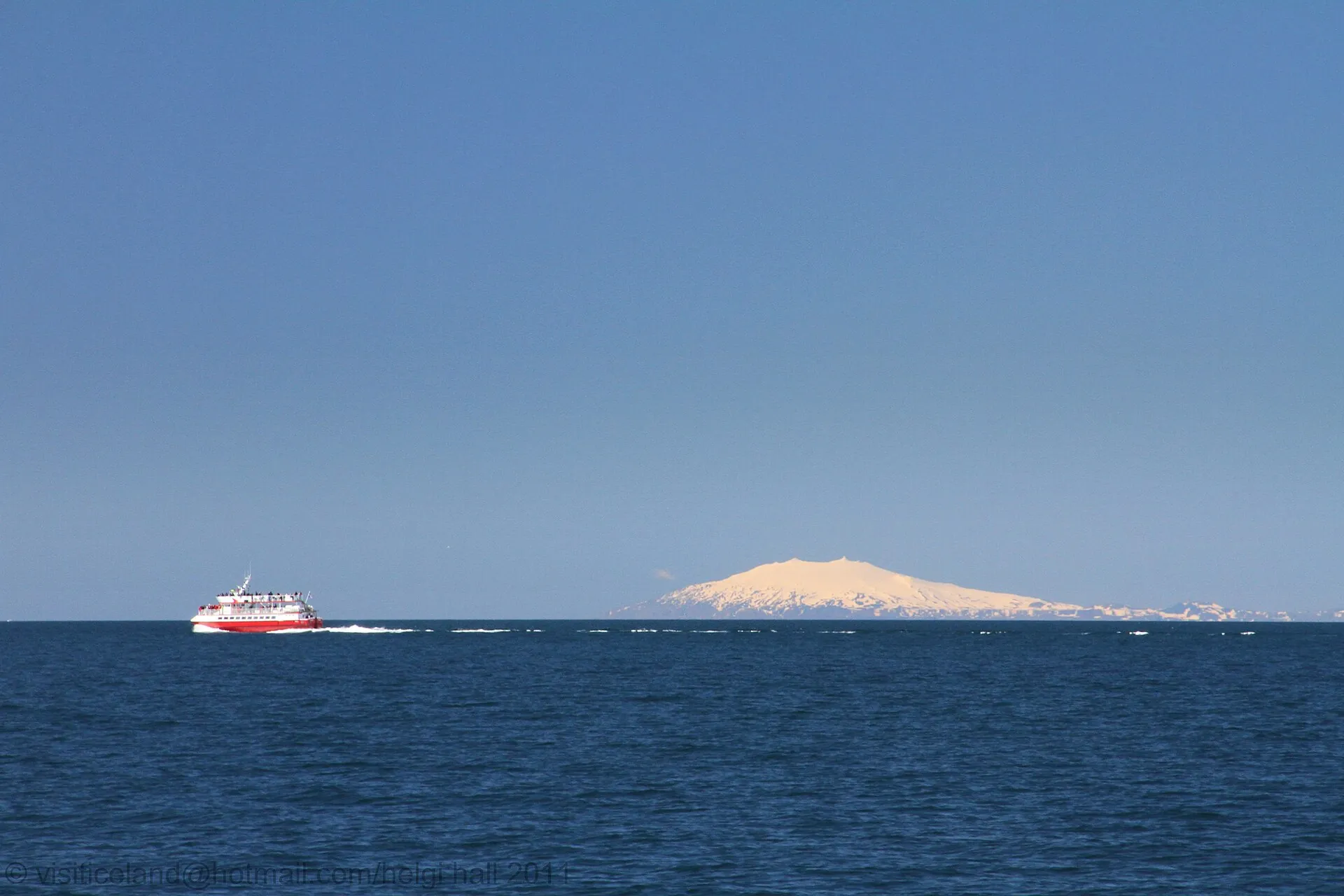
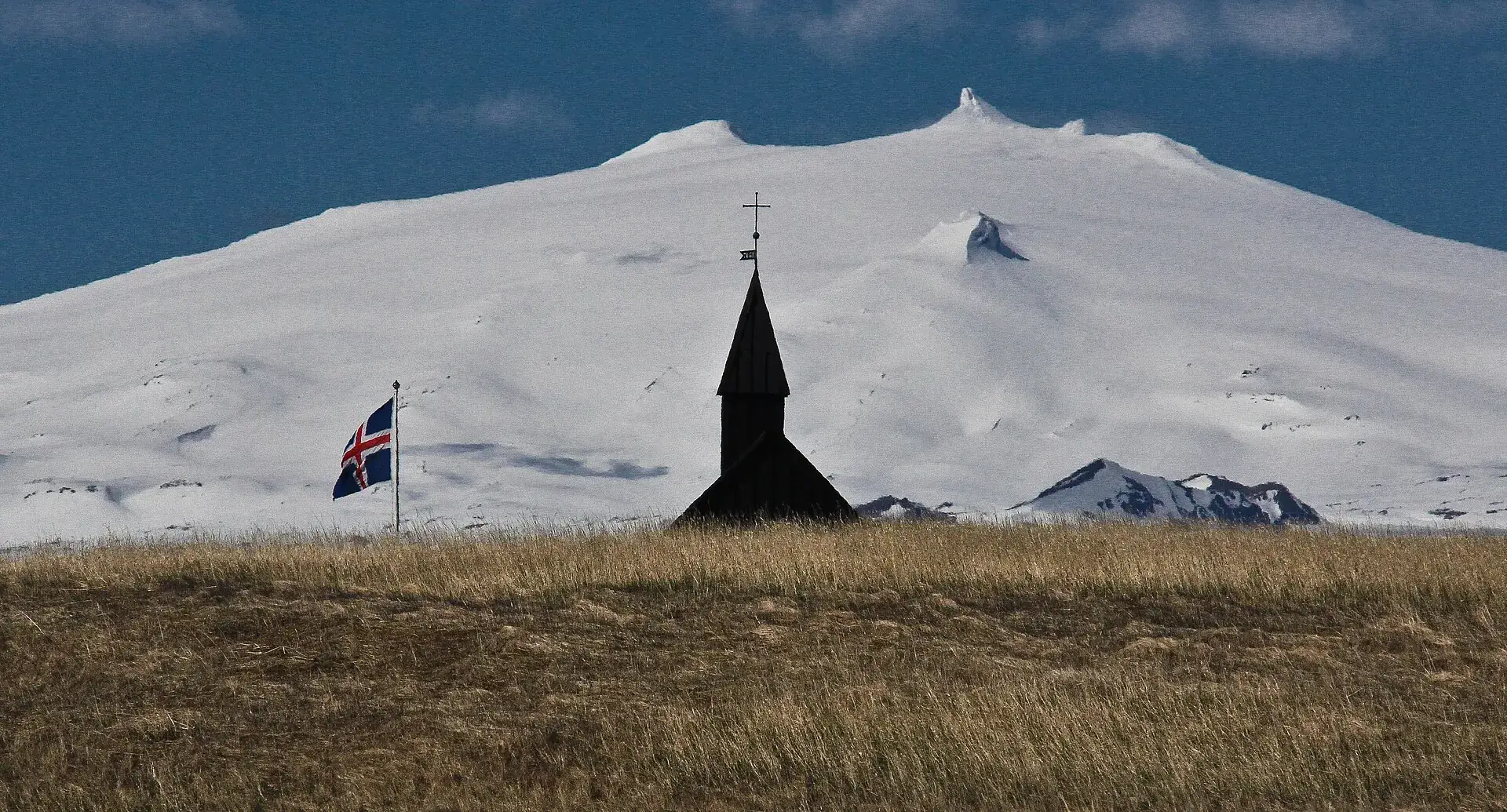
Snæfellsjökull as a white cone across Faxaflói bay, a tour boat in front – the view from Reykjavík The black church of Búðir in front of the snow-covered Snæfellsjökull, an Icelandic flag in the wind View from the summit of Snæfellsjökull toward the midnight sun on the summer solstice, reddish light over the ice

Snæfellsjökull

From Reykjavík it is 120 kilometers (75 miles) away – and still visible on clear days.

At the foot of the mountain: lava, black beaches and a black church.

At the top: the place where Jules Verne began his journey to the center of the earth. Tour only.

Scroll –
up onto the ice

As of September 22, 2026Snæfellsjökull National Park: open, but with a fee since August

The park is open around the clock, all year – admission is free. Since August 6, 2026, however, the nature conservation agency charges a service fee, collected through parking: 1,100 ISK per car, valid until midnight for every parking lot in the park. The volcano itself is at green with the Met Office; the last eruption was about 1,750 years ago. What limits visitors is not alert levels but weather, crevasses, a summer-only road and a locked cave.

Open
183km²

The park: coast, craters, trails

About 35 marked hiking trails, the beaches Djúpalónssandur and Skarðsvík, the craters Saxhóll and Rauðhóll, the Lóndrangar basalt pinnacles. No opening hours, no reservation.

Service fee per car, until midnight · since 08/20261,100 ISK
Guided tour only
45min

Vatnshellir lava cave

The entrance is locked; you get in only with Summit Guides, on behalf of the park. Daily, year-round, from age 5. Often sold out – book online ahead.

Adults · children 5–11 free5,900 ISK
Tour only
1,446m

The glacier

Climbing is not prohibited, but the park explicitly advises tours: crevasses, fog, storms. Easiest by snowcat from Arnarstapi, as long as road 570 is open – usually July to the end of September.

Snowcat from Arnarstapi, 2.5–3 hours18,000 ISK
Sources: Þjóðgarðurinn Snæfellsjökull, notice on the service fee of August 6, 2026 and park FAQ · Náttúruverndarstofnun, fee schedule no. 290/2026 under Nature Conservation Act 60/2013 art. 92 · Summit Guides (Vatnshellir), Glacier Paradise (snowcat), as of 09/2026 · IMO Volcanoes API (color code green, VALS 0). Payment via the Parka app, QR code at the parking lot or the machine at the Malarrif visitor center.
Green
SnæfellsjökullAviation colour code · checked on 2026-09-22 · Icelandic Meteorological Office (CC BY 4.0)
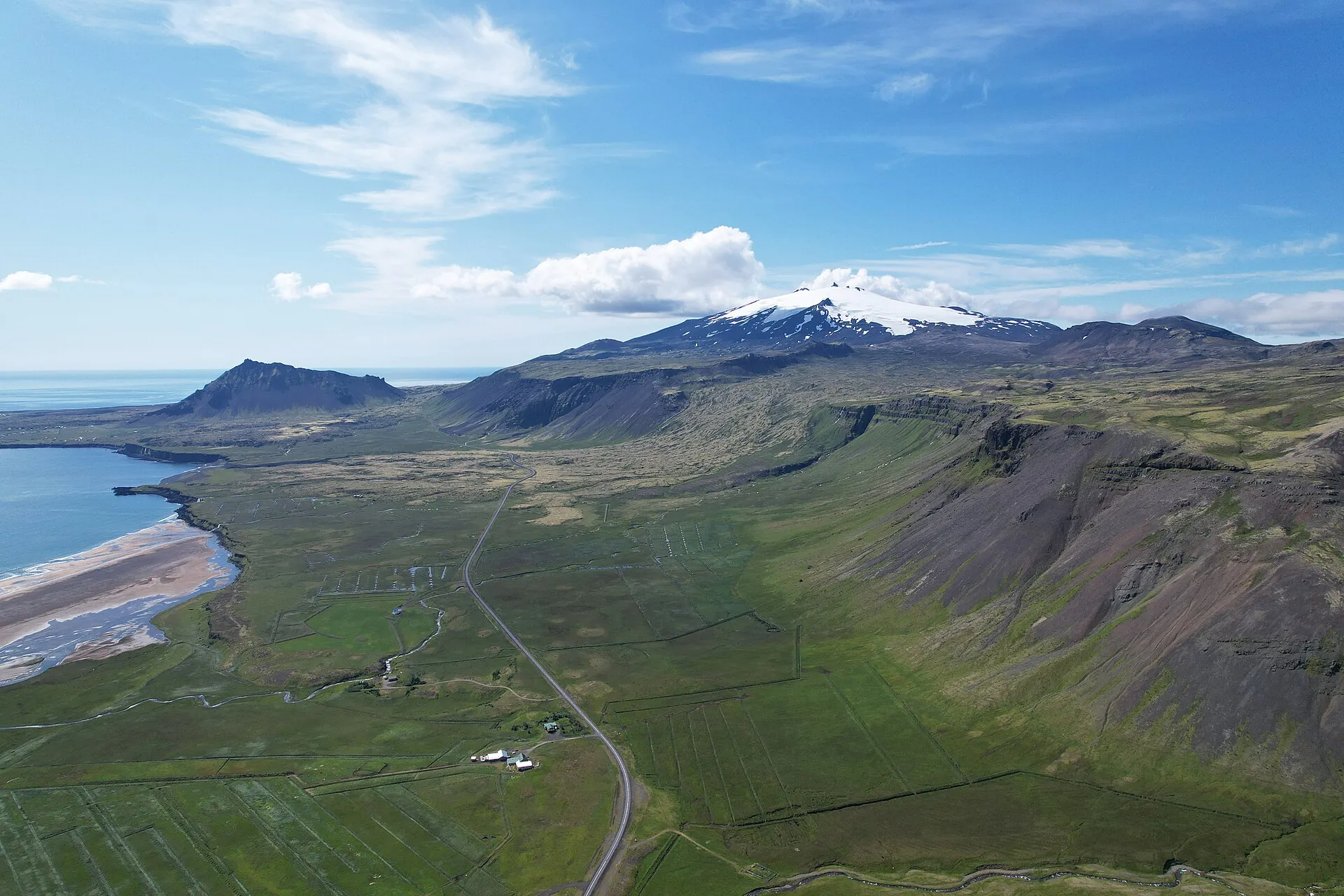
Aerial view of Snæfellsjökull: the snow-covered volcanic cone above green coastal land, a road winding along the slope
The only large central volcano in western Iceland, 700,000 years old. The road below is route 574, which circles the whole park.

Photo: Steinninn · CC BY 4.0

The experienceIceland in miniature: lava, surf, ice

The park stretches from the summit to the sea – the first in Iceland to do so. You drive route 574 along the coast, and every few miles the landscape changes: the mossy Búðahraun lava field, the basalt cliffs of Arnarstapi with thousands of seabirds, the black pebble beach of Djúpalónssandur with the rusted remains of a trawler from 1948, the 130-foot steel staircase up the Saxhóll crater. Above it all, when the clouds allow, the white cap. It has been shrinking for decades: 16 km² of ice in 1946, 10 to 11 km² in 2008, and in August 2012 the summit was ice-free for the first time.

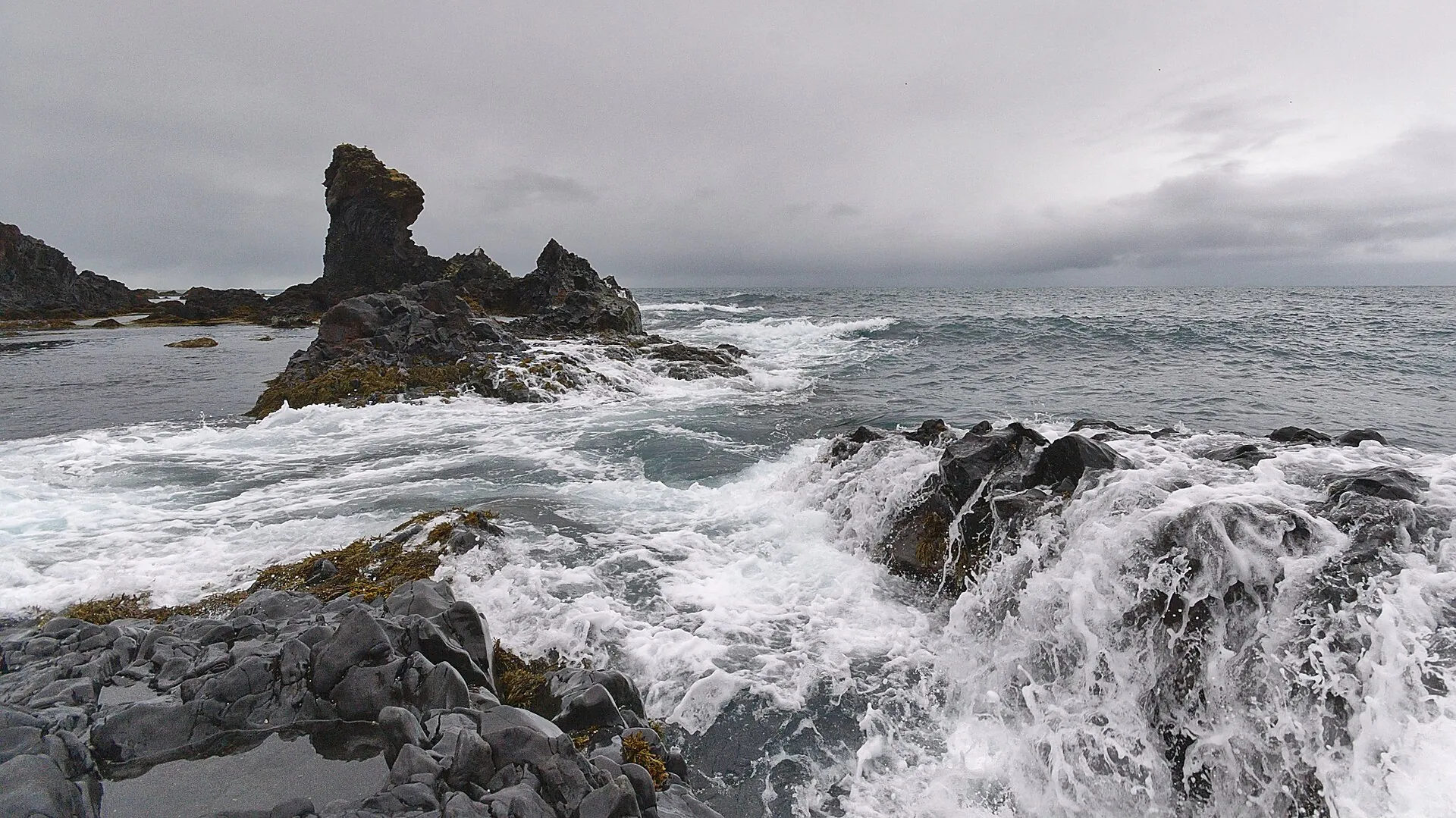
Surf on the black pebble beach of Djúpalónssandur, jagged lava rocks behind under a gray sky
Djúpalónssandur: four lifting stones for the rowers of old – and a surf you never turn your back on.

Photo: Rob Oo from NL · CC BY 2.0

The rulesParking ticket, cave tour, glacier tour: how it works

Three things cost money or need a booking. Everything else – trails, beaches, craters, both visitor centers – is covered by the parking ticket.

1

Pay once, park anywhere

1,100 ISK per car (up to 5 seats), 1,400 ISK for 6–9 seats, 450 ISK motorcycle, buses 2,700 to 9,400 ISK. Valid until midnight for the whole park: Djúpalónssandur, Saxhóll, Lóndrangar, Malarrif, Hellissandur, Skarðsvík, Öndverðarnes.

2

By app, QR code or machine

Parka app or website with your license plate, QR code at the parking lots, payment machine at the Malarrif visitor center (a machine at Djúpalónssandur is planned). Pay before you drive on – it saves questions from the rental company.

3

Book Vatnshellir online

Tours daily, fewer in winter; often sold out according to the operator. Check-in at the cave entrance at Gufuskálar on route 574, three minutes' drive from the Malarrif visitor center, 10 minutes early. Free cancellation up to 4 hours before the start, 8% off early departures.

4

Glacier: snowcat or guide

Glacier Paradise leaves Arnarstapi (Arnarstapavegur 2) at 10 am, bus to the foot of the glacier, then snowcat as high as possible, 2.5–3 hours, 18,000 ISK. On foot 3–5 hours, rated “difficult” by the park – only with a guide and rope or your own crevasse gear.

Official prices · as of 08–09/2026
National park service fee, car up to 5 seats, valid until midnight (about US$8) · 6–9 seats 1,400 ISK · motorcycle 450 ISK1,100 ISK
Service fee buses 10–21 / 22–32 / 33+ seats2,700 / 5,200 / 9,400 ISK
Vatnshellir guided tour, adults (about US$43) · seniors 65+ and students 4,600 ISK5,900 ISK
Vatnshellir, ages 12–17 · children 5–11 free · under 5 not admitted2,600 ISK
Snowcat onto the glacier from Arnarstapi (Glacier Paradise), adults (about US$130) · midnight sun tour 25,000 ISK18,000 ISK
Visitor centers Hellissandur and Malarrif, hiking trails, beachesfree
Sources: park notice of August 6, 2026 (search results also give August 10, 2026 as the start date) · summitguides.is · glacierparadise.is. Whether Parka's 1,960 ISK surcharge after 24 hours also applies to the park's lots is not confirmed. Park center Hellissandur daily 9:30 am–5 pm, Malarrif visitor center daily 10:30 am–4:30 pm (winter 11 am–4 pm), restrooms at both around the clock.
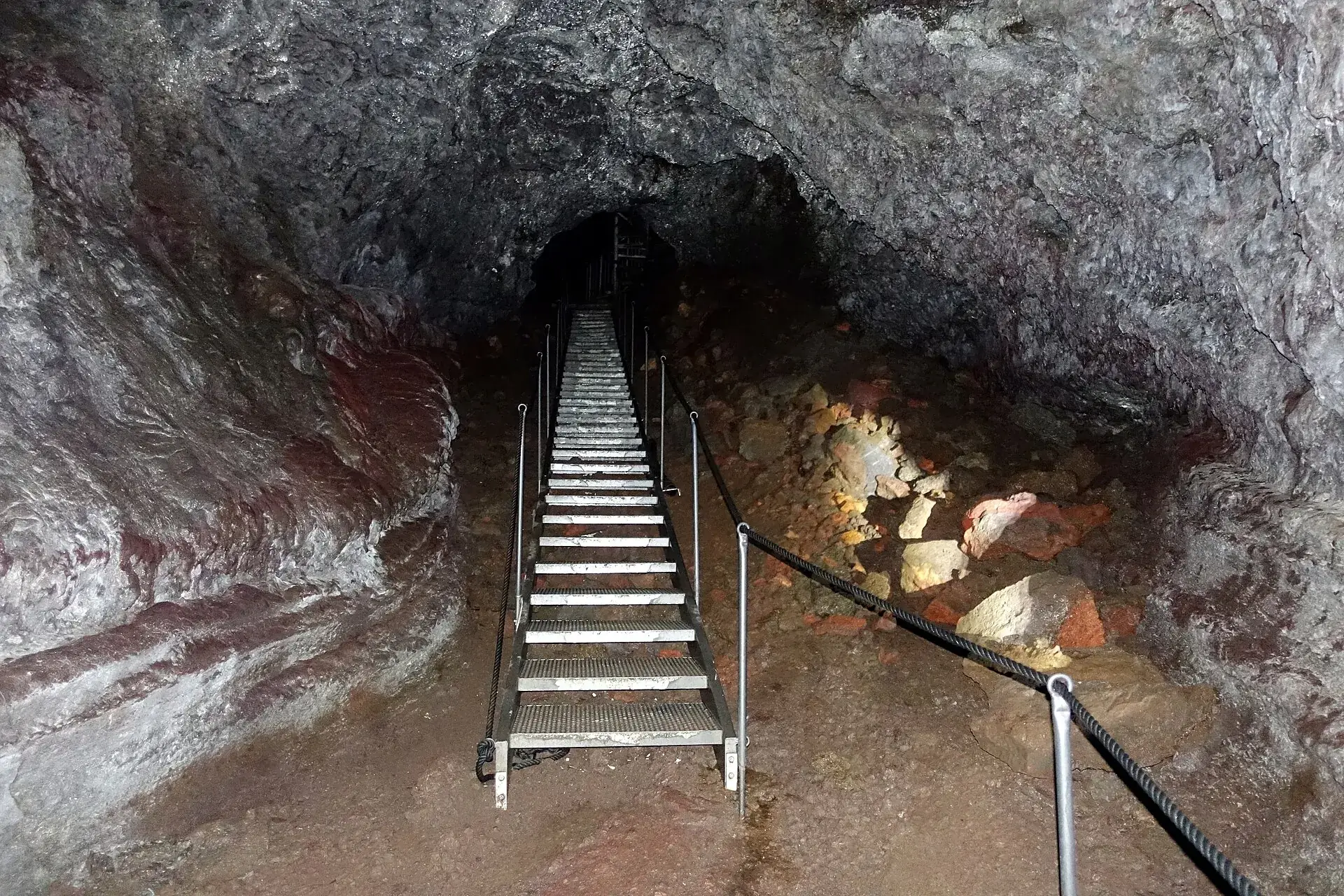
The steel staircase down into the Vatnshellir lava cave, reddish lava rock, a railing leading into the dark
Vatnshellir: 200 meters (650 ft) of lava tube, 30 meters (100 ft) below the surface, two spiral staircases – and just above freezing.

Photo: David Jones from Isle of Wight, United Kingdom · CC BY 2.0

Ways up and inOnto the glacier, into the cave, along the coast

The summit is not why most people come – the park is. Still: if you want to go up, you have two options, and both depend on road 570.

Summer only

Snowcat from Arnarstapi

Departure 10 am, bus transfer to the foot of the glacier (your own 4x4 may follow), then by snowcat to the summit plateau or as close as possible. Weather-dependent; visibility can vanish at any time. Resellers give May to July as the season, the operator none.

2.5–3 hours · 0 → 1,446 m (4,744 ft)18,000 ISK
Guide only

Glacier hike to the summit

From road 570 at Jökulháls or from Arnarstapi with a guide: 3–5 hours, about 750 m (2,460 ft) of climbing, rated “difficult” by the park. Best in late spring, while the crevasses are still snowed in; by late summer they are open. No current operator price is documented – Go West in Arnarstapi reports “currently not operating”.

700 → 1,446 m · Þríhyrningar rock pinnacles at the summitno price documented
Summer, 4x4

Road 570 over Jökulháls

Ólafsvík – pass at the glacier edge – Arnarstapi, 30 to 45 minutes, gravel, steep, no river crossings. The road administration opens it depending on snow, usually early July to the end of September, and closes it again. Check the status on umferdin.is; the same goes for F575 through Eysteinsdalur.

no toll · service fee via the parking ticketfree
Year-round

Coastal trails

Arnarstapi – Hellnar 2.5 km (1.5 miles) / 1 hour with basalt arches and the Baðstofa cave. Svalþúfa – Lóndrangar – Malarrif 2.6 km (1.6 miles) / 1.5 hours. Djúpalónssandur – Dritvík 1 km / 20 minutes, after 2 km through the lava from the upper parking lot to the beach. Wind is the usual reason the park rates trails as “demanding”.

Platforms at Djúpalónssandur and Svalþúfa wheelchair accessibleparking ticket
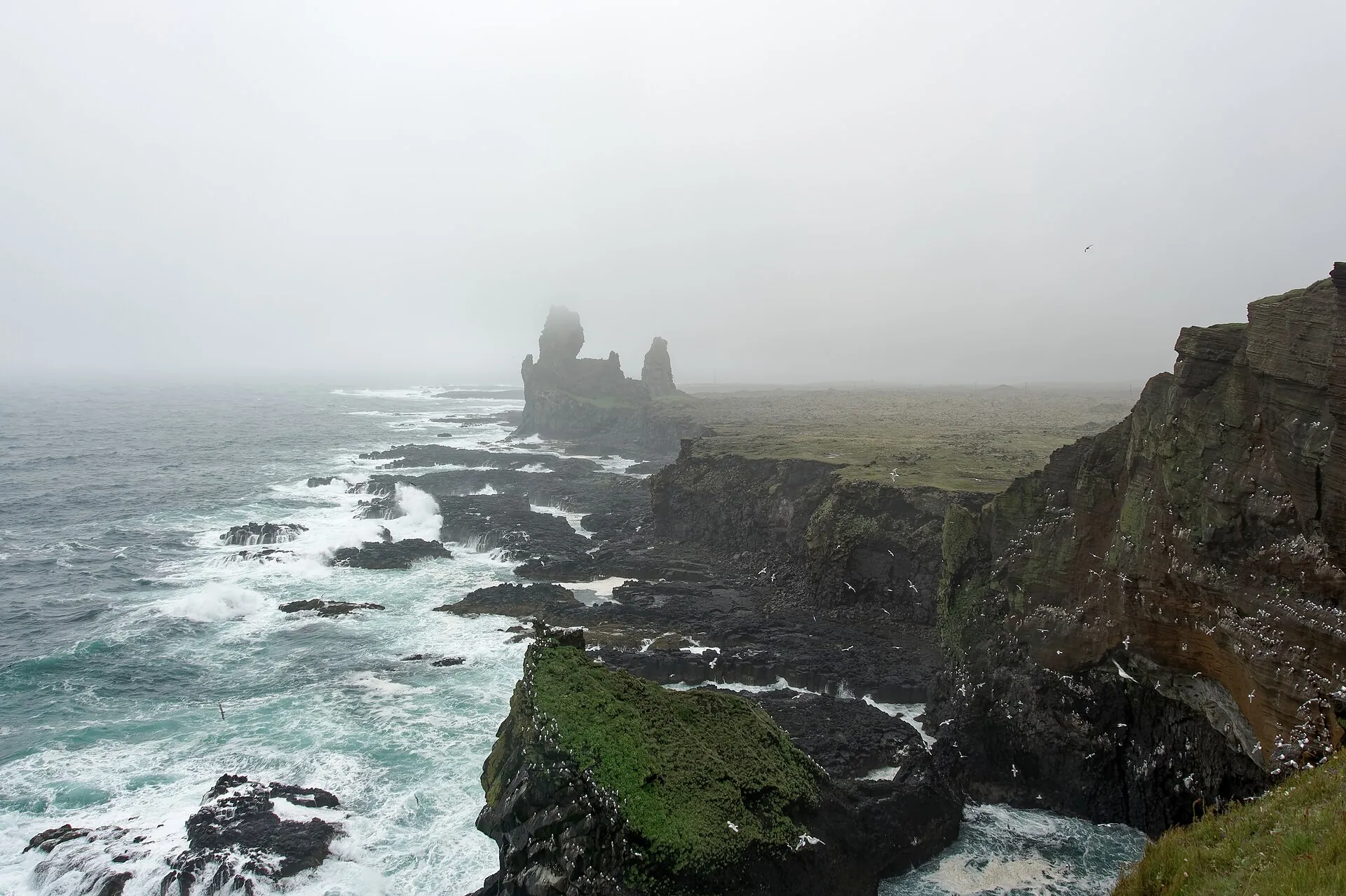
The Lóndrangar basalt pinnacles rise out of the surf, dark cliffs and spray in front
Lóndrangar: two volcanic plugs, everything else cleared away by the sea. The loop from Malarrif takes an hour and a half.

Photo: Jakub Hałun · CC BY 4.0

Bookable on siteCave and ATV inside the national park

With a rental car you do not need a day tour from Reykjavík. Two offers start right in the park – the cave tour is the same one the operator sells itself.

Affiliate links to GetYourGuide: if you book, we earn a commission and the price stays the same. Prices and ratings as of 22 September 2026.

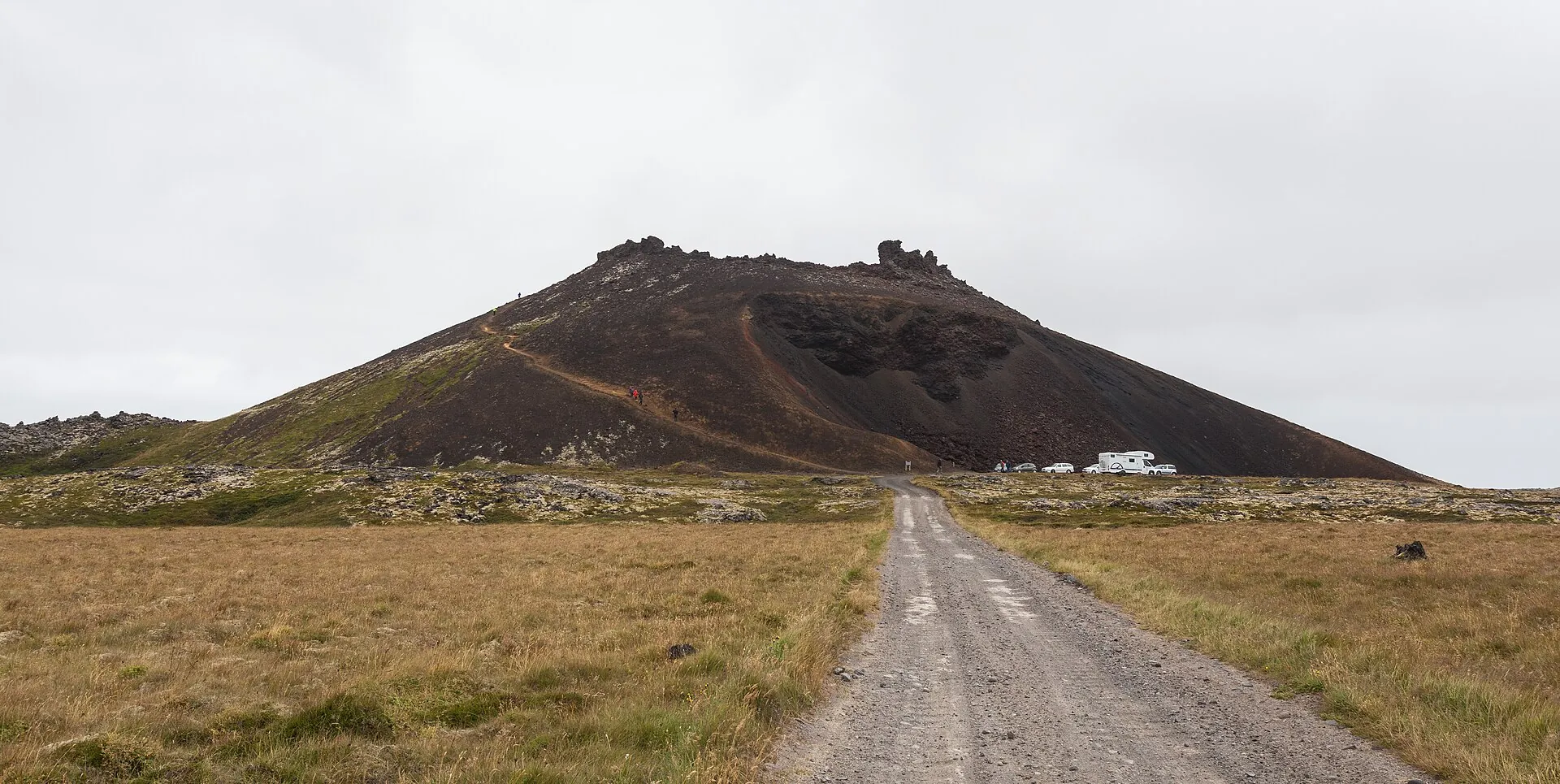
The red-brown Saxhóll cinder cone with the steel staircase to the crater rim, a gravel road through the lava field in front
Saxhóll: a 40-meter (130 ft) crater, one staircase, ten minutes – the volcano for everyone who does not want to go onto the glacier.

Photo: Diego Delso · CC BY-SA 4.0

Good to knowGetting there, best time, tips

Getting there

Without a car: Strætó from Reykjavík (Mjódd) with route 57 to Borgarnes, 58 Borgarnes–Vatnaleið–Stykkishólmur and 82 Vatnaleið–Grundarfjörður–Ólafsvík–Hellissandur; since January 1, 2026 twice daily, not on Tuesdays and Thursdays (arrival Hellissandur 11:21 am and 7:11 pm). The south side (Arnarstapi, Malarrif, Djúpalónssandur) has no bus – car or tour only.

By car: From Reykjavík road 1 to Borgarnes, then 54 (Snæfellsnesvegur) and 574 (Útnesvegur) around the peninsula; parking lots with Parka payment at Djúpalónssandur (paved in 2024, bus and car spaces), Saxhóll, Svalþúfa/Lóndrangar, Malarrif, Hellissandur, Skarðsvík, Öndverðarnes. 570 and F575 only with 4x4 and only in summer.

  • From Reykjavík · about 2.5–3 hours
    Roads 1, 54, 574 via Borgarnes to Hellissandur/Arnarstapi
  • From Borgarnes · about 1.5–2 hours
    Road 54, then 574
  • From Stykkishólmur · about 1.5 hours
    Road 54/574 via Grundarfjörður and Ólafsvík

Best time to go

June to early September: road 570 open (snowcat, glacier pass), long daylight, restrooms at Djúpalónssandur. For climbing the glacier on foot late spring (May/June) is better, because the crevasses are still snowed in. Vatnshellir and the coastal trails work year-round; in winter the park is empty, but storms and darkness limit you. The summit is often in cloud – book the snowcat tour in the morning with a clear forecast.

Who it suits

Children
Very good: short coastal trails, Saxhóll with staircase (40 m / 130 ft high crater), Djúpalónssandur with lifting stones. Vatnshellir from age 5 (children up to 11 free). Snowcat for all ages, glacier hike only for experienced teenagers.
Minimum age
Vatnshellir 5 years; otherwise none documented
Fitness
Coastal trails easy to 'demanding' (park rating, mostly because of lava and wind), glacier 'difficult' (3–5 h). Vatnshellir: uneven floor, two spiral staircases.
Heart and lungs
No volcanic gases; mind the cold in the cave (around 0 °C / 32 °F) and wind on the glacier.
Wheelchair
Viewing platforms Djúpalónssandur and Svalþúfa accessible (ramp widened 2024); park center Hellissandur accessible; Vatnshellir and glacier not.
Dogs
no rule found on the park pages – see `unsicher`
Clothing
Wind- and waterproof layers even in summer; for Vatnshellir a warm jacket and gloves (just above freezing); for the snowcat sunglasses and a hat.
Footwear
Sturdy hiking shoes; Vatnshellir: hiking shoes or sneakers, no sandals, no smooth soles (operator).

Tips you will need on site

  • One parking ticket (1,100 ISK) is valid until midnight for the whole park – pay once via Parka, then use every parking lot.
  • Book Vatnshellir online in advance (often sold out); the meeting point is the cave entrance at Gufuskálar, the nearest restrooms are at Malarrif.
  • Onto the glacier only with a tour: snowcat from Arnarstapi at 10 am (18,000 ISK), on foot only with a guide and rope – the crevasses open in late summer.
  • Check road 570 on umferdin.is beforehand; it is usually open only July to September and not for two-wheel drive.
  • Drones stay in the bag along the coast from April 15 to September 15 – a ban to protect nesting birds; otherwise a permit is needed.
  • Camping is prohibited in the park (exception: hikers and cyclists for one night at the designated spot); campgrounds exist in Hellissandur, Ólafsvík and Arnarstapi.
  • Take the waves at Djúpalónssandur seriously and try the lifting stones only with a straight back – the 'Amlóði' (23 kg / 51 lb) is enough for the legend.
  • Without a car: Strætó 82 ends in Hellissandur at the park center; for the south side you need a tour or a rental car.

A short history

  • The stratovolcano is about 700,000 years old and the only large central volcano in western Iceland; at least 20 eruptions in the Holocene, including three Plinian ones about 8,500, 4,000 and 1,800 years ago.
  • Last eruption around AD 200 – before the settlement; the Vatnshellir lava cave formed 5,000–8,000 years ago in an eruption at the Purkhólar crater field.
  • 16th–19th century: Dritvík is Iceland's largest spring fishing station; the lifting stones at Djúpalónssandur were used to select rowers.
  • 1864: Jules Verne has Professor Lidenbrock descend into 'Sneffels' toward the center of the earth.
  • March 1948: the English trawler Epine GY-7 runs aground at Djúpalónssandur; the iron parts still lie on the beach today.
  • June 28, 2001: the national park is established (183 km²), Iceland's first park from summit to sea; protection regulation redrafted in 2021.
  • 1946–2008 the ice cap shrinks from 16 to 10–11 km²; in August 2012 the summit is ice-free for the first time.
  • March 24, 2023: opening of the BREEAM-certified park center in Hellissandur (710 m²); in 2024 new platforms at Saxhóll and Svalþúfa, Djúpalónssandur parking lot paved.
  • August 6/10, 2026: introduction of the service fee via the parking ticket; August 12, 2026 total solar eclipse with traffic management in the park.
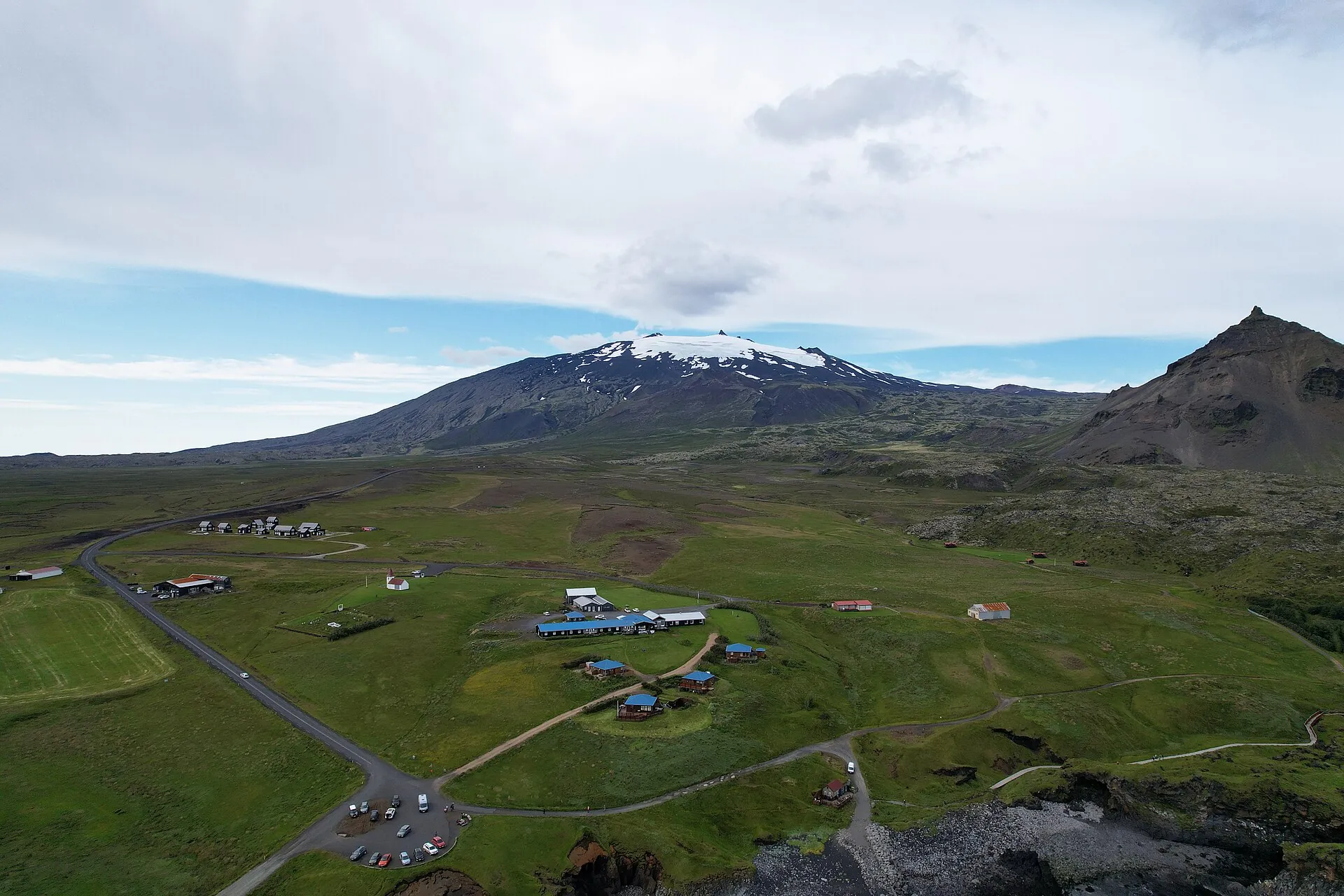
Aerial view of Arnarstapi: the fishing village on the coast, behind it Mount Stapafell and the snow-covered Snæfellsjökull
Arnarstapi with Stapafell and the glacier: this is where the snowcat leaves – and where road 570 ends, when it is open.

Photo: Steinninn · CC BY 4.0

What the park prohibitsDrones, tents, closures

Banned Apr 15 – Sep 15

Drones

Completely banned along the coast and below the Útnesvegur from April 15 to September 15 – seabird nesting season. Otherwise only with a park permit via the conservation agency's service portal, including recreational flights.

Prohibited

Camping

Not allowed in the park. The only exception: hikers and cyclists for one night at the designated spot. Campgrounds exist in Hellissandur, Ólafsvík and Arnarstapi.

At times

Closures

The administration closes sensitive areas when needed. Documented in 2026: Saxhóll and Öndverðarnesvegur in June/July for construction; for the solar eclipse on August 12, 2026 one-way traffic on road 570 and a shuttle to Öndverðarnes. As of September 22, 2026: no closure known.

Sources: park – travel and safety advice, licensing, park news 2026 · Snæfellsbær municipality, traffic management August 12, 2026. Fine amounts are not published. No rule on dogs in the park was found.
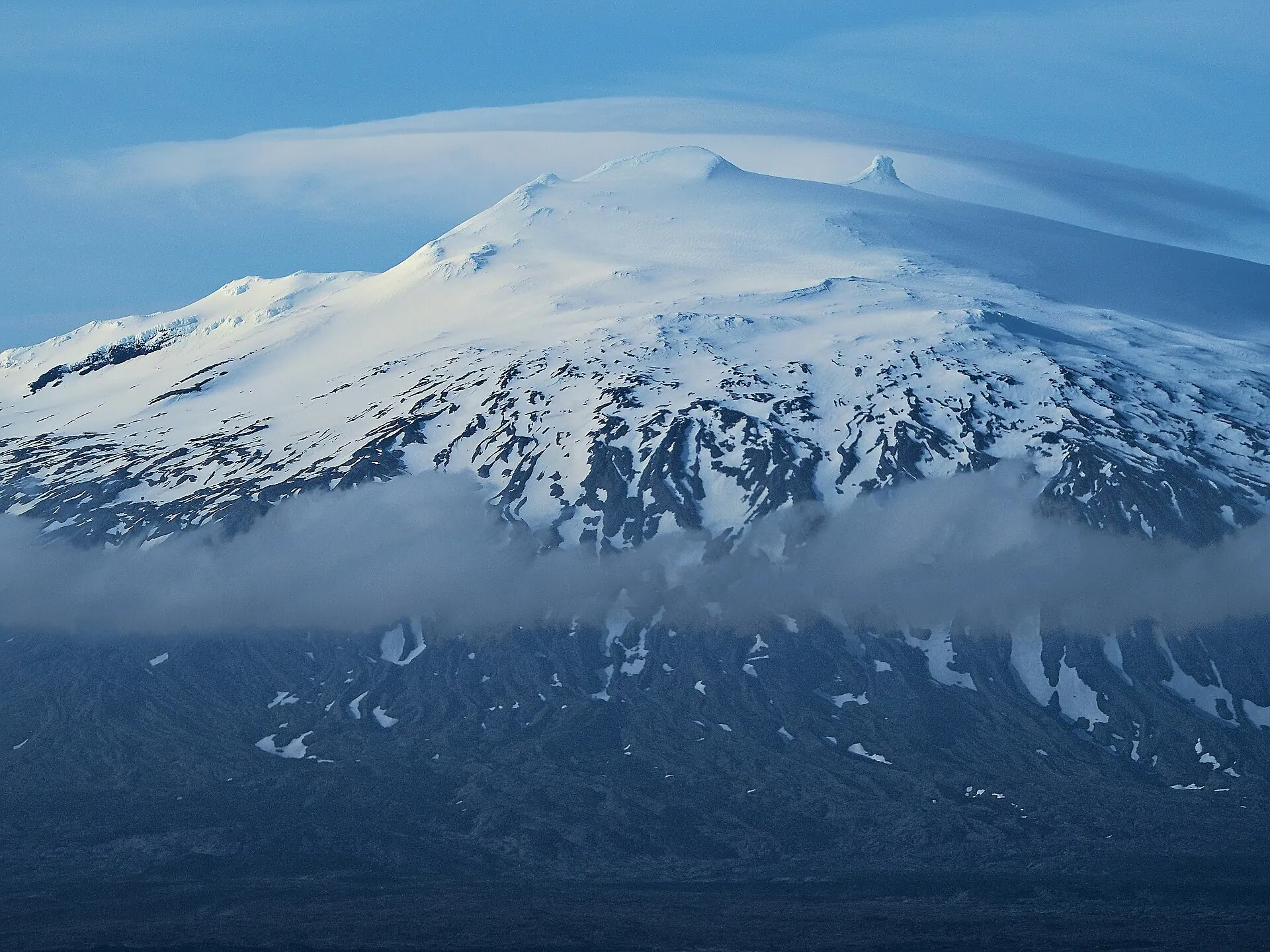
Snæfellsjökull with a cloud layer on its slope and clouds above the summit, blue-gray evening light
Clouds above and below the summit: the normal state. You book the snowcat in the morning with a clear forecast.

Photo: joiseyshowaa from Freehold, NJ, USA · CC BY-SA 2.0

Outdated onlineWhat other sites get wrong

“The national park is free.”
Since August 2026 a service fee is collected via the parking ticket, 1,100 ISK per car until midnight. Admission stays free – but nobody gets there without paid parking.
“You can explore Vatnshellir on your own.”
The entrance is locked. The cave is entered only on a guided tour – Summit Guides, 45 minutes, from age 5.
“F570 is a rough highland track with river crossings.”
The road administration lists it as 570 without F status, and there are no fords. It is steep, gravel, often snow-covered and open in summer only; 4x4 recommended.
“Snæfellsjökull is an extinct volcano.”
The Met Office lists it as an active system at green and alert level 0. The last eruption was about 1,750 years ago; there were three large Plinian eruptions in the Holocene.
“The park has opening hours.”
It does not. Opening hours apply only to the two centers: Hellissandur 9:30 am–5 pm, Malarrif 10:30 am–4:30 pm.

Quick answersBefore the drive to the peninsula

Does Snæfellsjökull National Park charge admission?

No, but since August 2026 there is a service fee collected through parking: 1,100 ISK per car, valid until midnight for every parking lot in the park. Pay via the Parka app, QR code or the machine at Malarrif.

Can you climb Snæfellsjökull?

Yes, but the park explicitly recommends tours: 3–5 hours, rated “difficult”, crevasses and fog. The easiest way is the snowcat from Arnarstapi (2.5–3 hours, 18,000 ISK), as long as road 570 is open.

How do you get into the Vatnshellir cave?

Only on the 45-minute guided tour by Summit Guides, daily and year-round, from age 5. Adults 5,900 ISK, children 5–11 free. Book online – tours are often sold out.

Is road 570 still open in September?

Usually yes, until the end of September – but the road administration closes it as soon as snow lies. umferdin.is shows the status for the day. On September 22, 2026 the status could not be read there.

Is Snæfellsnes worth a day trip from Reykjavík?

For the peninsula, yes: 11 to 12 hours around the park with Kirkjufell, Arnarstapi and Djúpalónssandur. The bus tours usually do not take you onto the glacier or into the cave – for that you need a rental car or the offers on site.

Is Snæfellsjökull the volcano from “Journey to the Center of the Earth”?

Yes. In 1864 Jules Verne had Professor Lidenbrock descend into “Sneffels”. There is no way into the earth's interior – but the Vatnshellir lava cave does take you 30 meters (100 ft) down.

Is Snæfellsjökull active?

It counts as an active volcano that has been dormant for about 1,750 years. As of September 22, 2026 the Icelandic Met Office lists it at aviation colour code green and alert level 0. The earthquakes on Snæfellsnes since 2024 belong to the neighboring Ljósufjöll system.

How much does Vatnshellir cost and how long does it take?

The guided tour takes 45 minutes and costs 5,900 ISK for adults, 2,600 ISK for ages 12–17; children 5 to 11 are free, younger ones are not admitted. Helmet and lamp are provided; it is just above freezing.

Is the park suitable for children?

Yes: short trails, the Saxhóll crater cone with its staircase, the lifting stones at Djúpalónssandur beach, the cave from age 5 and the snowcat with no age limit. Only the glacier hike is not for children.

What should you wear?

Wind- and waterproof layers even in summer, sturdy shoes. For Vatnshellir add a warm jacket and gloves, no sandals or smooth soles; on the glacier sunglasses and a hat.

How do you get from Reykjavík to Snæfellsjökull?

By car about 190 km (120 miles) on roads 1, 54 and 574 (2.5–3 hours). By Strætó: 57 to Borgarnes, 58 to Vatnaleið, 82 to Ólafsvík and Hellissandur – twice daily, not on Tuesdays and Thursdays; the south side with Arnarstapi has no bus.

When is road 570 over Jökulháls open?

Usually from early July to the end of September, depending on snow; Vegagerðin announces opening and closing on umferdin.is. It is gravel and steep, 4x4 recommended; the same goes for F575 through Eysteinsdalur.

Can you camp or fly drones in the park?

Camping is prohibited; only hikers and cyclists may stay one night at the designated spot. Drones are completely banned along the coast from April 15 to September 15, otherwise only with a park permit.

Is Djúpalónssandur dangerous?

The beach is freely accessible, but the Atlantic surf is unpredictable – keep your distance from the water, children by the hand. The trail from the parking lot runs about 2 km (1.2 miles) through lava; restrooms at the upper lot in summer.

Where are the visitor centers and what do they cost?

Free: the park center in Hellissandur (daily 9:30 am–5 pm, with restaurant and shop) and the Malarrif visitor center on the south coast (daily 10:30 am–4:30 pm, exhibition, playground). Restrooms at both around the clock.

When is the best time to visit?

June to early September for the glacier pass and snowcat; May/June for glacier hikes with closed snow cover. Cave and coast work year-round, in winter with short days and storm risk.
Sources · accessed on 22 September 2026

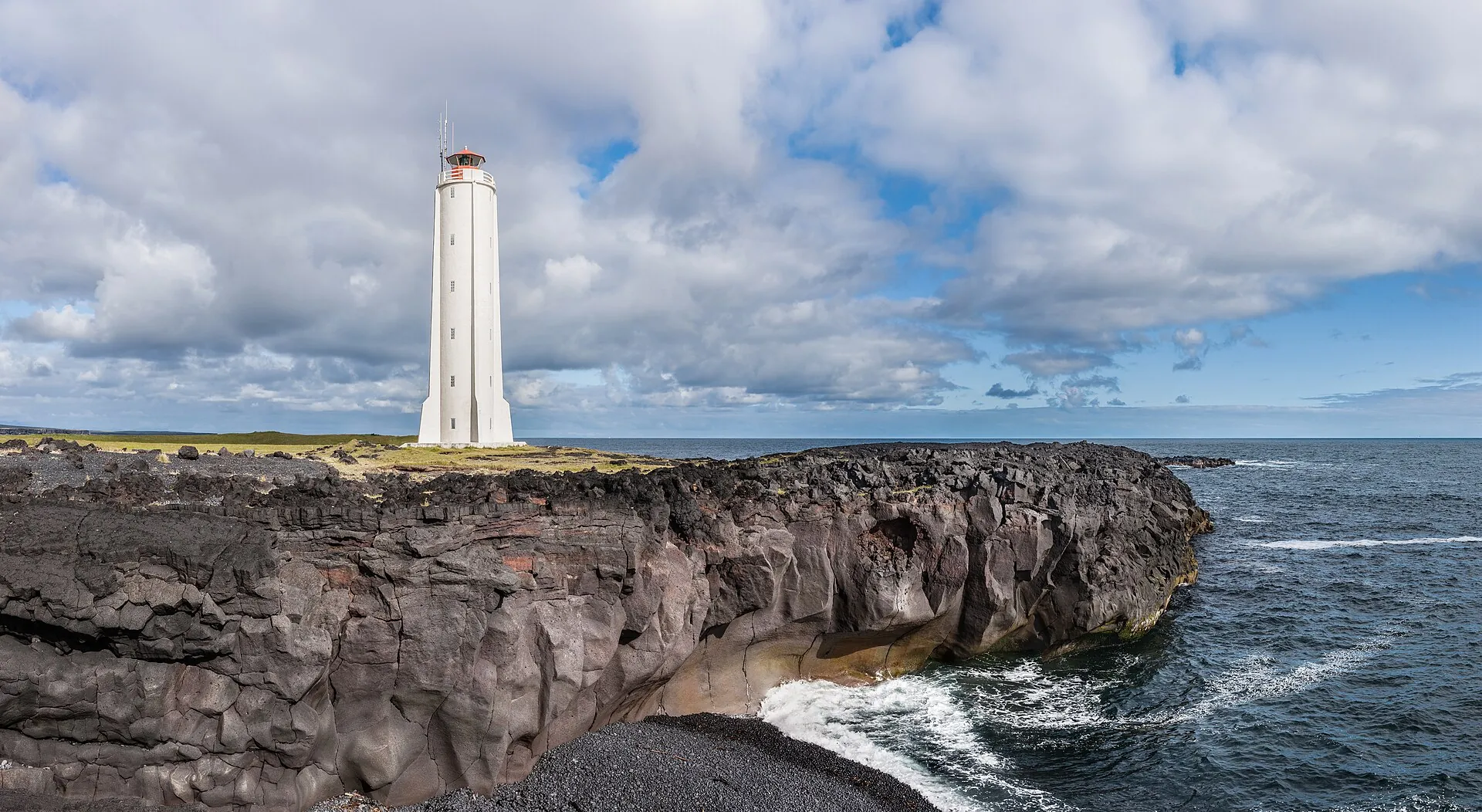
The white Malarrif lighthouse on black lava cliffs above the sea, cloudy sky
Malarrif: lighthouse, visitor center, payment machine – the place where you get the parking ticket even without the app.

Photo: Richard Bartz · CC BY-SA 3.0