Volcano·Guide
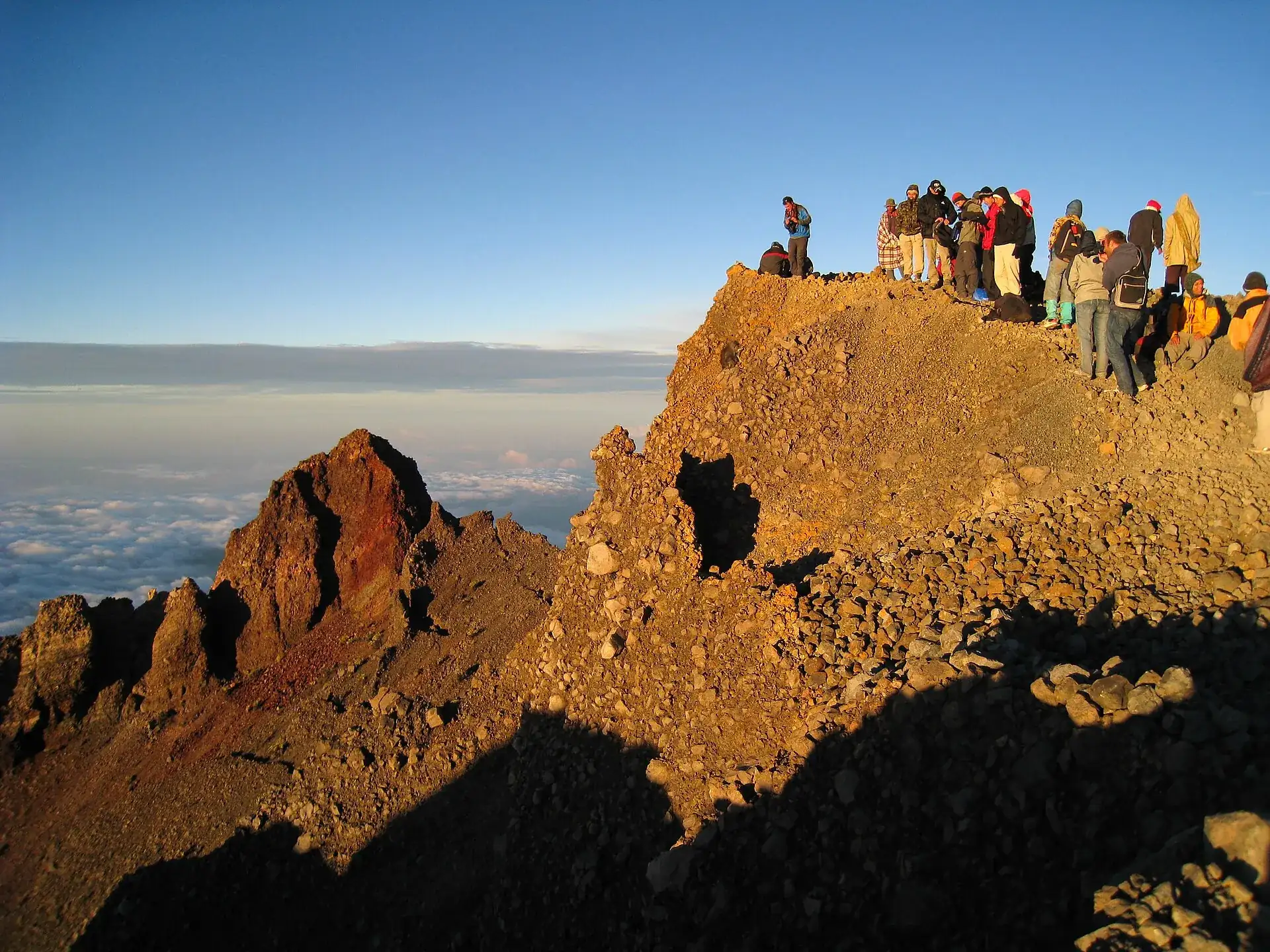
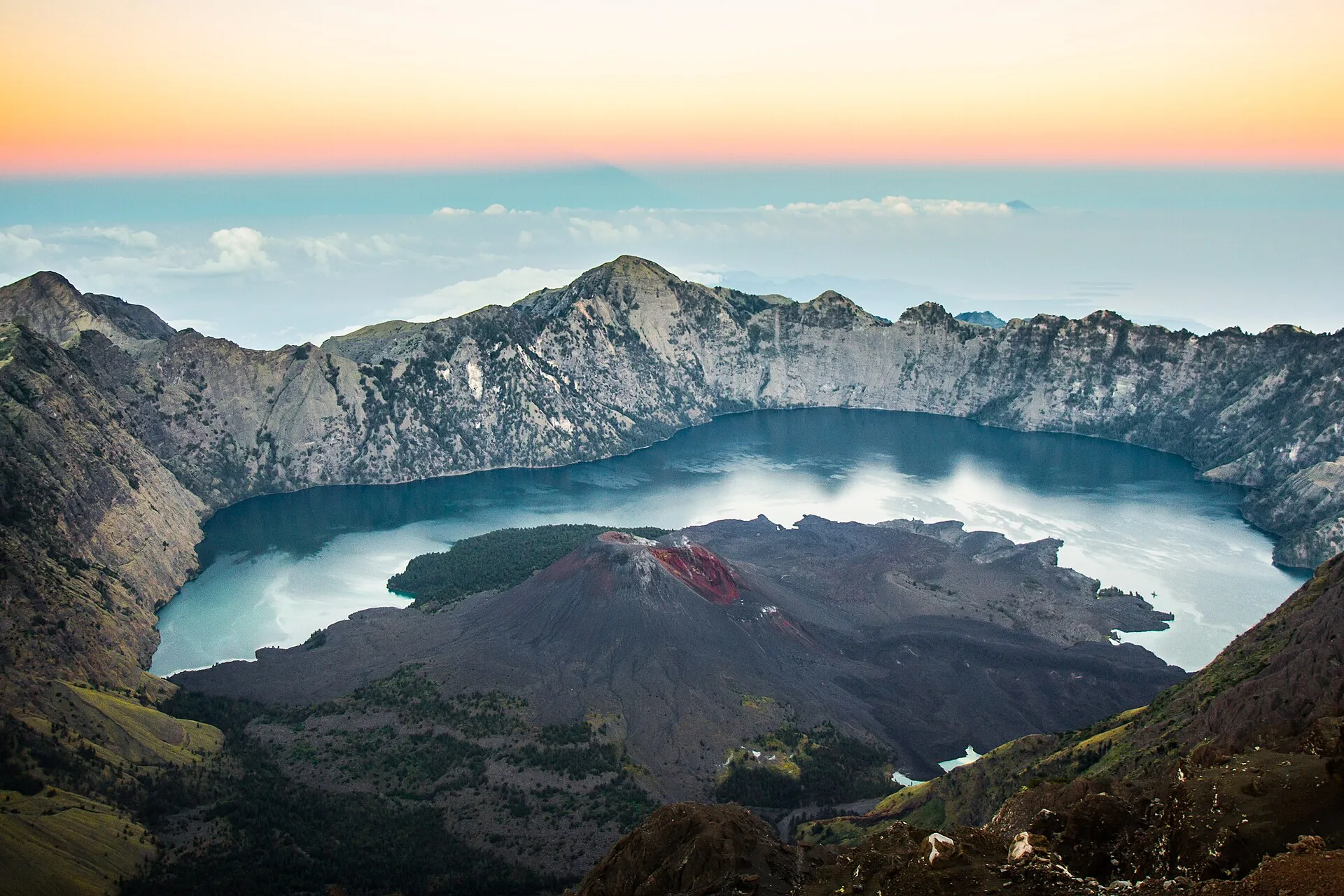
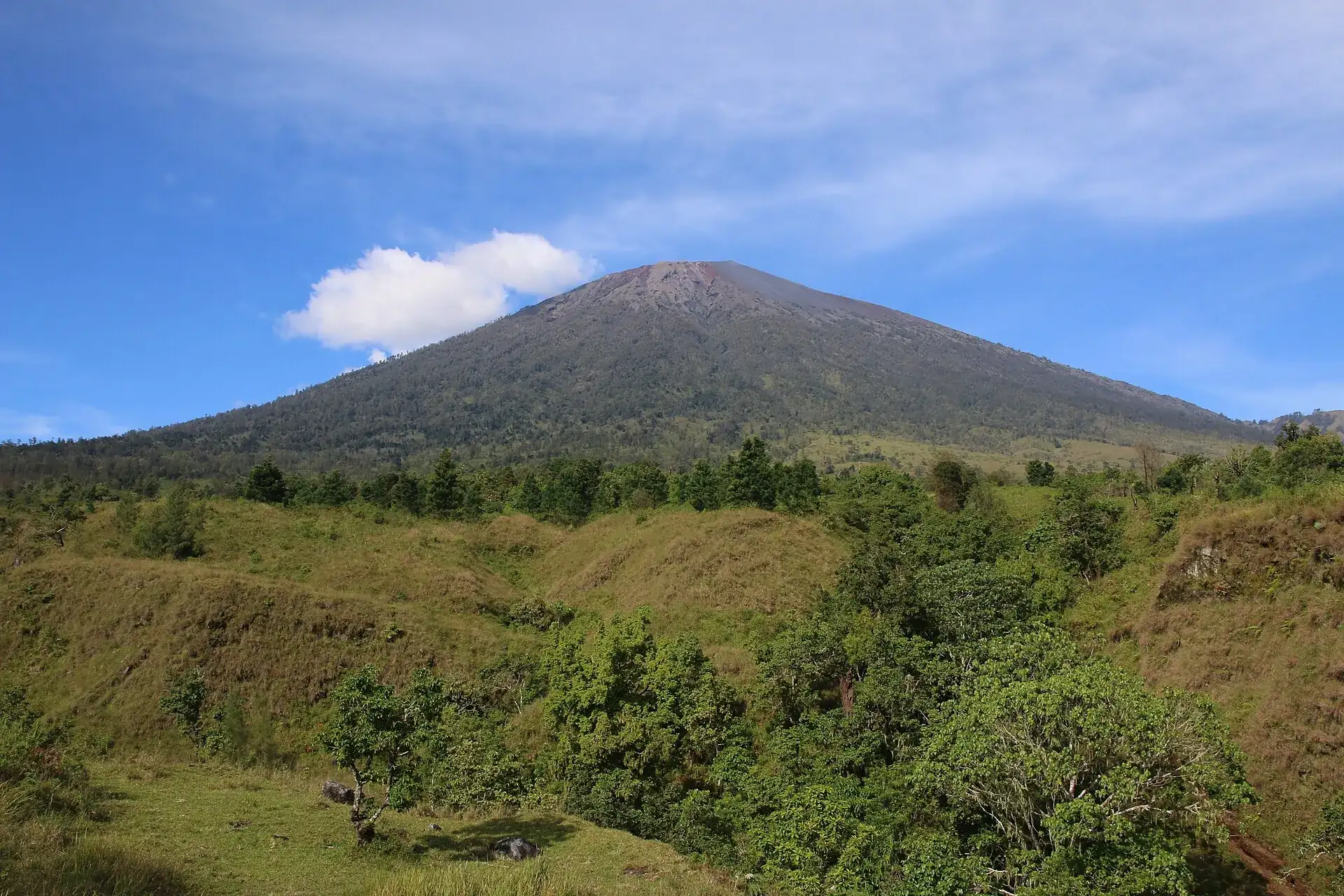
Mount Rinjani on Lombok seen from the Sembalun route: green savanna hills in the foreground, the bare cone behind them under a blue sky View from the crater rim of Mount Rinjani onto the crater lake Segara Anak and the dark cone of Barujari, with clouds above the caldera wall Hikers standing on the summit ridge of Mount Rinjani at sunrise, a sea of cloud below them

Mount Rinjani

From the Sembalun valley the mountain looks like a long meadow with a view.

Seven hours later you stand on the crater rim, looking down at a lake with a volcano in it.

The summit comes on the second night. Three hours of loose sand.

Scroll –
two and a half days in three frames

As of 21 September 2026Is Mount Rinjani open? Limited opening, no new bookings

Rinjani is not open normally. Since 1 September 2026, under a Ministry of Forestry circular on wildfire prevention, it has been open 'on a limited basis': the national park authority TNGR has suspended online booking through eRinjani. Anyone who booked and paid before that date may go; there are no new tickets until further notice. At the gate, baggage is checked for sources of fire and open fire is banned. TNGR reassesses the situation regularly.

Two fixed limits come on top of that. The mountain closes every year from 1 January to 31 March – officially confirmed for 2026, all six routes. And the volcano agency PVMBG has listed Rinjani at Level II (Waspada) continuously since 2015: trekking is explicitly permitted, while the active Barujari cone and everything within 1.5 km (about a mile) of its crater is off limits. The crater rim, the summit route and the usual campsites lie outside that radius.

Limited opening

Booking through eRinjani

Since 1 September 2026 the app has taken no new bookings. Tickets already paid for are still honored, according to TNGR. There is no ticket sale at the gate – without an eRinjani ticket nobody gets in. No reopening date has been announced.

Ministry of Forestry circular, 31 August 2026
Closed every year

1 January to 31 March

The rainy-season closure of all six routes, officially confirmed for 2026: booking closed on 28 December 2025, last check-in 31 December 2025. Otherwise the season runs from 1 April to 31 December.

TNGR announcement of 22 December 2025
Exclusion zone
1.5km

Around Barujari

PVMBG prohibits all activity and camping on the Barujari cone, on its young lava fields and within 1.5 km of its crater. Outside that, trekking is permitted – with a mask and eye protection in your pack in case ash falls.

PVMBG daily report, 20 September 2026 · Level II since 2015
Per person and day
250,000IDR

Rinjani entrance fee

For foreigners on the Sembalun, Senaru and Torean routes; on the southern routes Aik Berik, Tetebatu and Timbanuh it is 200,000 IDR. In force since 3 November 2025 under ministerial regulation Permenhut 17/2025. A three-day trek therefore costs 750,000 IDR in park fees alone.

about €12.20 a day · plus insurance250,000 IDR
Sources: TNGR, 1 September 2026 (limited opening, eRinjani booking suspended, baggage checks) · TNGR, 22 December 2025 (closure 1 January – 31 March 2026) · TNGR, 7 November 2025 (rates since 3 November 2025) · MAGMA Indonesia / PVMBG, daily report of 20 September 2026 (Level II, 1.5 km zone). Current notices are posted on rinjaninationalpark.id.
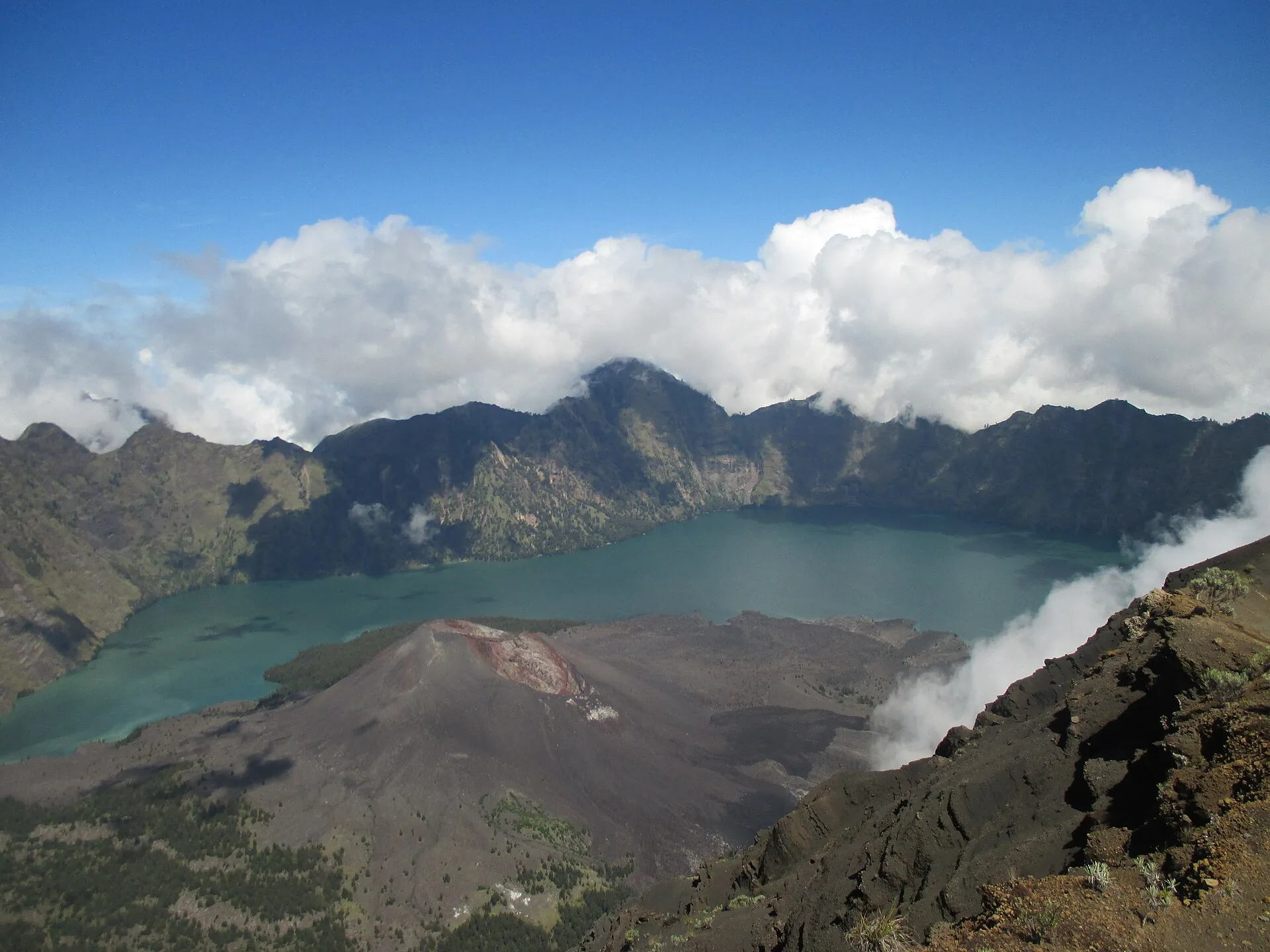
View across the caldera of Mount Rinjani on Lombok: the crater lake Segara Anak with the dark Barujari cone and its reddish crater, steep caldera walls all around
The cone in the lake is Barujari. Nobody is allowed within a mile and a half of it.

Photo: César González Palomo · CC BY-SA 2.0

What it is likeMount Rinjani trek: two days, 2,500 m of climbing, loose sand

Rinjani is not a day hike with a sunrise. It is a serious multi-day trek with tents, porters and a summit push at two in the morning. The Ministry of Forestry rates it Grade IV and explicitly wants to keep the inexperienced away – for comparison it rates Gede on Java as Grade III.

The classic route starts at Sembalun, about 1,150 m (3,773 ft): six to eight hours across open savanna and then steeply up to the Plawangan Sembalun camp on the crater rim at roughly 2,640 m (8,661 ft). Segara Anak lies below with Barujari in it, and at night the rim gets close to freezing according to operators – on 20 September, PVMBG measured 11 to 23 °C (52–73 °F) down at the Sembalun post in the valley.

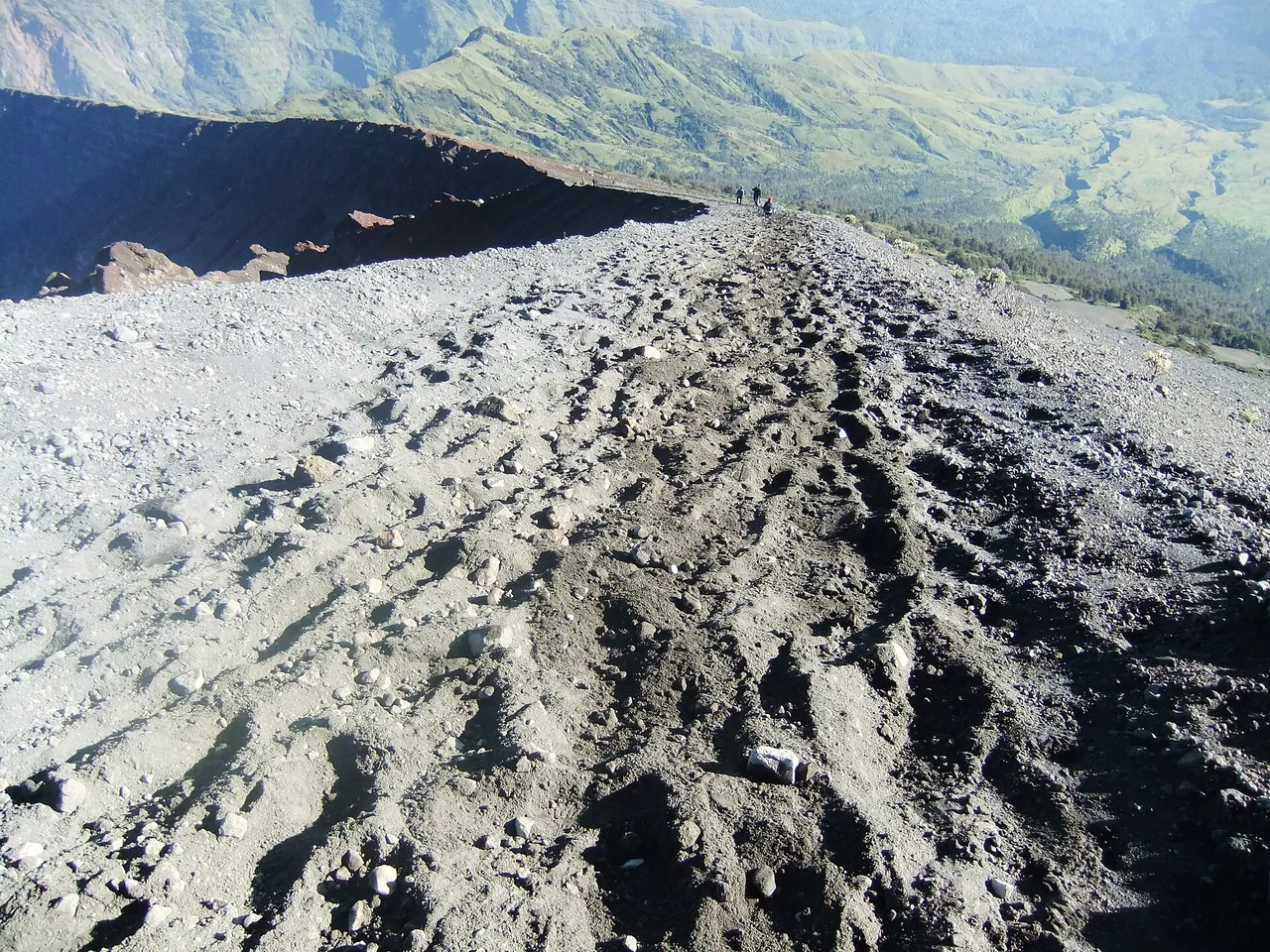
The summit push starts around 2 a.m. Three to four hours on loose volcanic sand along an exposed ridge, in the dark, in the wind. If that is not for you, this is where you find out – not before. At the top you stand at 3,726 m (12,224 ft), Indonesia's second-highest volcano, and on a clear morning you can see as far as Bali. Then comes the same sand on the way down.

Who should not do this? Anyone without mountain trips behind them – the proof of experience is mandatory and not a formality. Anyone with a heart or lung condition: the health check the day before exists exactly to screen that. Children. And anyone counting on fast rescue: on 25 May 2026 a helicopter sent for an injured Malaysian climber had to turn back because of fog, and he was treated on foot by porters, guides and a medical team.

The honest alternative is the crater rim. From Senaru it is seven to nine hours through montane rainforest up to Plawangan Senaru – the same view of the lake, without the summit ridge. And if you would rather not climb at all, the Sembalun valley has easy viewpoint hills, and the northern foot has the Sendang Gile and Tiu Kelep waterfalls.

With guide, porter and tentMount Rinjani 2 day trek: tours from Sembalun and Senaru

For foreigners, booking almost always runs through a registered trekking organizer who supplies guides, porters, tents and transfers. Important, as of 21 September 2026: eRinjani is taking no new bookings. Tours are still being sold anyway. Before booking, ask the operator whether they can actually get a ticket for your date – and choose a rate you can cancel.

Affiliate links to GetYourGuide: if you book, we earn a commission and the price stays the same. Prices and ratings as of 21 September 2026. The 250,000 IDR daily park fee and the insurance are not automatically part of the price – check each listing. And whether your date can be booked at all is decided by the park authority, not the operator.

The rulesRinjani rules since August 2025: Grade IV, guides, health check

After several accidents – including a fatal fall in June 2025 – the mountain closed completely from 1 to 10 August 2025. Since it reopened on 11 August 2025, a revised Ministry of Forestry SOP has applied. Its full text exists only inside the eRinjani app; what follows is what the park authority and the Indonesian press have published.

1

Grade IV classification

The ministry's new grading module of August 2025 runs from Grade 1 to 5. Rinjani sits at IV – not a beginners' mountain. The ministry uses Gede on Java as its reference point for Grade III.

2

Proof of experience

You have to show earlier mountain trips – by photo, certificate or interview. TNGR's mandatory provisions of 12 June 2026 require 'demonstrable mountain experience of your own'.

3

Health check the day before

A health and fitness check at a health facility, due one day before the start. That makes arriving the previous evening effectively compulsory. The location, cost and procedure are not officially published.

4

At least two people

Solo trips are ruled out. TNGR requires a minimum of two people per group plus a guide or an experienced mountaineer.

5

Guides 1:4, porters 1:2

Only certified guides registered with the ministry. One guide may take no more than four guests (five until December 2025), one porter no more than two foreign or three Indonesian guests.

6

Under 17 only with an adult

Minors need an adult with them and written parental permission. For children the trek is unsuitable in any case.

7

Insurance

Insurance is part of the ticket. The press quotes 10,000 IDR for the standard policy and 290,000 IDR for the premium version with helicopter evacuation. Whether premium is compulsory for foreigners is reported inconsistently.

8

Check in, check out, blacklist

Fail to check out, or overrun your booked time, and you are banned for two years – your trekking organizer too. In 2023 that hit 23,531 people, more than 80 percent of them foreigners. TNGR publishes the list.

9

Three forbidden routes

Off limits even with a ticket: Barujari and its 1.5 km radius, the 'south summit' Puncak Selatan (3,171 m) via Timbanuh, and the descent from Pelawangan Aik Berik to Segara Anak. TNGR calls them illegal and extremely dangerous.

Official prices · as of 09/2026 · 1,000 IDR ≈ €0.049
Park entry for foreigners, Sembalun, Senaru and Torean routes · per person and day, no holiday surcharge250,000 IDR (about €12.20)
Park entry for foreigners, southern routes Aik Berik, Tetebatu and Timbanuh · per person and day200,000 IDR (about €9.80)
Park entry for Indonesians, class 1: weekday / public holiday50,000 / 75,000 IDR
Insurance, standard / premium with helicopter evacuation (amounts per press reports, April 2026)10,000 / 290,000 IDR
Penalty for an illegal ascent (per press reports, 2025; the original articles were not reachable)5 times the ticket price
Sources: TNGR, 14 August 2025 (reopening on 11 August 2025, SOP revision: Grade IV, guide ratio, insurance, emergency plan) · TNGR, 12 June 2026 (at least two people, a guide, proof of experience, under 17 only with an adult) · Antara, August 2025 (ratios 1:4 and 1:2, health check, certified guides) · IDN Times (2023 blacklist, daily quota of 700). The full SOP exists only inside the eRinjani app – so gate hours, maximum length of stay and camping rules are unknown to us.

Six gates, four ways upRinjani hike routes: Sembalun, Senaru, Torean, the south

Gate and camp elevations, walking times and package prices come from operators and Wikipedia; the fees and the closures are official. You always book a specific gate – you cannot switch.

Route → what it involves, how long, what it costs
Sembalun to the summit · about 1,150 m to 3,726 m (3,773–12,224 ft) · 2–3 daysThe classic. Day 1: six to eight hours to the Plawangan Sembalun camp on the crater rim (about 2,640 m / 8,661 ft). The summit push starts around 2 a.m. and takes three to four hours on loose volcanic sand. Adding the descent to Segara Anak and an exit via Senaru or Torean makes it three to four days. 250,000 IDR per day.
Senaru to the crater rim and the lake · about 600 m to 2,640 m (1,969–8,661 ft) · 2 daysSeven to nine hours through montane rainforest to Plawangan Senaru, overlooking Segara Anak and Barujari; from there you can drop to the lake. It is also the usual exit for summit treks. 250,000 IDR per day.
Torean to Segara Anak · about 600 m to 2,000 m (1,969–6,562 ft)Eight to ten hours through the gorge of the Kokok Putih, popular as the descent on three- and four-day trips. Exposed sections, with rockfall and slippery footing after rain. 250,000 IDR per day.
Southern routes Timbanuh, Tetebatu and Aik Berik · up to about 2,700 m (8,858 ft) · 2 daysTo the southern crater rim only. Going on to the lake, and the 'south summit' Puncak Selatan, are both banned. In return, the cheaper rate: 200,000 IDR per day.
The summit ridge of Mount Rinjani by day: a broad back of loose gray volcanic sand and scree, the flank falling away on one side into the caldera
Three steps up, two back down. That last slope is the real trek.

Photo: Midori · CC BY 3.0

Good to knowGetting to Mount Rinjani, best time, tips

Getting there

Without a car: There is no reliable public transport to Sembalun or Senaru. The normal option is the trekking organizer's transfer from Lombok (Praya) airport, Mataram, Senggigi or Bangsal harbor (for the Gili Islands); from Bali by fast boat or flight.

By car: Sealed roads run as far as Sembalun and Senaru; vehicles stay with the organizer or the guesthouse. Arriving the evening before is effectively compulsory because of the health check the previous day.

  • From Senggigi · 2–2.5 hours to Senaru, 3–3.5 hours to Sembalun
    Transfer via Pemenang and Bayan to Senaru; Sembalun is another 1.5 hours
  • From Mataram · about 3 hours
    Transfer via Aikmel to Sembalun
  • From Lombok (Praya) airport · 3–3.5 hours
    Transfer to Sembalun or Senaru
  • From Bali (Padang Bai / airport) · a full travel day
    Fast boat to Bangsal or a 45-minute flight to Lombok, then a transfer

Best time to go

The dry season runs from roughly May to October; the official season is 1 April to 31 December, with January to March closed because of heavy rain, storms and landslides. April and November/December are often wet. July to September is the busiest period – quotas run short then, and towards the end of the dry season wildfires become a risk (which is why there have been no new bookings since 1 September 2026). The summit push starts around 2 a.m. so that you are up there at sunrise, before the clouds build.

Who it suits

Children
Under 17 only in the company of an adult and with written parental permission (TNGR). As a Grade IV trek it is unsuitable for children; for teenagers, only with mountain experience.
Minimum age
no fixed minimum age published; under 17 requires an escort and permission
Fitness
Very demanding: the Ministry of Forestry rates Rinjani Grade IV – not for beginners. More than 2,500 m (8,200 ft) of climbing, and the summit ridge is loose volcanic sand with drop-offs. Demonstrable trekking experience and a health check the day before are required.
Altitude
Relevant: camps at around 2,640 m (8,661 ft), summit at 3,726 m (12,224 ft), climbing from sea level in two days. With headache plus nausea or dizziness, do not go higher.
Heart and lungs
Not suitable; the mandatory health check (blood pressure among other things) exists precisely to screen out such risks. Because of possible ashfall, PVMBG advises carrying a mask and eye protection.
Wheelchair
not possible
Dogs
no rule found (a national park – not provided for)
Clothing
PVMBG measured 11–23 °C (52–73 °F) at the Sembalun post on 20 September 2026; at the crater rim and the summit, nights near freezing with strong wind (operator figures). Warm layers, windproofs, hat, gloves, headlamp.
Footwear
Proper hiking boots, gaiters against the sand, poles for the summit slope.

Tips you will need on site

  • Check the status before you book flights: eRinjani has taken no new bookings since 1 September 2026. If you are planning for autumn 2026, ask your trekking organizer for the current position and for the cancellation terms.
  • Book only with a registered trekking organizer, and ask to see the guide's certificate, the guide ratio (no more than four guests per guide) and the eRinjani ticket issued in your own passport name.
  • Bring proof of your own mountain experience (photos, a log book) and travel insurance that covers mountain rescue; take the premium policy with the helicopter – and know that the helicopter cannot land in fog.
  • Arrive the day before: the health check is due one day before the start, and starting rested makes the summit ridge safer.
  • Check out, and stick to the time you booked – otherwise it is two years on the blacklist, for your organizer as well.
  • On the summit ridge in the dark, stay with your guide; do not rest alone or fall behind. That is exactly how the accident of June 2025 began.
  • Carry your rubbish out; refillable bottles and containers are compulsory, and open fire is banned in the dry season, with baggage checked for it.
  • If Grade IV is too much: the Senaru crater rim as a two-day trip, or the hills of the Sembalun valley.

A short history

  • 1257: the eruption of Samalas, the predecessor of today's Rinjani – one of the most powerful eruptions of recorded history; it left the caldera with Segara Anak lake (at about 2,000 m, roughly 200 m deep).
  • 1994: an eruptive phase of Barujari; a cold lahar kills 30 people from the village of Aikmel. The national park is founded in 1997.
  • 2009, 2010, 31 October 2015 and 27 September 2016: further Barujari eruptions; in 2016 tourists are taken off the mountain. Since 2015 the alert has stood at Level II, according to PVMBG.
  • 29 July and 5 August 2018: earthquakes of magnitude 6.4 and stronger trigger landslides; hundreds of hikers are stranded on the mountain for a time and the routes stay closed for months. Rinjani-Lombok had become a UNESCO Global Geopark in April 2018.
  • 2023: TNGR blacklists 23,549 people – almost all of them for failing to check out or for overrunning.
  • 20/21 June 2025: a 26-year-old Brazilian climber falls several hundred meters during the night-time summit push; the recovery takes four days and she is found dead. The case draws international criticism of the rescue system and of guiding practice.
  • 1–10 August 2025: a full closure; from 11 August 2025 the revised SOP applies (Grade IV, guide ratio, insurance, emergency plan). Premium insurance follows on 1 October 2025, and higher entry classes on 3 November 2025 (Permenhut 17/2025).
  • 2026: the season opens on 1 April with RFID wristbands, emergency beacons and drone logistics (per press reports); since 1 September 2026 the park has been open on a limited basis because of wildfire risk.

With the crater lake and hot springsRinjani in three days: summit, Segara Anak, Torean

If you want the lake as well, allow three to four days: the summit on the second morning, then the descent into the caldera to the hot springs on the shore and out via Senaru or Torean. Each extra day adds another 250,000 IDR in park fees.

Affiliate links to GetYourGuide: if you book, we earn a commission and the price stays the same. Prices and ratings as of 21 September 2026. The hot springs are on the lakeshore – the Barujari cone in the middle of the lake, and 1.5 km around it, stay closed.

Outdated onlineWhat other sites get wrong

“Entry costs 150,000 IDR per day.”
Out of date. Since 3 November 2025 foreigners pay 250,000 IDR per day on Sembalun, Senaru and Torean, and 200,000 IDR on the southern routes (TNGR, under Permenhut 17/2025). The interim rate of 200,000 IDR from 2024/25 is out of date too.
“You can do Rinjani on your own.”
Not anymore. TNGR requires at least two people per group, a guide and proof of experience; the 2025 SOP admits only certified, registered guides at a ratio of no more than 1:4. Trip reports about solo trekking date from before 2018.
“Level II means the mountain is closed.”
Rinjani has stood at Level II continuously since 2015, and PVMBG explicitly permits trekking. Only Barujari and a 1.5 km radius are closed. What limits the mountain right now is wildfire prevention, not the alert level.
“With premium insurance the helicopter comes if something happens.”
It comes if it can. On 25 May 2026 the helicopter sent for an injured Malaysian climber had to turn back because of fog; he was treated on foot by porters, guides and a medical team.
“You buy tickets at the gate, and the mountain is open all year.”
Both wrong. Booking runs only through the eRinjani app with a daily quota – and since 1 September 2026 temporarily not at all. From January to March the park is closed anyway.

Quick answersBefore the Rinjani trek

Can I book a Rinjani trek for autumn 2026?

Operators are still selling, but the park authority has taken no new eRinjani bookings since 1 September 2026. Ask your trekking organizer explicitly whether they can get a ticket for your date, get the cancellation terms in writing, and book flights only after that. No reopening date has been announced.

What does a Rinjani trek cost in total?

Park entry alone is 250,000 IDR per person per day, so 750,000 IDR (about €37) for three days, plus insurance. One local operator quotes all-in packages with guide, porter, tent, food and transfer from about US$210 for two days and US$250 for three; the tours listed on this page run €104 to €193.

Is the crater rim enough instead of the summit?

For most people, yes. From Plawangan Senaru or Plawangan Sembalun at about 2,640 m (8,661 ft) you look down on Segara Anak and Barujari – the view people come for. The summit push adds another 1,100 m (3,600 ft) on loose sand, in the dark, in the wind.

Do you need mountain experience for Rinjani?

Yes, and you will be asked for it. The SOP requires proof of earlier mountain trips by photo, certificate or interview, plus a health check the day before. With the Grade IV classification the Ministry of Forestry explicitly aims to screen out the inexperienced.

What do you need to bring?

Proper hiking boots, gaiters against the sand, poles, warm layers and windproofs for the night on the crater rim, a hat, gloves and a headlamp. Plus refillable food and drink containers, which are compulsory, and the mask and eye protection PVMBG recommends in case of ashfall.

How do you get to Rinjani from Bali?

By fast boat to Bangsal or a 45-minute flight to Lombok, then a transfer – a full travel day together. Because the health check falls the day before, you should be in Sembalun or Senaru a day ahead of your start anyway.

Is Mount Rinjani open right now?

Only partly. Since 1 September 2026 the park has been 'open on a limited basis' because of wildfire risk: anyone who booked and paid before that date may go, but new bookings through eRinjani are suspended. TNGR reassesses regularly; from January to March it is closed in any case.

What is the Rinjani entrance fee for foreigners?

250,000 IDR per person per day (about €12.20) on the Sembalun, Senaru and Torean routes, and 200,000 IDR on the southern routes – as of September 2026, in force since 3 November 2025. Insurance comes on top: 10,000 IDR standard or 290,000 IDR premium with a helicopter. So a three-day trek costs 750,000 IDR in park fees alone.

Can you climb Mount Rinjani without a guide?

No. TNGR requires at least two people per group and a guide, and the 2025 SOP requires certified, registered guides at a ratio of no more than 1:4. Press reports mention five years on the blacklist and a financial penalty for illegal ascents; the original articles were not reachable, and only the two-year ban for failing to check out is firmly documented.

What changed after the fatal accident of June 2025?

The mountain closed from 1 to 10 August 2025 and reopened with a new SOP: Grade IV classification, proof of your own mountain experience, a health check the day before, stricter guide and porter ratios, insurance with a helicopter option, and an emergency plan. In 2026, press reports add RFID wristbands, emergency beacons and drones.

How do you book a Rinjani ticket?

Through the eRinjani app, for a fixed date and gate and against a daily quota (700 people in total). In practice foreigners book through a registered trekking organizer. As of 21 September 2026, booking is temporarily stopped.

When is Mount Rinjani closed?

Every year in the rainy season – in 2026 from 1 January to 31 March. On top of that come special closures for eruptions, earthquakes, accidents or wildfire risk.

What alert level is Mount Rinjani at?

Level II (Waspada), according to PVMBG continuously since 2015 and confirmed in the report of 20 September 2026. Trekking is permitted; the Barujari cone and a 1.5 km radius are off limits. PVMBG advises carrying a mask and eye protection against ash.

How long does the Rinjani trek take?

Two days and one night for the summit or the crater rim, three to four days including the crater lake and an exit via Senaru or Torean. Summit day starts around 2 a.m. and often runs ten hours or more.

How hard is Mount Rinjani?

Very hard: officially Grade IV, more than 2,500 m (8,200 ft) of climbing, and the final summit slope is loose sand on an exposed ridge. The Ministry of Forestry explicitly wants to keep beginners away and requires proof of experience.

Can children and teenagers come along?

Under 17 only in the company of an adult and with written parental permission. For children the trek is unsuitable.

What happens if you do not check out?

You go on the TNGR blacklist for two years, and so does your organizer. In 2023 that affected more than 23,000 people, mostly foreigners. The list is public.

When is the best time for Rinjani?

May to October. July to September is high season with tight quotas, and towards the end of the dry season the wildfire risk rises. April, November and December are often rainy.
Sources · accessed on 21 September 2026

  • TNGR, 1 September 2026 – limited opening under circular SE.4/KSDAE/SKSDAE/KSA.02.02/08/2026: eRinjani booking suspended, paid bookings still honored, baggage checks and a fire ban
  • TNGR, 12 June 2026 – mandatory provisions: at least two people, a guide or experienced mountaineer, proof of experience, under 17 only with an adult, refillable containers
  • TNGR, 14 August 2025 – reopening on 11 August 2025 with the revised SOP: Grade IV, guide ratio, insurance, emergency plan
  • TNGR, 7 November 2025 – new entry classes from 3 November 2025 under Permenhut 17/2025 · TNGR, 22 December 2025 – closure of all six routes from 1 January to 31 March 2026
  • MAGMA Indonesia / PVMBG – alert levels; daily report for Rinjani, 20 September 2026: Level II, 1.5 km exclusion zone around Barujari, trekking otherwise permitted, mask and eye protection advised
  • Antara, August 2025 – SOP details: Grade 4, proof of experience, guides 1:4 from January 2026, porters 1:2, health check the day before, registered guides only
  • CNBC Indonesia, 31 August 2026 – the wildfire circular; nine areas closed, Rinjani 'open on a limited basis'
  • IDN Times – 2023 blacklist: 23,549 entries, two-year ban, more than 80 % foreigners, organizers banned too; daily quota of 700 across six gates
  • detik, April 2026 – ban on the south summit Puncak Selatan and on the descent from Pelawangan Aik Berik to the lake
  • Suara NTB, 26 May 2026 – a Malaysian climber's fall, premium insurance, the helicopter had to turn back because of fog
  • German Federal Foreign Office, as of 21 September 2026 – check alert levels, avoid exclusion zones, trek with local guides, rainy season November to March
  • Photos: Giovari max (CC BY-SA 4.0), Hadiyan Faizun (CC BY-SA 4.0), Petter Lindgren (CC BY-SA 3.0), César González Palomo (CC BY-SA 2.0), Midori (CC BY 3.0), via Wikimedia Commons