Volcano·Guide
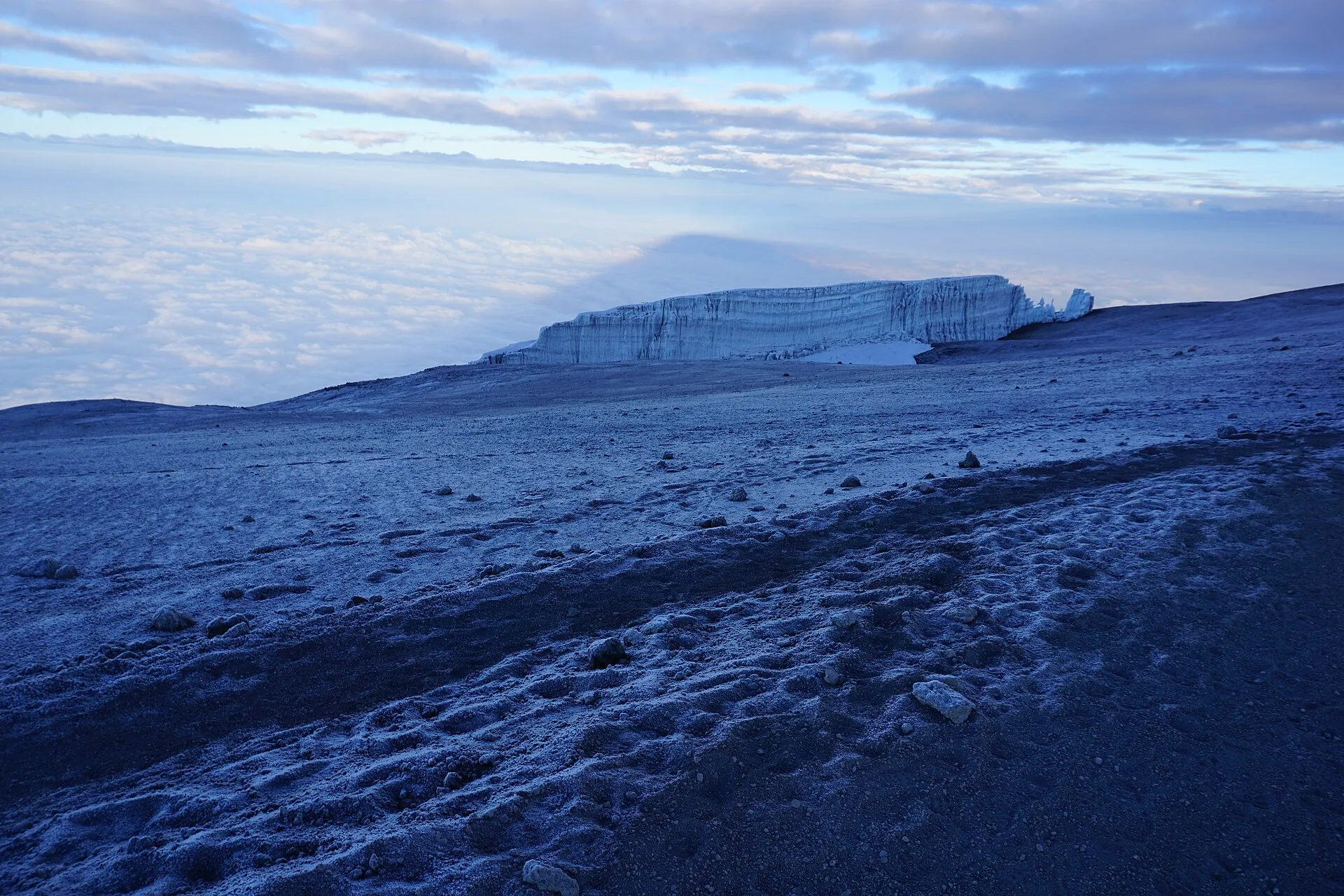
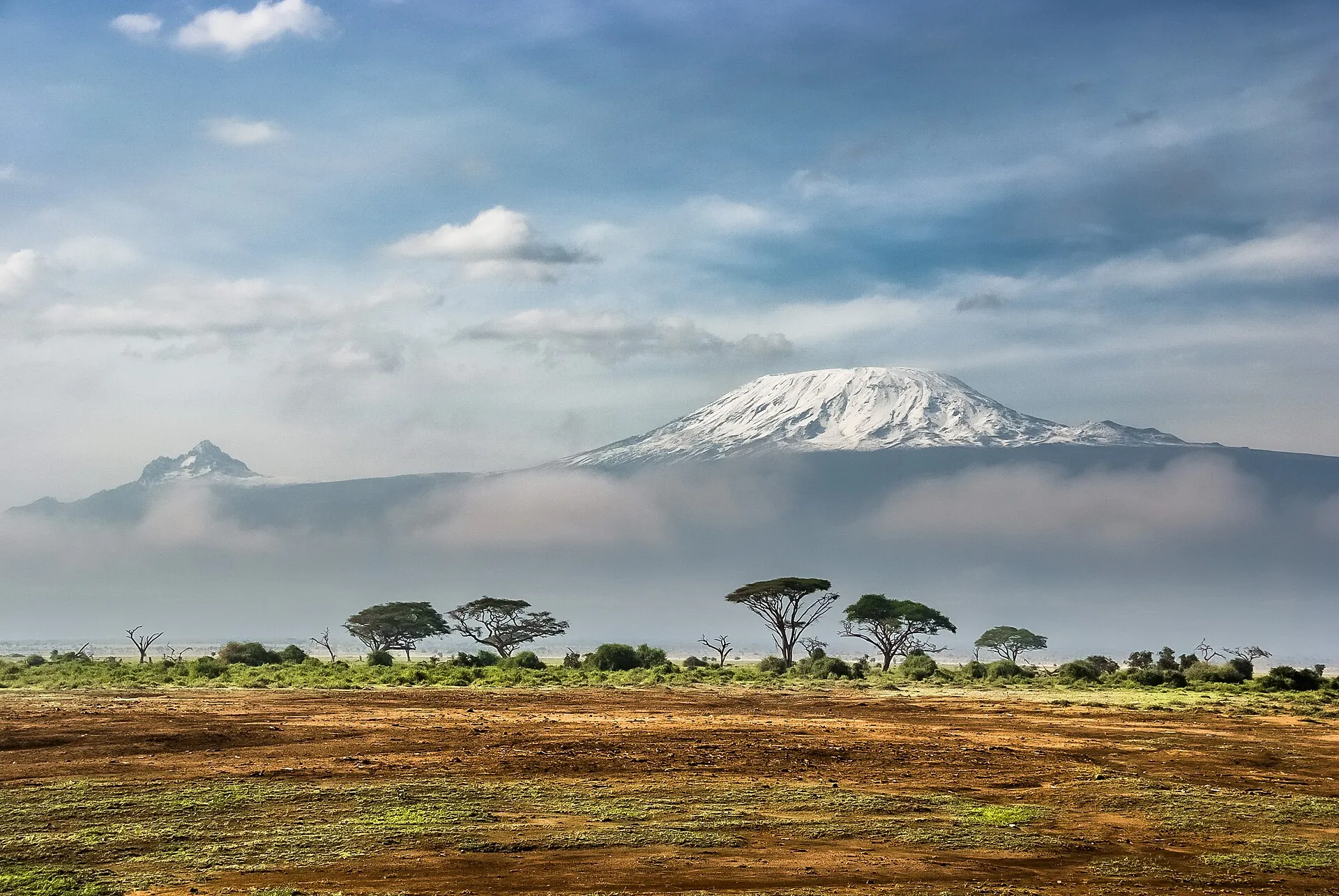
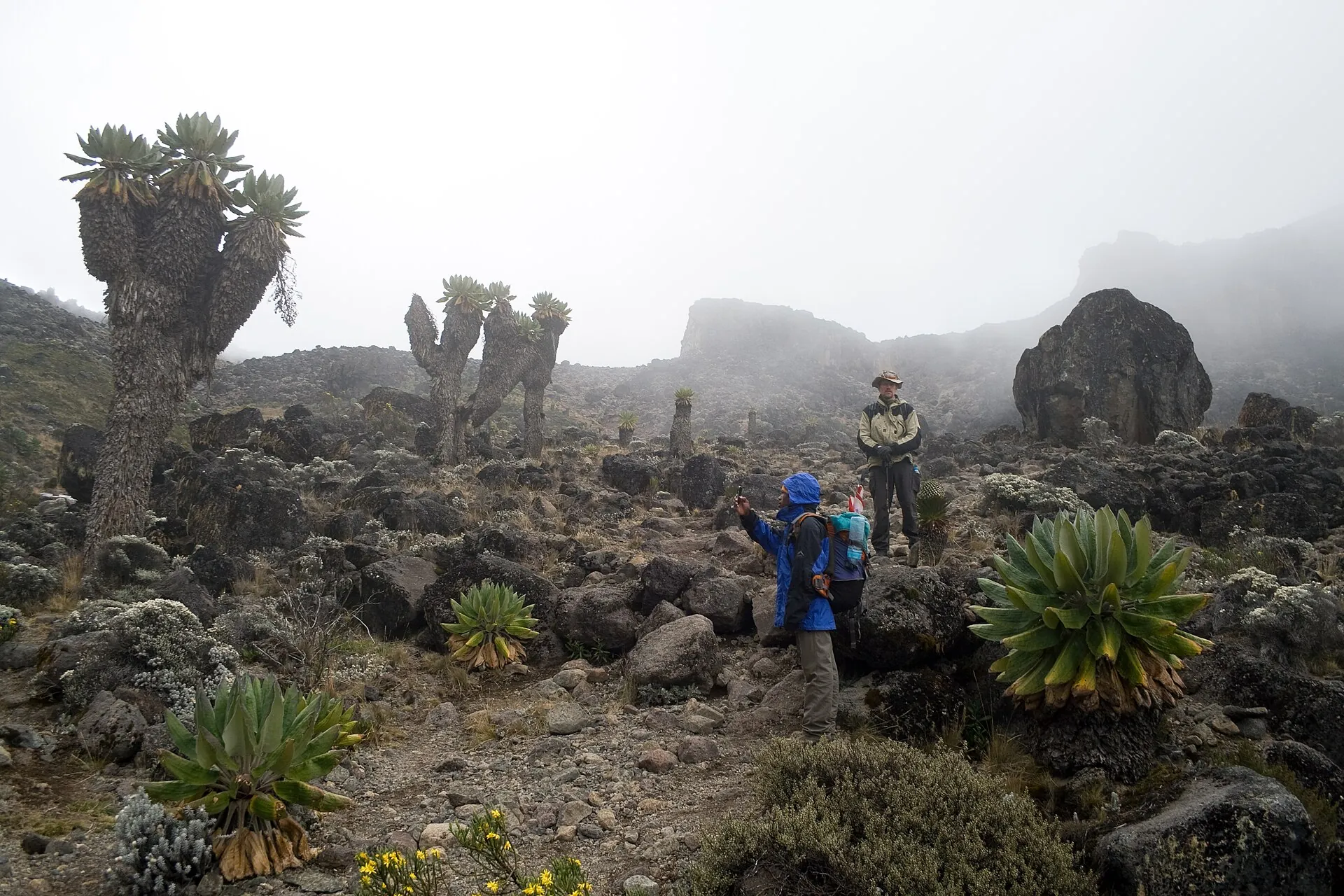
Snow-capped Kilimanjaro above the savanna of Amboseli, umbrella acacias and a bank of cloud in front Hikers among giant groundsels taller than they are in the misty heath zone of Kilimanjaro, boulders behind them The edge of a glacier near the summit of Kilimanjaro at dawn, frozen scree in front and a sea of cloud below

Kilimanjaro

From the plain it is a white line above the acacias.

Halfway up you stand in the mist among plants that grow nowhere else.

At the top there is ice – and less of it every year.

Scroll –
up through five climate zones

As of 23 September 2026Kilimanjaro today: open – but only with a permit and a guide

The park is open, and as of 23 September 2026 neither TANAPA nor national travel advice reports a closure. The catch: you get past no gate without a permit bought through a registered Tanzanian operator and without a licensed mountain guide – not even for the day hike to Mandara Hut. And the park fees come on top of everything else.

Open
19,341ft

Uhuru Peak on seven routes

Every route to the summit is walkable – with a licensed guide, an assistant guide, a cook and porters. Five to nine days, no climbing. The summit push starts at midnight and takes 12 to 16 hours.

Park fees for 7 days on Machame, per person, 18% VAT included$956
Open
8,860ft

Day hike to Mandara Hut

From Marangu Gate through the rainforest to Mandara Hut and on to the Maundi Crater, about 8 km (5 miles) each way, 5 to 7 hours in all. A permit and a guide are required here too; the day permit covers 12 daylight hours.

Park fees per person, exclusive of 18% VAT; operators from Moshi charge $170–275from $108
Closed

Solo climbs and children above 3,700 m

Without a registered operator there is no permit, and solo climbers are turned away at the gate. TANAPA bars children under 10 from going above 3,700 m (12,140 ft) – higher only with special permission granted by KINAPA in advance.

TANAPA park rules, Kilimanjaro National Park brochure
Sources: TANAPA tariff 2023/2026 and the TANAPA Kilimanjaro National Park brochure, accessed 22 September 2026 · German Federal Foreign Office travel advice for Tanzania, as of 22 September 2026 (unchanged since 25 August 2026): the situation after the October 2025 elections remains volatile, avoid demonstrations; on the mountain itself it warns explicitly about altitude sickness and states that mountain rescue is 'practically non-existent'. Note: the 2023/2026 tariff expired on 30 June 2026 and no 2026/27 tariff had been published by 22 September 2026 – whether different amounts have applied since July 2026 is open.
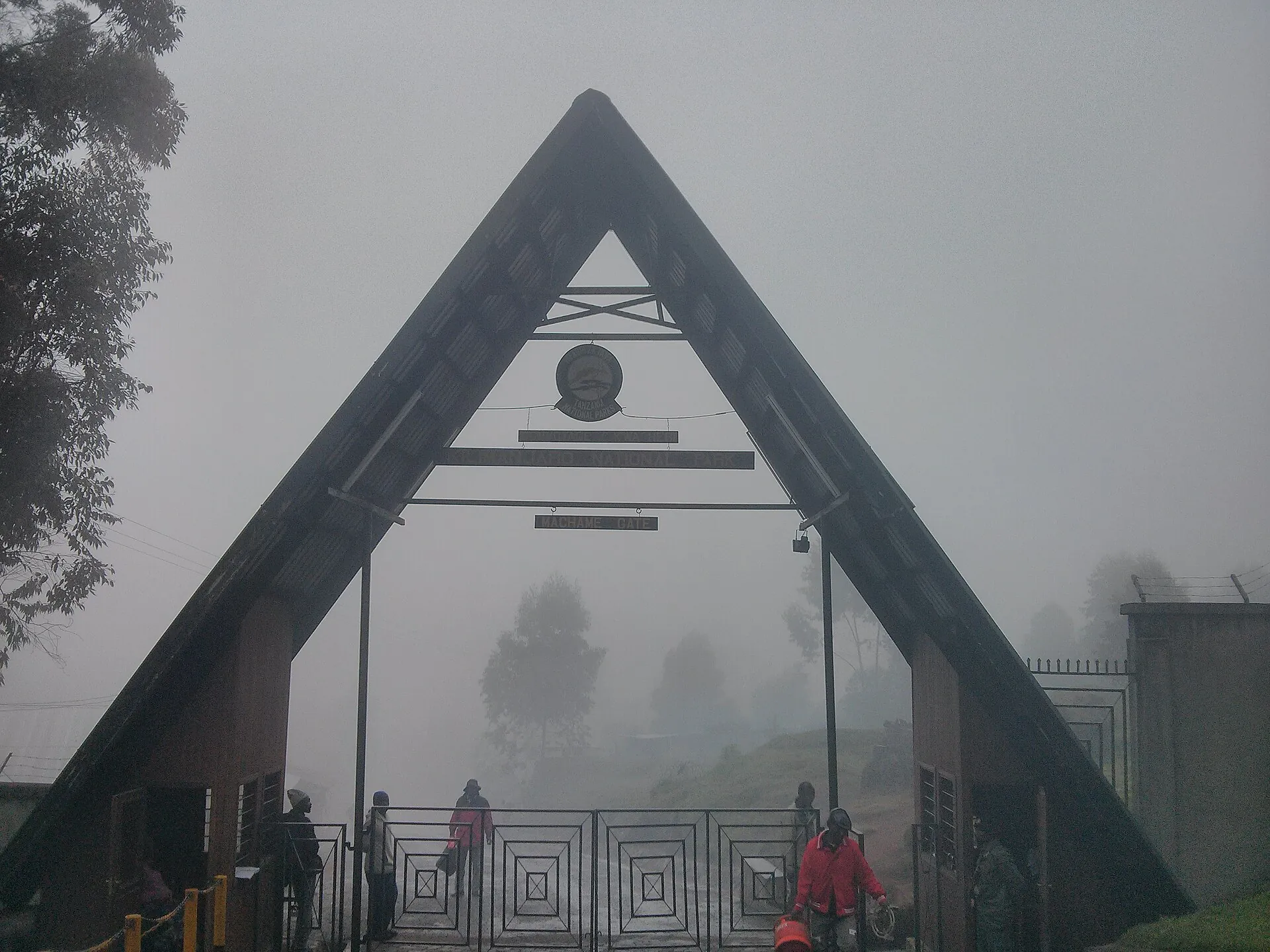
The wooden A-frame gate of the Machame route on Kilimanjaro in morning mist, hikers at the turnstile
At Machame Gate every climber is registered with a passport and every porter load is weighed – in high season that takes an hour.

Photo: BerotBurns · CC BY-SA 3.0

Five climate zones on one mountainWhat the climb up Kilimanjaro feels like

The highest free-standing volcano on earth: three cones – Kibo, Mawenzi and Shira – with Kibo dormant and fumaroles still venting in its summit crater. Its last activity was 150,000 to 200,000 years ago. It is dangerous all the same, just not volcanically.

Day one runs through rainforest: warm, wet, moss on the trees, colobus monkeys over the trail. On day two the forest stops as if cut off and you stand in heath among giant groundsels shaped like candelabras. Up here it is hot by day and freezing at night.

Above 4,000 m (13,100 ft) everything is stone. The alpine desert on Kibo has no shade and no water, only scree and wind. At Barafu or Kibo camp you lie down at 7 pm and get up at 11: the summit push runs at night, so the scree is frozen and you are on top at sunrise.

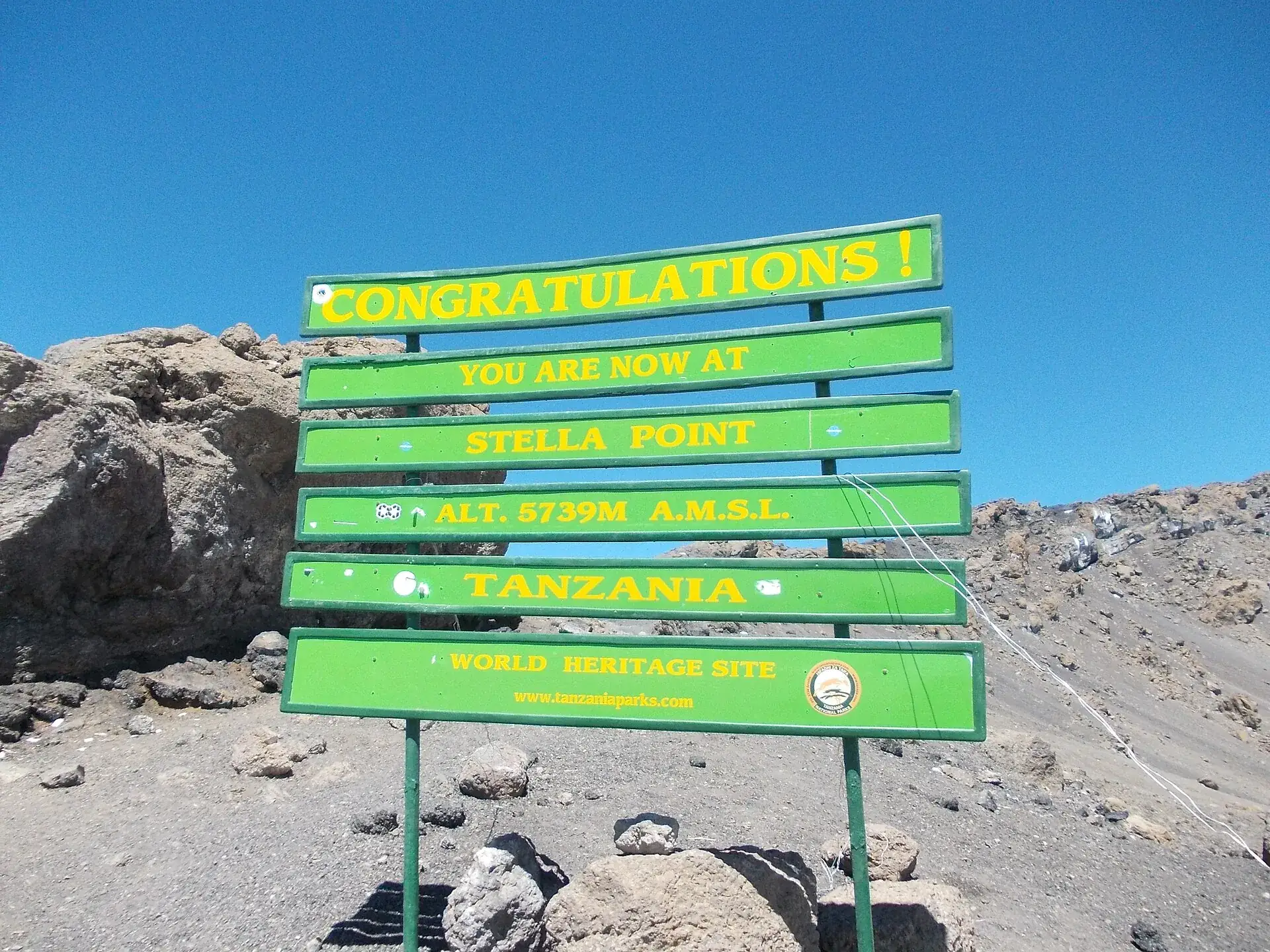
The last 1,200 m (3,900 ft) are the real test – not technically, but because of the air. At Stella Point (5,739 m / 18,829 ft) a green sign congratulates you; Uhuru Peak is another 45 minutes along the crater rim, past what is left of the glaciers. Then you walk about 2,700 m (8,900 ft) back down in a single day.

Affiliate links to GetYourGuide: if you book, we earn a commission and the price stays the same. Prices and ratings as of 22 September 2026. These are day hikes, not summit climbs – GetYourGuide does not sell summit expeditions for Kilimanjaro. Before booking, check whether the park fees (at least $108 a day) are included.

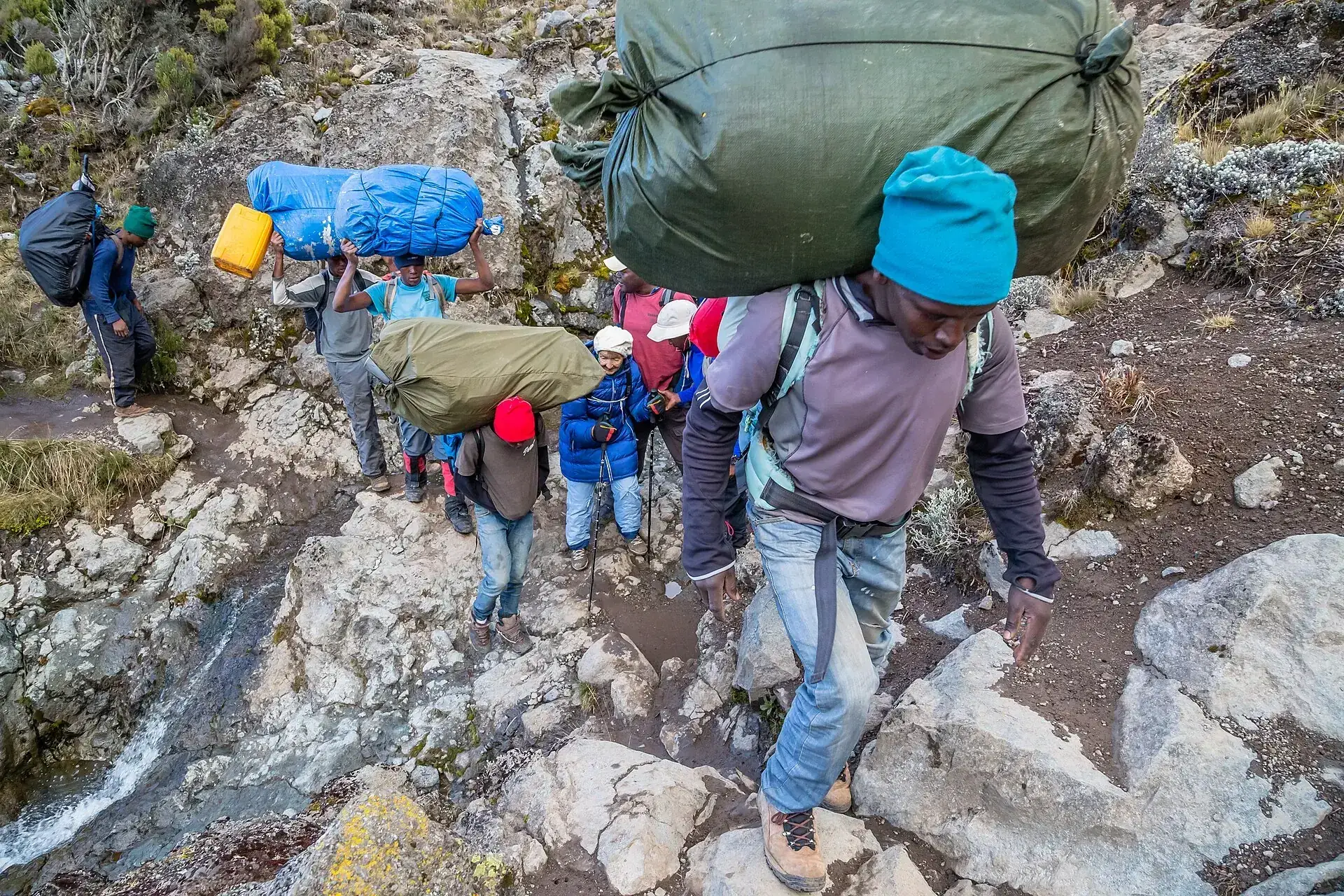
Porters carrying large loads on their heads climb wet rock steps on Kilimanjaro, a stream running beside the trail
Nobody goes up without them: TANAPA caps a porter's load at 25 kg (55 lb), their own kit included.

Photo: Sergei Andreichuk · CC BY-SA 4.0

Permit, guide, feesWhat TANAPA requires – and what it costs

Kilimanjaro National Park belongs to the Tanzanian park authority TANAPA and is run by KINAPA. The rules are short: a permit through a registered operator, a licensed guide, designated trails and campsites only – and 18 percent VAT on every fee.

1

Permits only through an operator

TANAPA issues permits in its own reservation system, and only a registered Tanzanian operator can book them. Nothing is sold at the gate – there you only register, with your passport, usually between 7 and 10 am.

2

Guide, assistant, cook, porters

A multi-day climb comes with a whole team; solo climbers are turned away at the gate. The day hike needs a licensed guide too. Every crew member is registered and every porter load is weighed.

3

Cashless, paid in advance

There is no cash payment at the gate for tourists: TANAPA settles through the government payment gateway GePG, by card or mobile money. The operator pays the fees before the climb starts.

4

Children, altitude, exceptions

Under 10 the limit is 3,700 m (12,140 ft) – that is in the TANAPA park rules. Some operators quote 3,100 m, which has no official basis. Exceptions have to be approved by KINAPA in advance.

Official TANAPA fees · tariff 2023/2026 · all amounts exclusive of 18% VAT
Conservation fee per person and day, foreign visitors aged 16 and over · children 5–15: $20, under 5 free$70
Camping per person and night on Machame, Lemosho, Rongai, Umbwe, Mweka · children $10$50
Hut at Mandara, Horombo or Kibo on the Marangu route, per person and night · children $20$60
Rescue fee per person and trip, non-refundable$20
Crew fee per Tanzanian guide, porter or cook and tripTZS 5,000
Crater camping or Upper Barafu per person and night · climbing Mawenzi $750 a day$100
Vehicle with foreign plates up to 2,000 kg, e.g. the transfer to Londorossi Gate$40
Source: TANAPA tariff 2023/2026 (valid 1 July 2023 to 30 June 2026), accessed 22 September 2026 – it states explicitly that 'All charges are VAT (18%) exclusive'. Worked example for 7 days on Machame: 7 × 70 + 6 × 50 + 20 = $810 net, about $956 with VAT. No tariff for the 2026/27 financial year had been published by 22 September 2026; the TANAPA tariff page was still headed 'Financial Year 2023/2024'. In May 2025 the government froze park fees for at least twelve months.
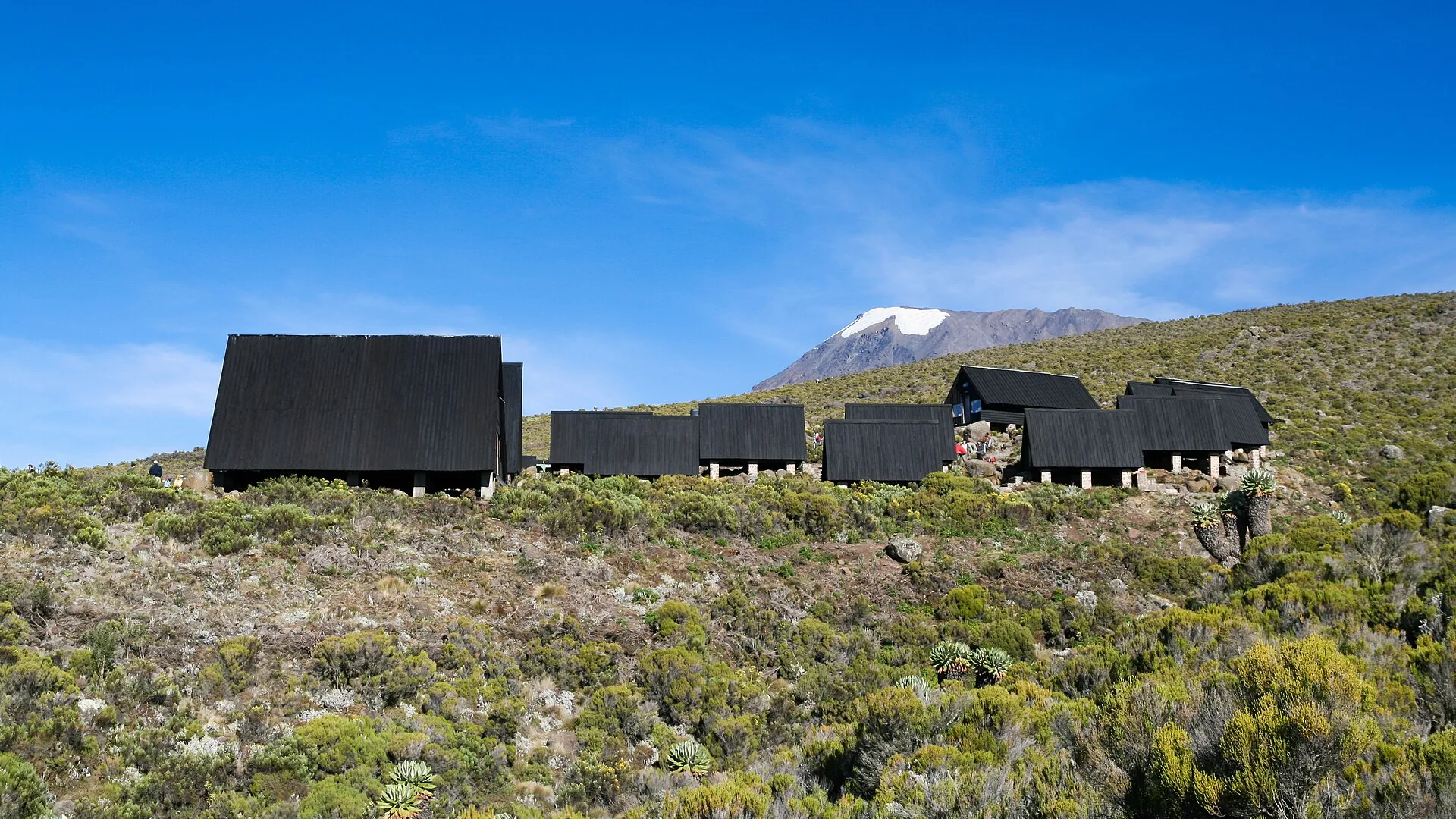
The dark rows of huts at Horombo camp on Kilimanjaro above the heath vegetation, snow-covered Kibo behind
Horombo at 3,720 m (12,200 ft) is the one stage where many people spend a whole day acclimatizing – and that alone doubles the summit odds.

Photo: Christoph Strässler from Oberdorf BL, Schweiz · CC BY-SA 2.0

Seven routes, very different oddsThe routes up Kilimanjaro

Route → days, summit rate, park fees
Marangu (the 'Coca-Cola route'), from 1,840 m (6,040 ft) · 5–6 daysThe only hut route: Mandara (2,700 m), Horombo (3,720 m), Kibo (4,700 m), descending the same way. Summit rate in the 2006 KINAPA data about 30% in 5 days and about 50% with an acclimatization day. Park fees for 6 days about $873 including VAT.
Machame (the 'Whiskey route'), from 1,640–1,800 m · 6–7 daysThe most popular camping route: the Shira Plateau, the Barranco Wall, Barafu Camp (4,670 m), descending via Mweka. Summit rate about 50% in 6 days and about 70% in 7. Park fees for 7 days about $956 including VAT. The Barranco Wall is tricky when wet or icy.
Lemosho (west side), from about 2,100 m · 7–8 daysThe longest acclimatization and the highest success rate: about 85% in 7 days and about 90% in 8. The drive to Londorossi Gate takes 3 to 4 hours in a 4x4. Park fees for 8 days about $1,097 including VAT, plus a vehicle fee from $40.
Rongai (north side), from about 1,950 m · 6–7 daysThe driest route, which is why it is also used in the rainy seasons: via Mawenzi Tarn and Kibo Hut, descending on Marangu. Summit rate about 50% and 70%. The summit night counts as hard, because there is little chance to walk high and sleep low.
Day hike Marangu Gate – Mandara Hut – Maundi Crater · 5–7 hoursAbout 8 km (5 miles) each way through the rainforest, 3 to 4 hours up and 2 to 3 down, from 1,840 to 2,700 m. From the Maundi Crater you see Lake Chala, Lake Jipe and Nyumba ya Mungu. Guide and permit required; the day permit covers 12 daylight hours.
Sources: TANAPA tariff 2023/2026 and the TANAPA brochure (routes, elevations, rules) · summit rates by route come from KINAPA data of 2006, the last published statistics; current rates are operator estimates. Gate and camp elevations differ by up to 150 m between sources.
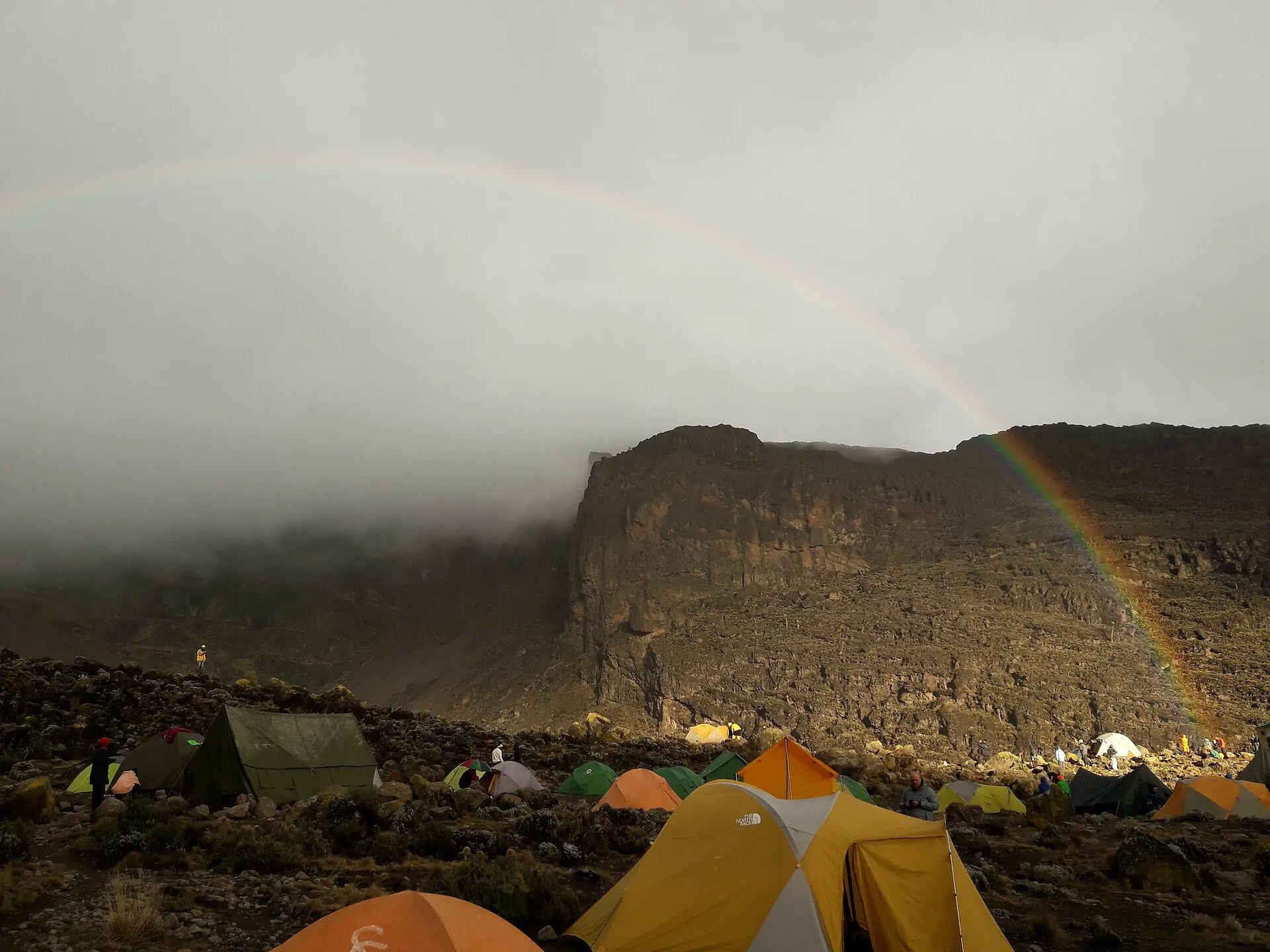
Tents at Barranco Camp on Kilimanjaro under a rainbow, the dark rock wall behind them in cloud
Barranco Camp at about 3,900 m (12,800 ft): the wall behind it is the first item on the next morning's program.

Photo: KpokeJlJla · CC BY-SA 4.0

The real riskAltitude sickness on Kilimanjaro

The mountain needs no climbing – which is exactly why people underestimate it. Travel advice warns explicitly about altitude sickness on Kilimanjaro and Meru and states that mountain rescue is 'practically non-existent'.

From the gate at about 1,800 m (5,900 ft) to Uhuru Peak at 5,895 m is more than 4,000 m of ascent in a handful of days. Book five days and you save money at the cost of the summit: in the KINAPA data only about one climber in three reaches the crater rim on the 5-day Marangu route, against about nine in ten on 8-day Lemosho.

Figures operators quote from the authorities give 3 to 10 deaths a year among 30,000 to 50,000 climbers, almost always from high-altitude pulmonary or cerebral edema. No official statistic exists.

In practice that means: book a long route, spend two nights in Moshi or Arusha beforehand or climb Mount Meru to acclimatize, drink plenty, and go down rather than on when a headache comes with nausea. Guides usually measure oxygen saturation daily. And insure for trekking to 6,000 m and helicopter evacuation – whether the Kilimanjaro SAR rescue service still flies is contradictory in the sources.

The green sign at Stella Point on Kilimanjaro at 5,739 meters: 'Congratulations, you are now at Stella Point'
Stella Point, 5,739 m (18,829 ft). Uhuru Peak is another 45 minutes along the rim – the longest of the whole climb.

Photo: Caelo80 · CC BY-SA 3.0

Good to knowGetting there, best time, tips

Getting there

Without a car: International flights land at Kilimanjaro International Airport (JRO) between Arusha and Moshi; visa on arrival ($50 or $100 depending on nationality) or an e-visa beforehand through visa.immigration.go.tz. From the airport it is a shuttle or taxi to Moshi (about 42 km / 26 miles, 40 minutes) or Arusha (about 50 km, 50 minutes). Operators drive you to the gates; daladalas run from Moshi to Marangu and Machame, but without a guide they are no use.

By car: Marangu Gate: 41 km from Moshi, 86 km from the airport (TANAPA), paved; Machame Gate 30 km paved; Rongai 70 km (2 to 2.5 hours); Lemosho/Londorossi 3 to 4 hours with a 4x4. The tariff charges vehicles from $40 (foreign plates). You can park at the gates; do not leave valuables in the car (travel advice notes high crime).

  • From Moshi · about 1 hour
    Car to Marangu Gate (park headquarters)
  • From Kilimanjaro International Airport (JRO) · about 1.5 to 2 hours
    Car via Moshi to Marangu Gate
  • From Arusha · about 2.5 to 3 hours
    Car via Moshi to Marangu Gate (Arusha–JRO 50 km, JRO–Marangu 86 km)

Best time to go

TANAPA names two dry seasons with clear days and cold nights: late June to September, and December to early March. January and February are the clearest and therefore the busiest, July and August likewise; September and October are quieter with weather that is still good. The long rains run March to May (snow at the summit, mud in the forest) and the short rains in October and November – if you go then, pick the drier Rongai route. The summit push always starts at night so you are on top at sunrise.

Who it suits

Children
Official rule: children under 10 may not go above 3,700 m (12,140 ft) (TANAPA brochure; some operators quote 3,100 m). Exceptions only with special permission applied for with KINAPA in advance. The day hike to Mandara Hut (2,700 m) works well for school-age children; under-5s pay no entry fee.
Minimum age
10 years for climbs above 3,700 m; no minimum age for the rainforest
Fitness
No climbing, but 5 to 9 days with 5 to 7 hours of walking a day and a summit night of 12 to 16 hours starting at midnight in temperatures down to −15 °C (5 °F). Longer routes (7 to 8 days) roughly double your summit chances compared with a 5-day climb.
Altitude
The main risk. Travel advice warns explicitly about altitude sickness on Kilimanjaro and Meru; figures quoted by operators from the authorities give 3 to 10 deaths a year among 30,000 to 50,000 climbers, mostly HAPE and HACE. The remedies: slow routes, plenty of fluids, and turning back at the first symptoms. Guides usually measure oxygen saturation daily.
Heart and lungs
With heart or lung conditions, see a doctor first; the German Federal Foreign Office rates mountain rescue here as 'practically non-existent'. Helicopter rescue only works with the right insurance (Kilimanjaro SAR / AMREF Flying Doctors); otherwise porters carry the sick down on a one-wheeled stretcher.
Wheelchair
Not possible; TANAPA offers no accessible trails.
Dogs
Pets are banned in Tanzanian national parks.
Clothing
Five climate zones from rainforest to the summit: rain gear, fleece, down jacket, hat, gloves, sun protection, and a sleeping bag rated to −10 °C (14 °F) (the Marangu huts have mattresses). Plastic bags are banned nationwide.
Footwear
Broken-in waterproof mountain boots; gaiters and poles for the scree slope up to Stella Point.

Tips you will need on site

  • Book at least 7 days, better 8 – on the 5-day Marangu route only about one climber in three reaches the summit according to KINAPA data, against about 90% on 8-day Lemosho.
  • When comparing offers, check whether park fees (about $900 to $1,100 including VAT for 7 to 8 days) are included; packages under $1,500 almost always save on porter wages or safety.
  • Choose an operator partnered with KPAP (Kilimanjaro Porters Assistance Project), where porter loads, wages and gear are monitored.
  • Take out insurance that covers trekking to 6,000 m and helicopter evacuation; official travel advice considers mountain rescue here practically non-existent.
  • Spend two nights in Moshi or Arusha (about 900 to 1,400 m) before the climb, or use Mount Meru to acclimatize.
  • Have your passport ready at the gate – every climber is registered, which in high season at Machame Gate can easily take an hour.
  • Children under 10: only as far as Mandara Hut or the Maundi Crater (below 3,700 m), unless KINAPA has granted an exception in advance.
  • Bring cash for tips (operators suggest $250 to $350 per climber for the crew on a 7-day climb) – the park fees themselves are paid cashless by the operator.

A short history

  • Kibo, the highest of the three cones, last erupted roughly 150,000 to 200,000 years ago; Mawenzi (5,149 m) and Shira (3,962 m per TANAPA, 4,005 m per Wikipedia) are extinct, and the Shira Plateau is a collapsed older cone.
  • 6 October 1889: Hans Meyer and Ludwig Purtscheller make the first ascent of Kibo, guided by Mwini Amani from Pangani; whether the Chagga porter Yohani Kinyala Lauwo reached the top with them is disputed.
  • 1973: gazetted as a national park, opened to tourism in 1977; UNESCO World Heritage Site in 1987; 'Natural Wonder of Africa' in 2013.
  • 1991: according to operators, KINAPA introduces the requirement to climb with a licensed guide, an assistant guide, a cook and porters – since then no solo climbs.
  • 1912 to 2011: about 85% of the glacier area disappears; the remaining ice fields count as remnants rather than glaciers in balance.
  • 2012/13: 58,460 visitors and $51 million in revenue – the second most profitable park in Tanzania; today around 50,000 climbs a year.
  • 1 July 2023: the TANAPA tariff 2023/2026 comes into force ($70 conservation fee instead of $60, camping $50, hut $60, rescue $20), valid until 30 June 2026.
  • 26 May 2025: the government freezes park fees for at least 12 months; as of 22 September 2026 no 2026/27 tariff had been published on tanzaniaparks.go.tz.
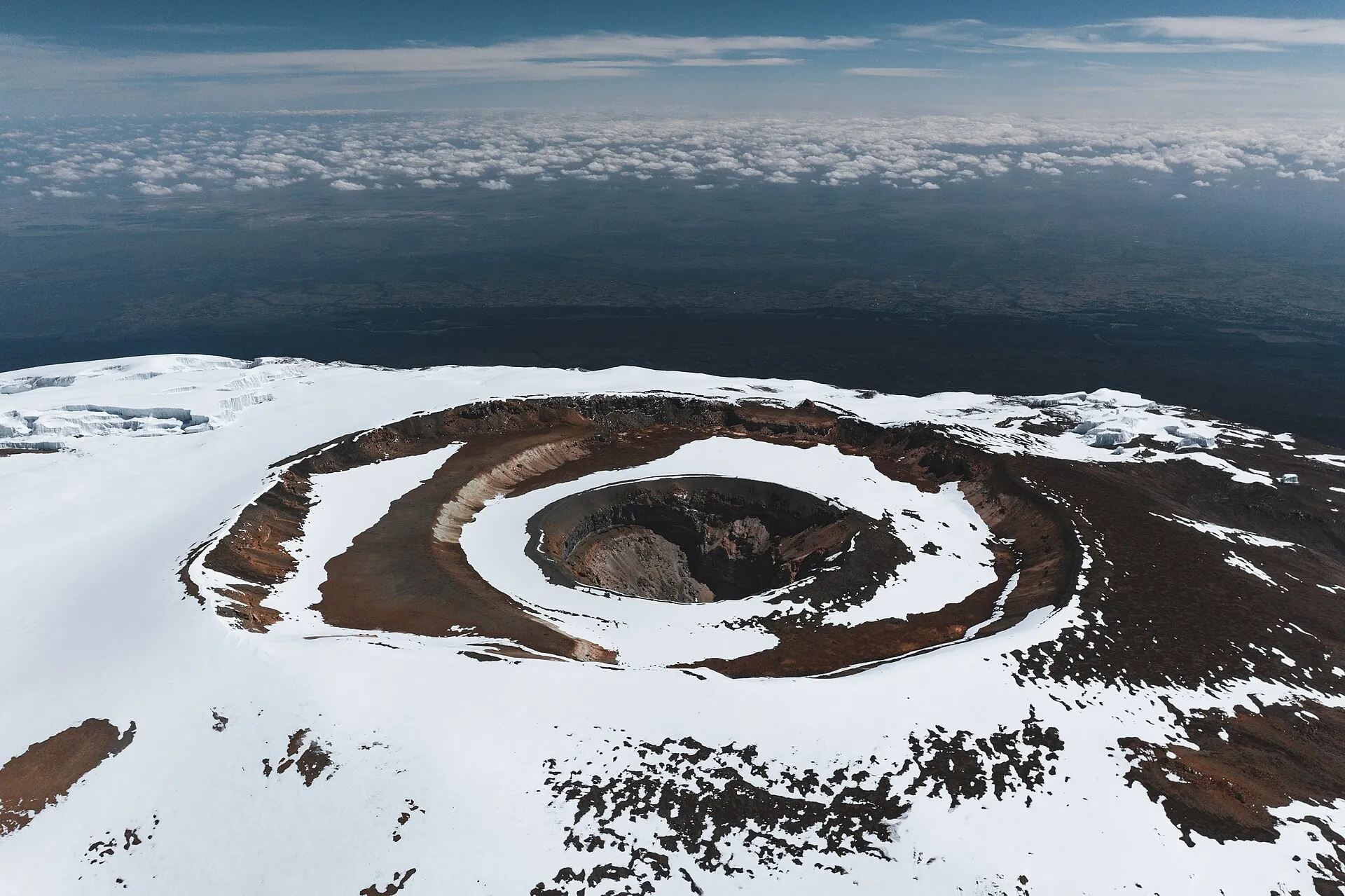
Aerial view of the Kibo summit crater on Kilimanjaro: the inner Reusch Crater in red-brown rock, ringed by snow and remnant glaciers
Fumaroles still vent in the Reusch Crater – the only sign that Kibo is merely asleep.

Photo: Altezzatravel · CC BY-SA 4.0

More toursAt the foot of the mountain: Materuni waterfall and coffee

If you are not going up, or you have a spare day after coming down: the Materuni waterfall and the Chagga villages with their coffee gardens sit on the southern slopes near Moshi – no park fee and no permit, because all of it lies below the park boundary.

Affiliate links to GetYourGuide: if you book, we earn a commission and the price stays the same. Prices and ratings as of 22 September 2026. These tours go to the foot of Kilimanjaro, not into the national park – the summit stays out of reach.

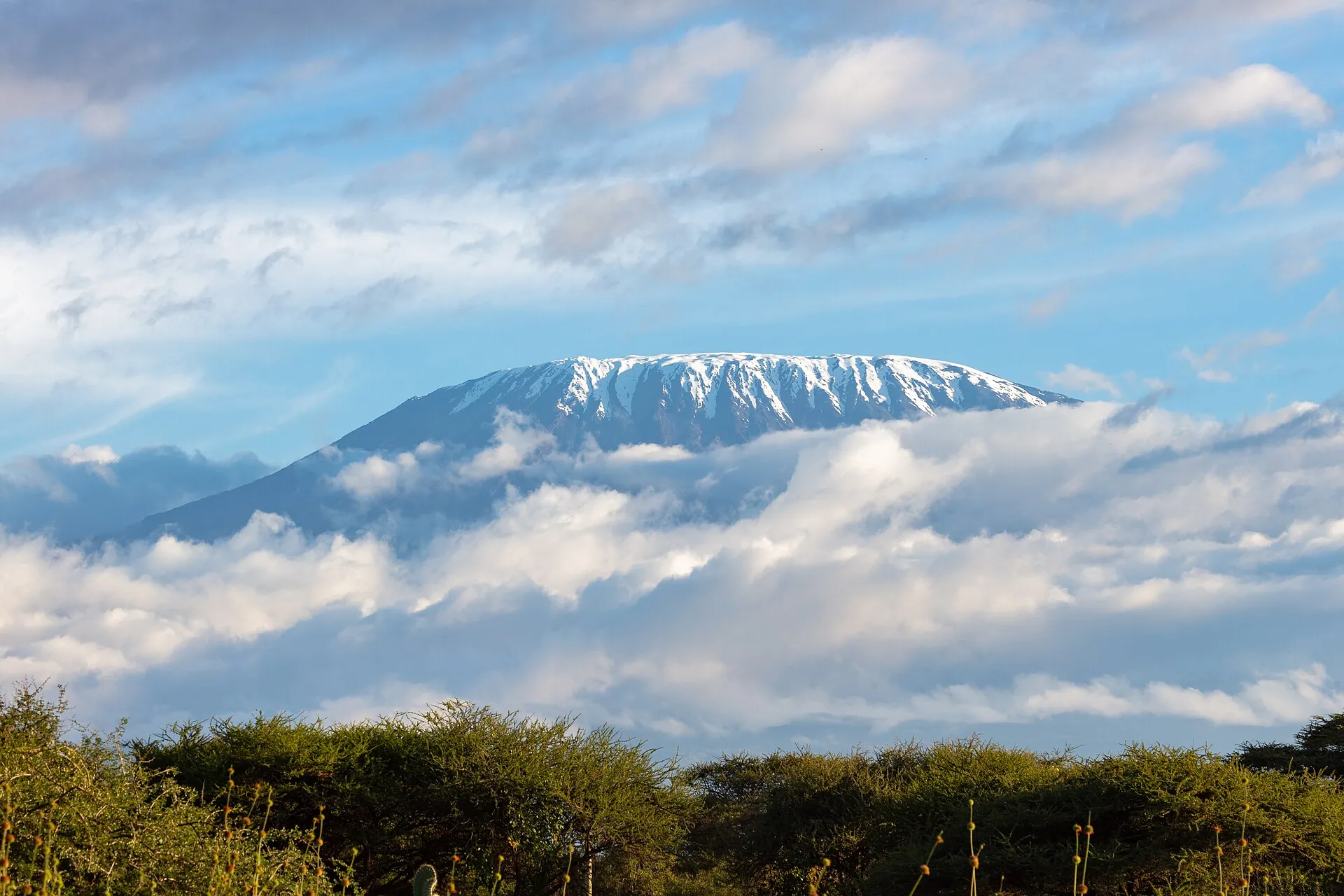
The flat summit cone of Kibo on Kilimanjaro above a closed bank of cloud, acacia scrub in the foreground
This is how you usually see it: a bank of cloud, and above it a white line that seems not to belong there.

Photo: Diego Delso · CC BY-SA 4.0

Outdated onlineWhat other sites get wrong

“With enough experience you can climb it alone.”
No. Permits exist only through registered Tanzanian operators, and every climber needs a licensed guide – on the day hike too. Solo climbers are turned away at the gate.
“Park fees are $70 a day and that is it.”
Every fee carries 18% VAT ('All charges are VAT exclusive'), plus a hut or camping fee per night, the rescue fee and crew fees. For 7 days that comes to about $956.
“The fee went up from $60 to $70 in January 2026.”
The $70 has been in the TANAPA tariff since 1 July 2023. Fees were even frozen in 2025/26.
“Children under 10 may not go above 3,100 meters.”
The TANAPA brochure sets the limit at 3,700 m. The 3,100 m figure appears on operator sites, not in the park rules.
“The hut fee is $40.”
The tariff gives $60 per person and night for Mandara, Horombo and Kibo.

Quick answersBefore the climb

What does climbing Kilimanjaro cost in total?

The park fees alone are about $956 for 7 days and about $1,097 for 8 days, VAT included. Operator packages start around $2,750 (Marangu) to $3,150 (Lemosho), and tips for the crew add $250 to $350. Anything under $1,500 is almost always saving on porter wages or safety.

Which route gives the best chance of the summit?

Lemosho in 8 days – about 90% in the KINAPA data. Machame in 7 days sits around 70%, and the 5-day Marangu route around 30%. The difference is almost purely acclimatization time.

Can you climb Kilimanjaro without experience?

Technically yes, there is no climbing anywhere. What it takes is 5 to 7 hours of walking a day, a summit night of 12 to 16 hours down to −15 °C (5 °F), and the willingness to turn back. If you have never done a multi-day hike, train first.

What does the Kilimanjaro day hike cost?

Park fees are at least $108 per person ($70 conservation fee, $20 rescue fee, crew fee, all exclusive of VAT). Operators from Moshi charge $170 to $275 with guide, transfer and lunch; comparable day tours on GetYourGuide start at about €72.

When can you see Kilimanjaro best?

Early in the morning and in the late afternoon during the dry seasons – during the day the summit usually disappears into cloud. It shows most clearly from Amboseli in Kenya and from the Moshi–Arusha road when the air is clear.

Do you need a visa for Tanzania?

Yes. The usual route is the e-visa through visa.immigration.go.tz, applied for with some lead time; a visa on arrival at Kilimanjaro International Airport is possible depending on nationality. The fee figures for it come from operator sources, not from the authority.

Is Kilimanjaro open and safe right now?

Yes, as of 22 September 2026 the park is open and neither TANAPA nor national travel advice reports a closure. Travel advice notes the volatile situation after the 2025 elections (avoid demonstrations) and, on the mountain itself, warns about altitude sickness and the lack of mountain rescue.

How much are the Kilimanjaro park fees?

Per the TANAPA tariff 2023/2026: $70 per day conservation fee, $50 per night camping or $60 per night in a hut, a $20 rescue fee and TZS 5,000 per crew member – all exclusive of 18% VAT. That is about $956 per person for 7 days on Machame and about $1,100 for 8 days on Lemosho.

How many days do you need for Kilimanjaro?

Five to nine, depending on the route. KINAPA data show about 30% summit success on 5-day Marangu, about 70% on 7-day Machame and about 90% on 8-day Lemosho. Fewer than 6 days is not advisable for altitude reasons.

Is Kilimanjaro dangerous?

Technically no, medically yes: official figures quoted by operators give 3 to 10 deaths a year, mostly from high-altitude pulmonary or cerebral edema. Travel advice warns that mountain rescue barely exists – so take a slow route, insure for helicopter evacuation and turn back in time.

Can children climb Kilimanjaro?

Under 10 only up to 3,700 m (a TANAPA rule), roughly as far as Horombo Hut; above that only with prior special permission from KINAPA. From age 10 there is no official age limit, though operators often set 12.

Is there a Kilimanjaro day hike?

Yes: from Marangu Gate to Mandara Hut (about 2,700 m) and the Maundi Crater, roughly 8 km (5 miles) each way, 5 to 7 hours. A guide and a permit are required for this too; park fees are $70 plus the rescue fee and crew fee exclusive of VAT, and operators charge $170 to $275 with everything included.

When is the best time for Kilimanjaro?

The dry seasons: late June to September, and December to early March (TANAPA). January/February and July/August are the clearest and busiest, September and October quieter. March to May is the long rainy season.

How do you get to Kilimanjaro?

Fly to Kilimanjaro International Airport (JRO) between Arusha and Moshi; visa on arrival or e-visa. Moshi is 42 km away, Marangu Gate 86 km. Operators pick you up at the airport or hotel and drive to the gate.

What clothing do you need?

Gear for five climate zones: rain protection for the forest, fleece and down jacket, hat and gloves for a summit night down to −15 °C (5 °F), a sleeping bag rated to −10 °C, waterproof broken-in boots, a headlamp. Porters carry up to 25 kg including their own kit.

How high is Kilimanjaro and is it an active volcano?

Uhuru Peak stands at 5,895 m (19,341 ft). Kibo is a dormant volcano with fumaroles in its crater; its last activity was 150,000 to 200,000 years ago. An eruption plays no part in the climb.

Can you pay the park fees in cash at the gate?

No. TANAPA settles cashless through the government payment gateway, cards and mobile money, and the operator pays before the climb. At the gate they only register passports and weigh porter loads.
Sources · accessed on 22 September 2026