9hectares
Doable in two to three hours
A fraction of the area of Pompeii (9 hectares are about 22 acres). The rest of the ancient city lies beneath modern Ercolano.
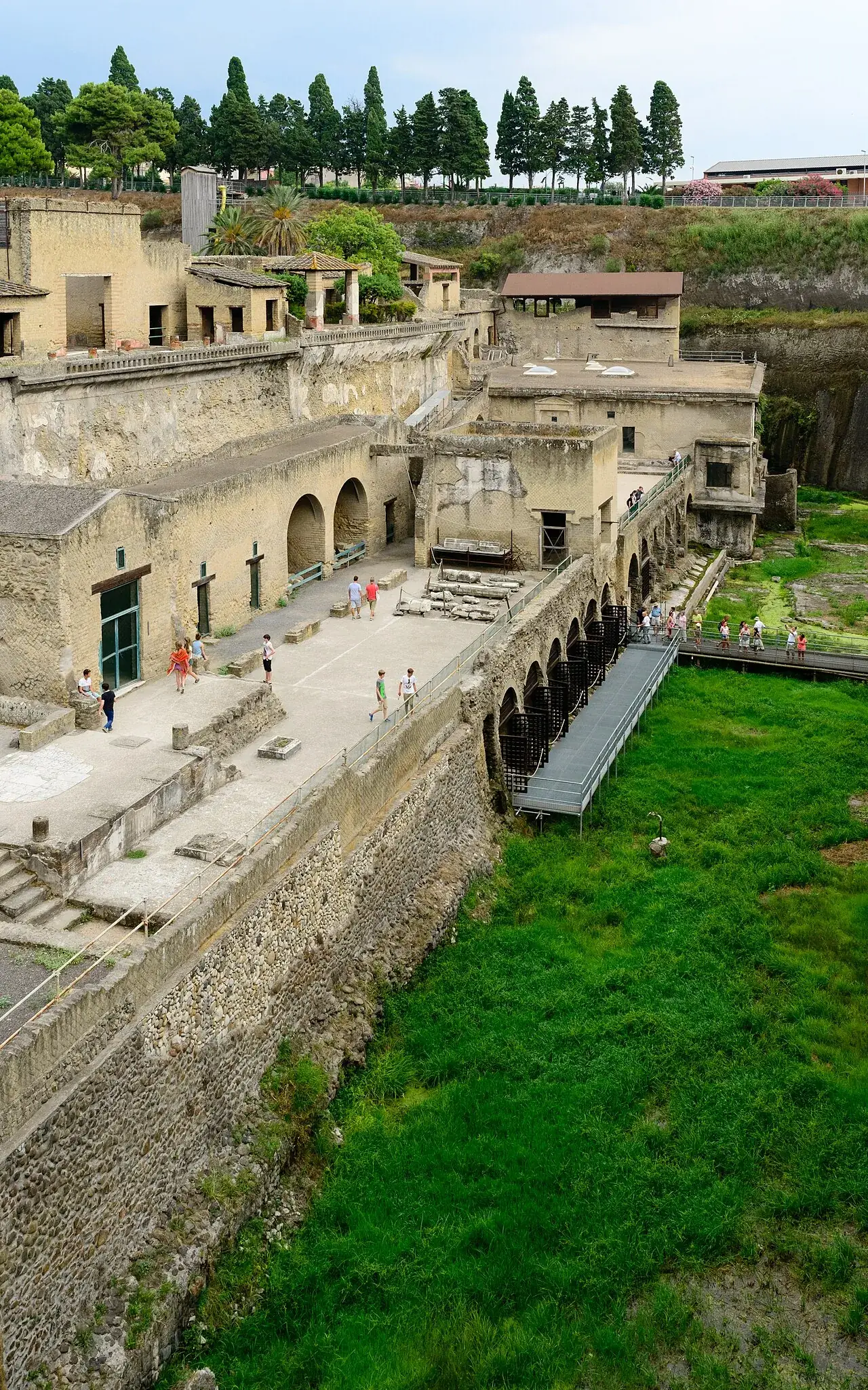
Up top is the Ercolano of today.
Up to 20 meters (66 ft) below: a Roman city, just as the pyroclastic flow left it.
Photo: Norbert Nagel · CC BY-SA 3.0
Pompeii was buried by ash, Herculaneum by pyroclastic flows at more than 400 °C (750 °F). They carbonized wood instead of burning it: beams, doors, beds and entire upper floors are still there. And there is neither a daily cap nor a time slot.
A fraction of the area of Pompeii (9 hectares are about 22 acres). The rest of the ancient city lies beneath modern Ercolano.
Ticket office at the entrance, no allocation, no personalized tickets. Online sales are handled by the official partner CoopCulture.
Circumvesuviana from Naples to “Ercolano Scavi”, about 20 minutes. The shuttle to Vesuvius leaves from the same station.
Closed only on December 25. 8:30 am–7:30 pm (last admission 6:00 pm), in winter until 5:00 pm (last admission 3:30 pm).
| Admission | 16 € |
| EU citizens aged 18 to 24 · free under 18 | 2 € |
| First Sunday of the month, April 25, June 2, November 4 – ticket only on the day itself at the ticket office | free |
| Ercolano Card, valid for one year | 30 € |
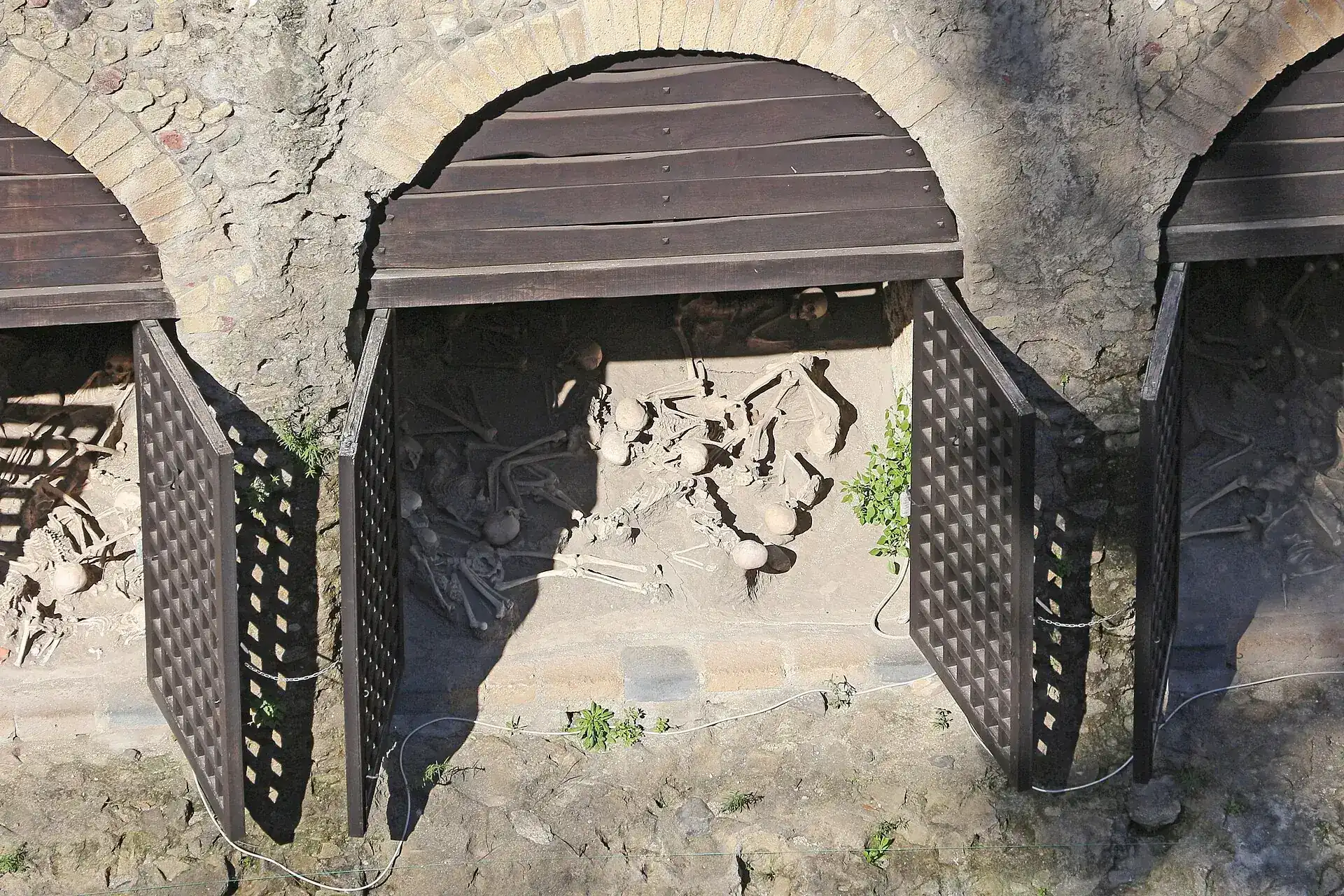
Photo: Bernard Gagnon · CC BY 4.0
Hundreds of skeletons lay in the boathouses on the ancient beach – the park speaks of about 300. Stories like that are not on any sign; here, two hours with a guide are enough for the whole city.
Affiliate links to GetYourGuide: if you book, we earn a commission and the price stays the same. Prices and ratings as of September 21, 2026.
Affiliate links to Tiqets: if you book, we earn a commission and the price stays the same. Prices and ratings as of September 21, 2026. Second partner: Tiqets. At the park's own ticket office and shop, entry costs €16 – the markup here pays for the audio guide and booking in English.
Two routes – and what is currently closed.
Compact visit in 2 hours. For anyone combining Herculaneum with Vesuvius or Pompeii on the same day. You start down at the ancient beach by the boathouses – that is where the catastrophe sinks in – and then work your way uphill, away from the sea: first the House of the Deer on the southern edge, then along Cardo IV to the wooden partition, into the Central Baths and to the Neptune mosaic, and at the top on the Decumanus Maximus the Hall of the Augustales. The way back is along Cardo V, past the thermopolium and the Palaestra. Distances are short; the time goes on looking, not on walking.
Boathouses and ancient beach → House of the Deer → House of the Wooden Partition → Central Baths → House of Neptune and Amphitrite → Hall of the Augustales → Thermopolium by the Palaestra → Palaestra
Thorough visit in 3 hours. For anyone visiting Herculaneum alone and wanting to take in everything that is accessible. Go to the Antiquarium and the boat first, because that is where the originals are whose find spots you then walk past (the deer groups, the Hydra, the fugitives' belongings); then the same loop as the short route, with the House of the Bicentenary on the Decumanus Maximus added. If a house is closed, alternatives such as the Samnite House (Casa Sannitica) or the House of the Mosaic Atrium (Casa dell'Atrio a Mosaico) are right on the route. If you have booked one of the Saturday slots for the Suburban Baths, allow another hour; the meeting point is the Terrace of Nonius Balbus above the beach.
Antiquarium and Boat Pavilion → Boathouses and ancient beach → House of the Deer → House of the Wooden Partition → Central Baths → House of Neptune and Amphitrite → House of the Bicentenary → Hall of the Augustales → Thermopolium by the Palaestra → Palaestra
At the foot of the city terrace, twelve masonry vaults open onto what was once the beach, probably storage or shelters for boats. In nine of them about 300 skeletons were found, of people who were hoping for rescue by sea – packed closely together, carrying jewelry, coins, house keys and even a set of surgical instruments. The place also shows how deep the city was buried: the wall of hardened volcanic material rises above you.
Two exhibition buildings in the park, outside the ancient city. Since December 2018 the Antiquarium has shown sculptures and frescoes from Herculaneum – among them the statue of Marcus Nonius Balbus, the bronze Hydra from the Palaestra and the marble groups from the garden of the House of the Deer – plus a room with the things the fugitives on the beach had with them. The pavilion next door holds the carbonized boat, more than nine meters (30 ft) long, found on the beach in the 1980s.
The park considers the baths between the city wall and the beach the best-preserved bath complex in the Roman world: colored marble floors, stucco reliefs with seven warriors in the warm room, original wooden doors and a marble basin knocked over by the force of the eruption. Originally probably the private baths of the Nonii Balbi family, later public. After more than twenty years of closure, they can be seen on guided visits of the restoration site and in no other way.
One of the luxury residences on the southern edge of the city, whose gardens and halls opened onto terraces facing the sea. It is named after two marble groups of deer being brought down by dogs; according to the park, the originals from the garden are in the Antiquarium. Walk through the house to the terrace and you understand why the upper class built right here.
Here stands something you will not find anywhere in Pompeii: a carbonized but intact folding wooden door with bronze fittings, which separated the atrium from the owner's reception room. The house was built before the Roman conquest and renovated in the early imperial period; the walls carry paintings in the Third Style. The best example of how the pyroclastic flows preserved wood in Herculaneum.
The city's public baths from the Julio-Claudian period, with separate sections for men and women. The main draw is the black-and-white floor mosaics: a Triton in the women's changing room, geometric patterns with a trident in the warm room next door. Vaults, benches and shelves are so complete that it takes little imagination to picture the baths in use.
A small house with the best-known image in Herculaneum: a wall mosaic of colored glass paste showing Neptune and Amphitrite, still vivid today. Facing the street is a shop belonging to the house, where carbonized wooden shelves, a stove and storage jars with beans and chickpeas were found. The two together – showpiece and everyday business – make the house a stop you should not skip.
An imposing house of the Augustan period on the Decumanus Maximus, named for the year it was excavated, 1938 – two hundred years after the excavations began. The reception room has restored wall paintings in the Fourth Style, including Daedalus and Pasiphaë, along with a sliding wooden grille. The half-timbered upper floor yielded wax tablets with legal documents.
Meeting house of the college that maintained the cult of the emperor, and one of the few public buildings in the city to have been excavated. The square hall with four central columns preserves large Fourth Style frescoes of Hercules, the city's mythical founder – once on Olympus with Jupiter, Juno and Minerva, once fighting Achelous. In a side room the skeleton of the caretaker lay on his bed.
The “Grande Taberna” is next to the Palaestra: an L-shaped counter faced with colored marble, with eight large storage jars set into it, and several back rooms behind. A painted ship and Greek graffiti were found on the walls. A quick stop as you walk past – and a good comparison with the snack bars in Pompeii.
The large sports complex on the eastern edge of the excavation has been uncovered in part – the rest is still embedded in volcanic rock beneath the modern town. At its center was a cross-shaped pool with a bronze fountain in the form of the many-headed Hydra; the original is in the Antiquarium. Shops and bakeries line the street side, including the recently restored pistrinum on Vicolo Meridionale with two donkey mills of lava stone.
The most famous villa of antiquity lies northwest of the city and is still largely buried; in the 18th century it was explored through tunnels, and the atrium wing was not uncovered until 1996–1998. It yielded more than 1,800 carbonized papyrus scrolls – the one surviving library from antiquity – and numerous sculptures now in the National Museum in Naples. There is currently nothing to visit on site; to see the finds, go to Naples.
Without a car: Circumvesuviana (EAV) from Naples toward Sorrento or Poggiomarino to “Ercolano Scavi”, then about a 6-minute walk to the entrance at Corso Resina 187. From Naples airport, take the Alibus to the central station and change there to the Circumvesuviana. According to EAV, the Campania Express is suspended from October 1, 2026 until further notice.
By car: A3 Naples–Salerno, exit Ercolano Scavi, then follow the signs. Parking lot at Via dei Papiri Ercolanesi 19.
Works well year-round because the site is small; most pleasant right at opening at 8:30 am or in the late afternoon. Ideal as a morning visit before heading up Mount Vesuvius, which starts from the same station.
No. There are no time slots and no known daily cap, and tickets are sold at the ticket office at the entrance. Online sales are handled by the official partner CoopCulture.
About nine hectares (22 acres) have been excavated. Two to three hours are enough for a thorough visit.
Take the Circumvesuviana to “Ercolano Scavi”, then walk about six minutes to the entrance at Corso Resina 187. By car, take the A3 to the Ercolano Scavi exit; the parking lot is at Via dei Papiri Ercolanesi 19.
The pyroclastic flows of AD 79 buried the city under 13 to 20 meters (43 to 66 ft) of material that hardened into tuff. That is why you look down onto the rooftops from the entrance.
Yes, with no size restriction, on a leash. In houses with mosaic floors they must be carried.
Very: manageable in size, lots to discover, free for under-18s.
The full-price ticket costs €16, EU citizens aged 18 to 24 pay €2, and admission is free for under-18s. The Ercolano Card annual pass costs €30.
Yes, guides are not mandatory. The park's guided tours are an optional extra.
From March 16 to October 14, daily from 8:30 am to 7:30 pm (last admission 6:00 pm); in winter until 5:00 pm (last admission 3:30 pm). The site is closed only on December 25 – there is no weekly closing day.
On the first Sunday of every month and on April 25, June 2 and November 4. The free ticket cannot be reserved online; you pick it up at the ticket office the same day.
Pompeii is huge and shows an entire city; Herculaneum is small but much better preserved, with upper floors and carbonized wood. If you are short on time or traveling with kids, Herculaneum is often the better fit – especially as it has neither a cap nor named tickets.
Vesuvius is at green, the lowest alert level, and is monitored around the clock. There is no particular risk for a day visit.
The modern town above the ruins is called Ercolano and lies in the Metropolitan City of Naples, west of Vesuvius. Until 1969 it was called Resina; the current name deliberately takes up the ancient one. In Italian the excavation site itself is the “Parco Archeologico di Ercolano”, and the Circumvesuviana station is “Ercolano Scavi”.
Mainly because of its size: Pompeii's urban area covers about 98 hectares, of which roughly two thirds are uncovered – in Herculaneum it is only about nine hectares, and the rest lies beneath modern Ercolano. Pompeii was covered only by ash and pumice and could be excavated on a large scale from 1748 on; Herculaneum sits under 13 to 20 meters of material hardened into tuff, which makes any excavation laborious. Then there are the plaster casts of the victims, which have shaped the image of the catastrophe since Fiorelli (from 1863). Herculaneum, however, is the better preserved – with upper floors, carbonized wood and furniture.
Sources · accessed on September 21, 2026

.jpg)