Volcano·Guide
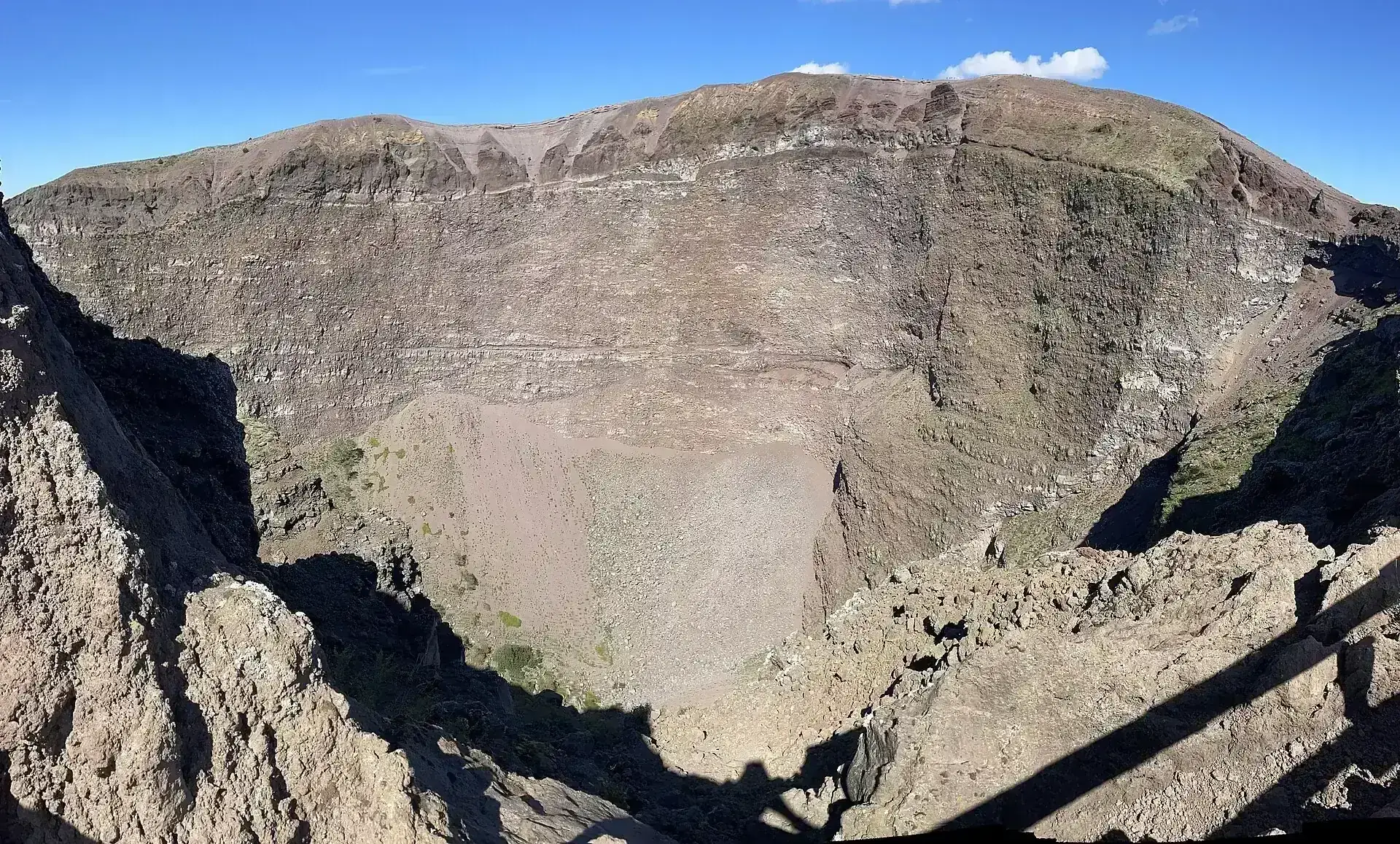
View from the crater rim into the crater of Mount Vesuvius, with the Bay of Naples beyond

Mount Vesuvius today

The most famous volcano in the world has been silent since 1944. Whether it still is today is for the authorities to say – we fetch their answer every morning.

Photo: Photo2023 · CC BY 4.0

As of today

Is Mount Vesuvius active right now?

Vesuvius counts as an active volcano – it has merely been quiet since March 1944. It is monitored around the clock by the INGV Osservatorio Vesuviano, the oldest volcano observatory in the world; the alert level is set by the national civil protection in Rome. We fetch it at six every morning, together with the earthquakes of the past days from INGV's catalogue.

With a timed ticket

Can I go up today?

Yes – the crater is open all year, but not on a whim: only with a timed ticket bought online in advance (€11.68), daily from 9 am, and not in severe weather. Closures at Vesuvius are in practice down to the weather, not the volcano. The official alert level is in the line below, fetched this morning.

Closed from weather alert orange

Is the crater path open?

If the regional civil protection of Campania issues a weather alert of level orange or higher for the day, ticket sales and the path close automatically and unused tickets are refunded. There is no data feed for the park's daily status, so we show the rules rather than a traffic light; the park publishes its notices at parconazionaledelvesuvio.it.

Green
Vesuvius alert levelCivil protection alert level (green/yellow/orange/red) · checked on 2026-10-03 · Dipartimento della Protezione Civile – Presidenza del Consiglio dei Ministri (CC BY 4.0)

What green means

The base level: nothing unusual. The observatory's monthly bulletin for August 2026 reports 112 weak earthquakes (the strongest magnitude 1.6) and no magmatic ground deformation; fumarole temperatures are slightly above average (around 78 °C at fumarole B3, a good 5 °C more), which INGV does not rate as a significant development. For visitors, green means: no volcano-related restrictions. In practice Vesuvius closes because of weather, not because of the volcano.

What yellow, orange and red would mean

Yellow would be attention: closer monitoring, no closures. Orange would be pre-alarm: preparation for evacuation. Red would be alarm: evacuation of the Red Zone – 25 municipalities with around 700,000 people – under the national emergency plan. From everything known from 1944 and from other volcanoes, an eruption would announce itself over weeks with earthquakes and uplift.

Why the earthquakes are shown here

Because they are the first thing that would change. Vesuvius has a handful of weak earthquakes a month, most below magnitude 2 and shallow beneath the crater. If the count rises markedly or earthquakes of magnitude 3 or more appear, INGV writes about it in the bulletin – and we would see it here.

Earthquakes today

The earthquakes at Vesuvius in the past days

Everything INGV locates beneath the cone and Monte Somma is counted. For comparison: in August 2026 there were 112 in the whole month, all weak.

1

Quakes in 7 days

in the last 30 days: 7. This counts everything INGV locates inside the caldera – most are too weak to be felt.

Md 1.2

Strongest in 7 days

on 2026-09-29 at 11:32, focus 1.9 km deep.

–

Last quake of Md 3 or more

none this year

–

Strongest of 2026

none this year

INGV earthquake catalogue, fetched automatically every morning · as of 2026-10-03 · Md = duration magnitude as reported by INGV · INGV – Catalogo dei terremoti (FDSN-Webservice, CC BY 4.0)

Sources: Dipartimento della Protezione Civile, alert level (fetched by us daily, CC BY 4.0); INGV Osservatorio Vesuviano, monthly bulletin August 2026 and the "Stato attuale" page; INGV earthquake catalogue (FDSN web service, CC BY 4.0, fetched by us daily). How we check is explained on How we check.

What you can do

Is Mount Vesuvius open today?

The crater is accessible all year, but not spontaneously: only with a timed ticket bought online in advance, and not in severe weather. The park publishes its operating status in its notices; there is no data feed for it, so here are the rules rather than a traffic light.

with a timed ticket

The crater path

Daily from 9 am, last entry between 3 pm and 6 pm depending on the month. €11.68 in advance, no ticket office on the mountain, the park guides' accompaniment is included. Everything about the walk is on Mount Vesuvius, how to buy on Vesuvius tickets.

from weather alert orange

When it closes automatically

If the regional civil protection of Campania issues a weather alert of level orange or higher for the day, ticket sales and the path close automatically; unused tickets are refunded within 60 days. In winter snow can block the access road – as it did on 31 March 2026, for one day.

permanently

What is never open

The rim path on the north and east side, and with it the actual summit. The access from Ottaviano via Quota 1050 is closed for construction work; the only entrance is Quota 1000 near Ercolano. Current notices from the park: parconazionaledelvesuvio.it.

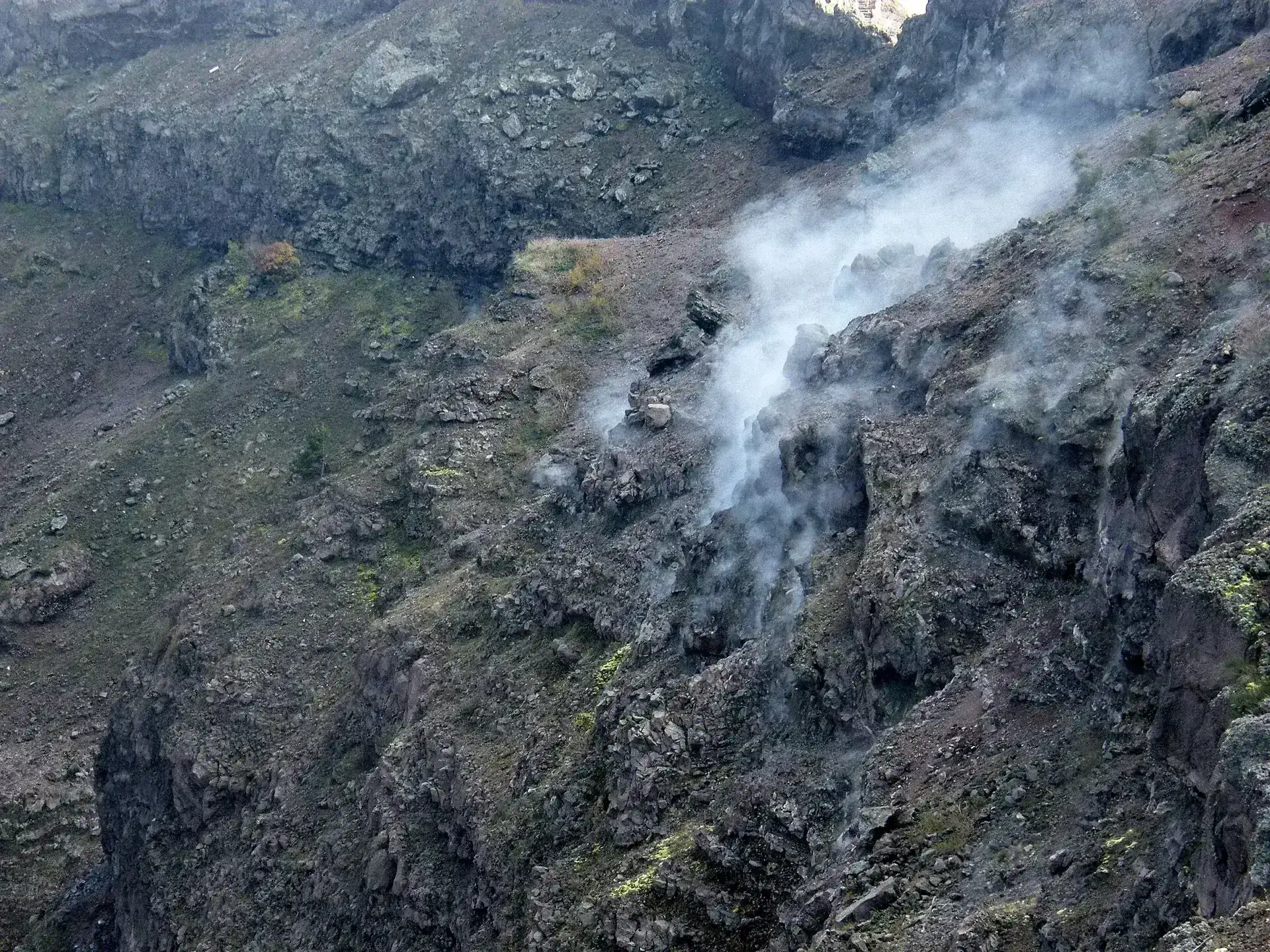
A fumarole on the crater rim of Mount Vesuvius, steam rising from reddish rock
The only thing Vesuvius shows today: steam from the crater wall. The observatory measures the temperatures there – and puts even small fluctuations in context, most recently a few degrees above average.

Photo: Pilgab · CC BY-SA 3.0

Vesuvius eruption

The last eruption of Vesuvius – and the ones before

Vesuvius is the volcano whose eruptions the world knows: the one in AD 79 that buried two towns, and the one in 1944 that wrote the last chapter in the middle of a war. In between lie centuries in which it was active almost continuously.

  1. AD 79Pompeii, Herculaneum, Stabiae, Oplontis

    The eruption that made the mountain famous: ash and pumice bury Pompeii, pyroclastic flows bury Herculaneum. The older volcano, Monte Somma, breaks apart – its half-ring encloses today's cone.

  2. 1631The strongest since antiquity

    Around 4,000 dead. Afterwards Vesuvius is active almost without interruption for three centuries, with one lava tongue after another on its slopes.

  3. 1841The observatory

    Foundation of the Osservatorio Vesuviano, the oldest volcanological observatory in the world. Today part of INGV, it measures the mountain around the clock.

  4. 1880Funiculì, Funiculà

    The funicular railway up Vesuvius opens – and gets a song everyone knows. The eruption of 1906 destroys it, and in 1944 the rebuilt line – after that, it was over.

  5. 1906216 dead

    The largest eruption of the 20th century: the weight of ash collapses roofs, the summit loses a good deal of height (death toll according to INGV).

  6. March 1944The last eruption to date

    Lava flows destroy San Sebastiano al Vesuvio and Massa di Somma, ash paralyses the Allied airfield; 21 dead according to the civil protection. Since then: fumaroles, weak earthquakes, silence.

  7. 1995National park

    Foundation of the Parco Nazionale del Vesuvio with 8,482 hectares (about 21,000 acres) in 13 municipalities. Around 700,000 people live in the Red Zone today.

Sources: Parco Nazionale del Vesuvio and Dipartimento della Protezione Civile (chronology, Red Zone, emergency plan); INGV Osservatorio Vesuviano (foundation 1841, monitoring). The civil protection puts the number of victims in 1944 at 21.

The question behind it

When will Vesuvius erupt again?

Nobody knows, and anyone who names a year is guessing. What is known: how it would announce itself, who would notice, and what happens then.

How it would announce itself

According to INGV "with considerable lead time" – with increasing earthquakes, uplift of the ground, changing gases and temperatures at the fumaroles. These are exactly the quantities the observatory measures and summarises in its monthly bulletin – for years with the same finding: nothing unusual.

What happens then

In the event of an alarm, the national emergency plan provides for the evacuation of the Red Zone, 25 municipalities with around 700,000 people, to partner regions all over Italy. The civil protection rehearses this; for visitors it would mean that the crater and its surroundings would be closed long before an eruption.

What this means for your visit

Nothing, as long as the level is green. The real risks on the crater path are sun, wind and loose gravel, not the volcano. The mountain you climb is the same one that buried two towns in AD 79 – but today it is the most closely monitored volcano in Europe.

In brief

The most common questions about Vesuvius today

Is Mount Vesuvius still active?

Yes, in the volcanological sense: it has erupted in historical times and can do so again. It has been quiet since March 1944 – fumaroles and weak earthquakes, nothing else. The official alert level is at the top, fetched afresh every morning.

When was the last eruption of Vesuvius?

In March 1944, during the Second World War. Lava flows destroyed San Sebastiano al Vesuvio and Massa di Somma; according to the civil protection 21 people died. It was the end of a phase of activity that had continued almost without interruption since 1631.

Are there earthquakes at Vesuvius right now?

A handful of weak ones a month, most below magnitude 2 and shallow beneath the crater – that is the normal state. The figures for the past seven and thirty days are at the top, taken from INGV's catalogue every morning.

Can I visit Vesuvius today?

Yes, with a timed ticket bought online in advance for €11.68, daily from 9 am. It closes only for a weather alert of level orange or higher, or for snow – not because of the volcano. Details on the Mount Vesuvius page and the tickets page.

Is it dangerous to be in Naples or Pompeii?

Not because of Vesuvius. According to current knowledge an eruption would announce itself over weeks, and the alert level would rise beforehand. The region's unrest currently comes from the other volcano: the Campi Flegrei west of the city, with uplift and earthquakes – they have a page of their own.

How up to date is this page?

We fetch the alert level and the earthquakes every day at 6 am; the fetch date is shown next to every figure. The details on the crater path come from the park's regulations of 29 June 2026; daily notices about closures are published by the park itself.
Sources · accessed on 25.09.2026