Volcano·Guide
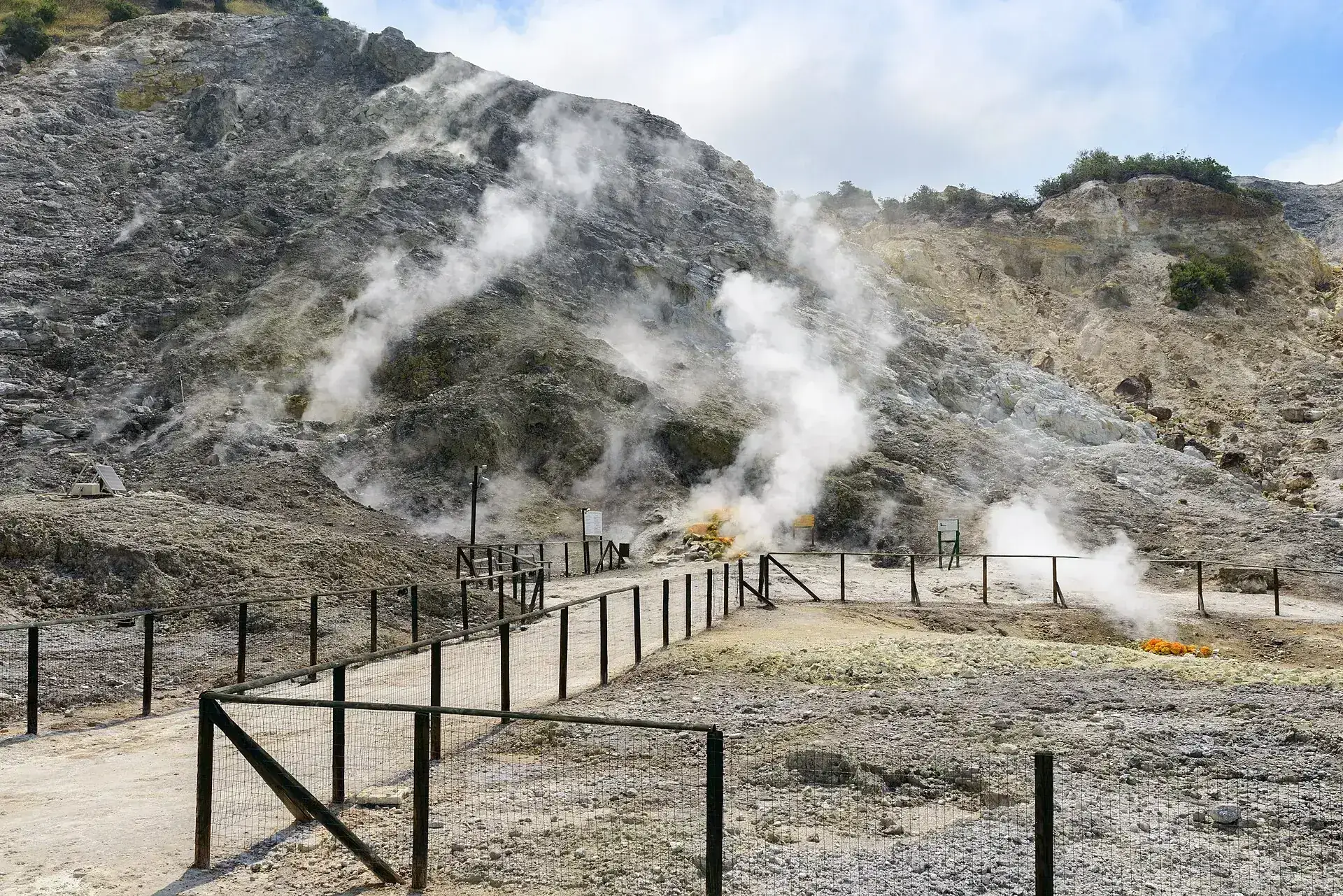
Steaming fumaroles behind wooden fences in the Solfatara crater at Pozzuoli, Campi Flegrei

Campi Flegrei today

Not a mountain that erupts – a ground that rises and shakes. What the authorities report today, and what it means for Pozzuoli, Baia and Cuma.

Photo: Norbert Nagel · CC BY-SA 3.0

As of today

Which alert level applies in the Campi Flegrei

For the Campi Flegrei – the Phlegraean Fields – there is exactly one official level: that of the national civil protection department in Rome, set on the advice of the Commissione Grandi Rischi using data from the INGV Osservatorio Vesuviano. We fetch it every morning at six.

open

Is it safe to visit Pozzuoli?

Yes, with one qualification. Alert level yellow closes nothing; the excavations at Baia, Cuma and the Anfiteatro Flavio in Pozzuoli are open, Monte Nuovo and Lake Averno freely accessible. The risk for a day visit is that of an earthquake, not an eruption: after a stronger swarm the sites close for a few days of safety checks. The earthquakes of the past days are shown below.

closed

Is the Solfatara open?

No, and it has not been since 12 September 2017, when three people died after the ground gave way. The grounds were released in February 2025 and the regional park is planning guided visits with CO₂ meters, but there is no opening date. Do not book a tour that promises the Solfatara.

Yellow
Campi Flegrei alert levelCivil protection alert level (green/yellow/orange/red) · checked on 2026-10-03 · Dipartimento della Protezione Civile – Presidenza del Consiglio dei Ministri (CC BY 4.0)

Yellow since 2012, phase 2 since 2023

Yellow means attenzione: the caldera is out of equilibrium and monitoring has been stepped up, but nothing is closed because of it. With the emergency plan of 30 October 2025, yellow was subdivided – phase 1 for the years 2012 to 2023, phase 2 for the moderate unrest since. The phase is not available through any API; it changes only by decree, which we enter by hand.

What orange and red would mean

Orange would be pre-alarm: the authorities prepare the evacuation, and schools and hospitals in the red zone are relocated as a precaution. Red is alarm: the red zone – Pozzuoli, Bacoli, Monte di Procida, Quarto and parts of Naples, around 500,000 people – is evacuated within 72 hours. Neither applies, and the INGV sees no development in that direction in the short term.

What the level does not tell you

Whether an excavation is open today. That is decided not by the volcanologists but by the earthquakes: after every stronger swarm the Parco Archeologico closes its sites for safety checks and reopens them days later. That is why the earthquakes of the past days are shown directly below.

Sources: Dipartimento della Protezione Civile, “Campi Flegrei” page and planning decree no. 3236 of 30 October 2025 (phases, 72-hour evacuation); INGV Osservatorio Vesuviano, weekly bulletin of 22 September 2026. How we check is explained on How we check.
Steaming fumaroles of the Solfatara in the Campi Flegrei, yellow sulphur on the ground
The Solfatara has been closed since 2017 – the bradyseism lifting Pozzuoli is still measured every day.

Photo: Norbert Nagel · CC BY-SA 3.0

Earthquakes now

The earthquakes of the past days

The ground at Pozzuoli is currently rising by about one centimetre a month, and the strain is released in earthquake swarms. We pull the figures below from the INGV earthquake catalogue every morning; everything within the caldera between Agnano, Pozzuoli and Bacoli is counted.

2

Quakes in 7 days

in the last 30 days: 10. This counts everything INGV locates inside the caldera – most are too weak to be felt.

Md 1.4

Strongest in 7 days

on 2026-09-26 at 02:40, focus 2.1 km deep.

Md 3.0

Last quake of Md 3 or more

on 2026-08-10 at 02:27, 3.6 km deep. From this magnitude a quake is clearly felt nearby.

Md 4.7

Strongest of 2026

on 2026-07-31 at 19:46, 2.6 km deep.

INGV earthquake catalogue, fetched automatically every morning · as of 2026-10-03 · Md = duration magnitude as reported by INGV · INGV – Catalogo dei terremoti (FDSN-Webservice, CC BY 4.0)

Why the quakes feel so strong

The hypocentres are usually only one to four kilometres (0.6 to 2.5 miles) deep, directly beneath the town. A magnitude 3 quake that hardly anyone would notice elsewhere rattles windows and doors in Pozzuoli. From magnitude 4 there is damage to old façades – as on 31 July 2026.

What happens after a swarm

The Parco Archeologico closes the Castello and Terme di Baia, Cuma and the Anfiteatro Flavio for inspection and announces the reopening on its news page, usually after two to five days; tickets already bought are refunded. The Cumana and the Metro stop running until the line has been checked. Monte Nuovo and Averno generally stay open.

If a quake strikes during your visit

Stay in the open, away from façades, walls and steep slopes; indoors, get under a door lintel or a table. Afterwards follow the staff. Civil protection sends warnings straight to your phone via IT-alert, including foreign phones logged into the Italian network – leave the system switched on.

What is open

What is open in the Campi Flegrei today

We check the status of the sites by hand; it changes after earthquakes. The status here is from 22 September 2026 – whether there has been a stronger quake since is shown in the “Last quake from Md 3” line above.

open

Baia, Cuma, Anfiteatro Flavio

The Castello di Baia with its museum, the Terme di Baia, Cuma and the Anfiteatro in Pozzuoli are open, the Anfiteatro with a restricted route. Since April 2026 tickets are sold online only through Musei Italiani, 25 to 50 people per half hour. Castello and Terme are closed on Mondays, Cuma and the Anfiteatro on Tuesdays.

open

Monte Nuovo and Lago d'Averno

The loop trail up the crater of 1538 is free, 9 am until one hour before sunset. The lakeside path around Averno is always open. Both are on foot from the Cumana stop at Lucrino – and since 11 September 2026 the Cumana runs all the way through to Torregaveta again.

closed

Solfatara

Closed since 12 September 2017, after three people died when the ground collapsed. The grounds have been released since February 2025 and the regional park is planning guided tours with CO₂ meters – there is no date. Do not book a tour that promises the Solfatara.

closed

Rione Terra

The tuff spur of ancient Puteoli, with its cathedral and underground route, has been closed since the earthquake of 31 July 2026. The Palazzo Migliaresi and Sedile dei Nobili are unusable, and the opening of the restored quarter planned for the summer was cancelled.

Checked on 22 September 2026: Parco Archeologico dei Campi Flegrei, “Info” and “News” pages; EAV (Cumana from 11 September 2026); Comune di Pozzuoli (Monte Nuovo); press reports on Rione Terra and Solfatara. Everything else – prices, getting there, tours – is on the main page.

The year 2026

What has happened in the Campi Flegrei in 2026

No eruption, but the most restless year since the eighties. The timeline of the quakes from magnitude 3 and their consequences, from the INGV catalogue and the announcements of the park, the railway and civil protection.

  1. 28 February 2026Md 3.5

    First quake of the year from magnitude 3, hypocentre just under three kilometres deep.

  2. 7 and 8 AprilMd 3.3 and 3.4

    A swarm over two nights. On 8 April the Parco Archeologico also switches its ticketing: since then tickets are sold online only.

  3. 21 MayMd 4.4

    The strongest quake of the series up to that point, three kilometres deep. The park sites stay closed for several days – the Anfiteatro, the most vulnerable, the longest.

  4. 24 and 25 JuneMd 3.0 and 3.6

    Another swarm, another closure of the sites for inspection, reopening after a few days.

  5. 31 July, 7:46 pmMd 4.7 – the strongest since records began

    Hypocentre around three kilometres deep between Pozzuoli and Quarto, 169 quakes in the night, 21 injured, a collapsed façade in Via Pergolesi. Rione Terra, the harbour, the Cumana tunnel at Monte Olibano and the park sites are closed. On 2 August the INGV declares the swarm over.

  6. 10 AugustMd 3.0

    Seven quakes, the sites close briefly. Afterwards the Anfiteatro Flavio reopens with a restricted route; Rione Terra stays closed. By early September Pozzuoli counts 480 evacuation orders and 217 unusable buildings.

  7. 11 SeptemberCumana runs through again

    EAV opens the Bagnoli–Torregaveta section with the new Pozzuoli Via Fasano station. Baia and Cuma can be reached without changing trains again.

  8. 22 SeptemberWeekly bulletin: a quiet week

    Five quakes up to Md 2.0, uplift 10 ± 3 mm a month, Bocca Grande fumarole at 173 °C. The INGV sees “no elements suggesting a significant development”. What has happened since is in the figures above.

Sources: INGV, earthquake catalogue (times in local time) and communiqué of 1 August 2026 · INGV Osservatorio Vesuviano, weekly bulletin of 22 September 2026 and monthly bulletin August 2026 · Parco Archeologico dei Campi Flegrei, News · EAV, announcement of 10 September 2026 · ANSA, 1 August 2026 · Il Post, 1 September 2026.

The word

Naples supervolcano: what is behind the term

The word is accurate and misleading at the same time. It describes what the caldera was capable of 39,000 years ago – not what it is doing today.

Where the name comes from

Around 39,000 years ago the caldera ejected the Campanian Ignimbrite, several hundred cubic kilometres of rock whose ash travelled as far as Russia. 15,000 years ago came the Neapolitan Yellow Tuff, the stone Naples is built from. Eruptions of that size are called supereruptions. They are the reason 39 GNSS stations and a seismic network are running here.

What the last eruption was

A small one. In 1538 Monte Nuovo rose in eight days, 130 metres (430 ft) high, after some 3,000 years of quiet and after years of uplift and earthquakes – the same thing that is happening again today. 24 people died and the village of Tripergole vanished. An eruption of that size is the scenario the emergency plan is designed for.

What the scientists see today

Uplift, earthquakes, more gas from the fumaroles – a hydrothermal system under pressure, not magma rising close to the surface. The bradyseism of 1982 to 1984 ended without an eruption. Whether it will go the same way this time nobody knows; hence alert level yellow, the drills and the evacuation plan. For a day visit the risk is that of an earthquake, not an eruption.

Quick questions

The most common questions about the Campi Flegrei today

Can I visit the Phlegraean Fields at the moment?

Yes. Alert level yellow closes nothing; the excavations at Baia, Cuma and Pozzuoli are open, Monte Nuovo and Averno freely accessible. What is missing are the Solfatara (since 2017) and Rione Terra (since 31 July 2026). After a stronger earthquake the sites close for a few days – the quakes of the past days are shown above.

Are there earthquakes in Pozzuoli right now?

Almost always; the question is how strong. The figures above show how many quakes the INGV has located in the caldera over the past seven days and when the last one from magnitude 3 was. Quakes below magnitude 2 are hardly felt by anyone; from 3 it gets loud in Pozzuoli, from 4 there is damage.

Is the Solfatara open?

No, not since 12 September 2017. The courts released the grounds in February 2025, the regional park is planning guided visits with CO₂ meters, and in July 2026 there was a fire at the crater. There is no opening date.

Is an eruption imminent?

Nothing points to it. In every weekly bulletin the INGV states whether it sees signs of a short-term development – most recently none. Going by everything known from 1538 and from other calderas, an eruption would announce itself over weeks with sharply increasing earthquakes and uplift; the level would go to orange first.

How up to date is this page?

We fetch the alert level and earthquakes daily at 6 am, and the fetch date is shown next to every figure. The status of the sites we check by hand, most recently on 22 September 2026; before your visit it is worth a look at the news page of the Parco Archeologico.
Sources · accessed on 25 September 2026